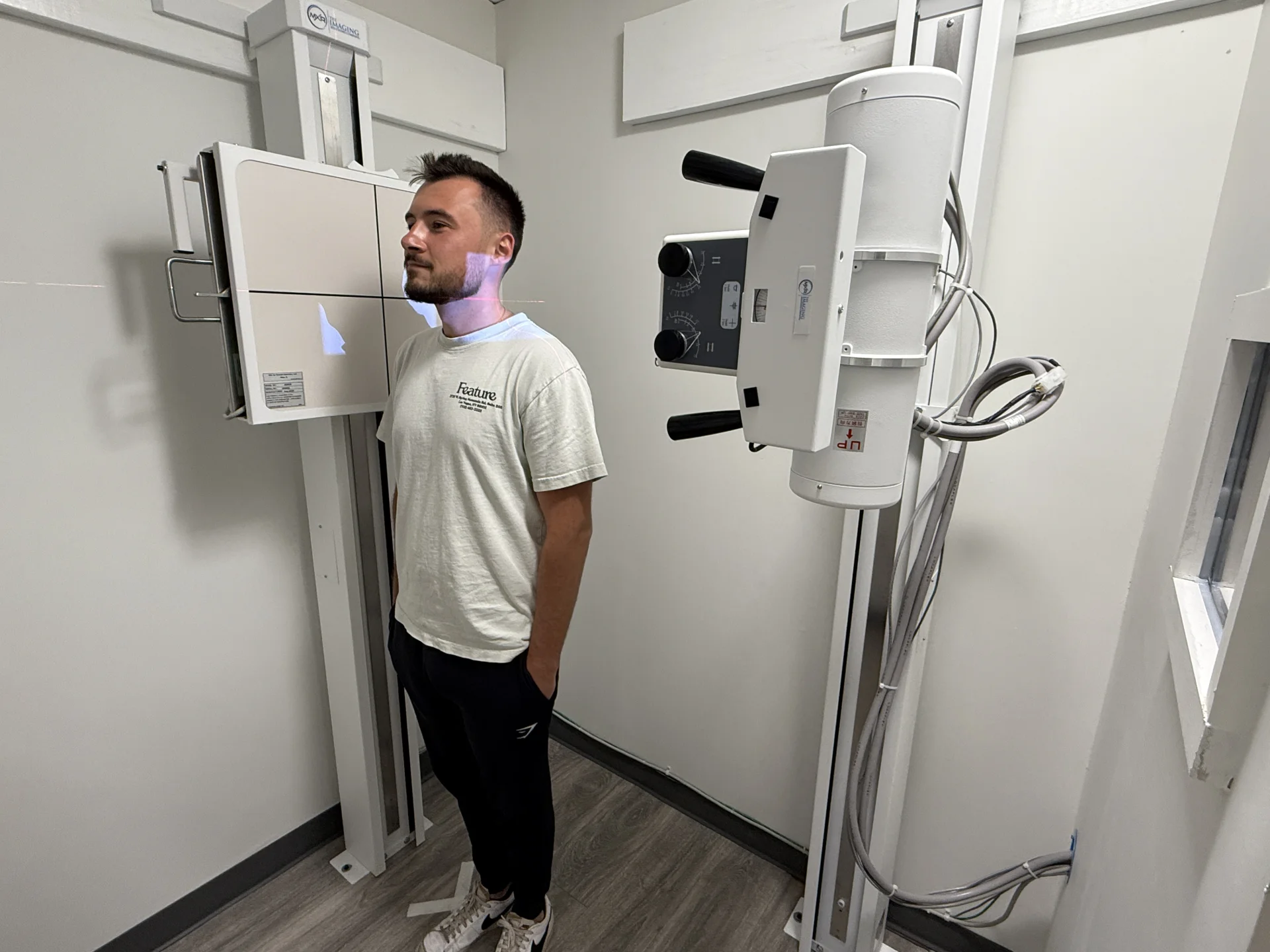


In-House Digital X-Ray in South Austin
On-site digital X-ray imaging ordered when the exam supports a specific diagnostic question. Same-visit review with the chiropractor who ordered the films, dose managed to clinical need, and no routine X-rays for every patient.
$97 new patient first visit with code NEW50, normally $200. X-rays are included when clinically indicated; the first visit is where that call is made.
What This Service Actually Is
In-house digital X-ray at Limitless is an on-site imaging tool the chiropractor uses to answer a specific diagnostic question that the exam has surfaced. It is not a screening service for every new patient, and it is not a stand-alone product. The clinical decision to image is made during the first visit, and the imaging is read back to you the same day with the rest of the exam findings.
Two things make this useful as a service. The first is access. When the chiropractor decides imaging would change the plan, the X-ray happens in the same building, in the same visit, without a separate referral to an off-site imaging center and a wait for results. The second is continuity: the chiropractor who ordered the films is the chiropractor who reads them with you, walks through what the images show, what they do not show, and how that interacts with the rest of the exam.
Imaging is a tool, not a verdict. An X-ray can show specific structural features such as alignment, joint-space changes, bony changes, and certain trauma signs. It cannot show soft-tissue injury at the resolution MRI offers, and it does not by itself confirm what is or is not causing pain. The clinical picture is built from history, exam, imaging when indicated, and follow-up, not from the films alone.
Why a Chiropractor Would Order an X-Ray
X-ray imaging is one of several tools available during the first-visit workup. It is ordered when the chiropractor needs to answer a specific question that the exam suggests and that imaging is well suited to answer. Common reasons include screening for findings that would change the care plan, ruling out a structural cause that should be referred out, and confirming bony anatomy in cases where prior injury or surgical history matters.
The decision is made on clinical grounds. National appropriateness criteria for low back pain reserve imaging for red flags, recent trauma, persistent or progressive neurological deficits, suspicion of serious disease, and cases that have not responded to a reasonable course of conservative care. Trauma imaging criteria look at mechanism, exam findings, and risk features rather than at the existence of an accident alone. Those are the patterns the Limitless first-visit screen follows.
Imaging is not part of every first visit. For straightforward mechanical low back or neck patterns without red flags, the exam alone is often enough to set the plan, and the imaging step is skipped. When imaging is indicated, the chiropractor explains what specific question the X-ray is meant to answer before the films are taken.
When Imaging Is Indicated, and When It Is Not
The decision uses clinical features, not policy. The table below summarizes the patterns that typically push toward imaging and the patterns that typically push away from it. Each case is decided individually after history and exam.
| Imaging Is Often Indicated When | Imaging Is Often Not Indicated When |
|---|---|
| Recent significant trauma with mechanism-of-injury concerns (high-speed crash, fall from height, direct impact) | Mechanical low back or neck pain with no red flags, intact neurological exam, and a clear conservative-care path |
| Focal neurological signs on exam (weakness, sensory deficit, abnormal reflexes) | Intact strength, sensation, and reflexes with a pattern consistent with soft-tissue or joint strain |
| Midline spinal tenderness, suspected fracture, or instability | Pain that reproduces predictably with movement in a reliable mechanical pattern |
| Red flags suggesting serious disease (fever, unexplained weight loss, history of cancer, night pain not relieved by rest) | Acute uncomplicated back or neck pain in the first several weeks of conservative care without red flags |
| Persistent or progressive symptoms after a structured conservative-care window | Symptoms improving on the expected curve with conservative care |
| Prior spine surgery, hardware, or significant prior injury when the chiropractor needs to confirm anatomy before adjusting | No prior surgery or significant trauma, and exam findings already fit the working diagnosis |
This is the same imaging-decision framework used on the car accident service page, because the underlying clinical principle is the same: image when the answer would change the plan, not because the patient walked in the door. The point of in-house imaging is to remove access friction for the cases where imaging is the right call, not to add an imaging step to every patient.
What X-Rays Can and Cannot Show
Plain-film X-ray is good at imaging bony anatomy and a subset of joint and alignment features. It is not the right tool for every spinal question. The chiropractor uses X-ray when the question is bony or alignment-related and routes the case differently when the question is soft-tissue, cord, or nerve-root specific.
| Question | What X-Ray Can Help Answer | When a Different Modality Is the Right Tool |
|---|---|---|
| Suspected fracture or bony injury | A reasonable first imaging step in many trauma presentations, per published trauma imaging criteria | Suspected unstable fracture or neurological compromise requires referral for CT or MRI through the medical pathway |
| Disc, cord, or nerve-root involvement | Indirect features such as disc-space narrowing; the disc itself is not directly imaged | When the picture suggests significant disc, cord, or nerve-root involvement, MRI is the appropriate study |
| Alignment, joint space, bony changes | Segmental alignment, disc-space height, facet-joint appearance, and degenerative changes that set context before adjusting | Imaging changes alone do not confirm a pain source; findings are interpreted alongside history and exam |
| Prior surgical hardware | Hardware position and bony context, which can change technique selection for adjustment | Soft-tissue questions around the surgical segment require coordination with the surgeon |
| Postural and structural baselines | Baseline structural documentation when there is a clinical reason to record it | Routine wellness scans without a diagnostic question are not supported by dose-optimization guidance |
Imaging findings do not always match symptoms. Degenerative findings show up commonly in adults without back pain, and many people with significant pain have unremarkable imaging. The chiropractor interprets films in the context of your exam, history, and goals rather than as a freestanding diagnosis.
The In-House Imaging Process
When imaging is indicated, the process is built around clinical justification, dose attention, and same-visit review. There is no separate referral, no separate appointment at an outside imaging center, and no wait for results before the chiropractor can give you a plan.
1.Clinical justification. The chiropractor explains the specific diagnostic question the X-ray is meant to answer before any films are taken. Imaging is not added as a default.
2.Pregnancy and shielding review. Before any imaging, pregnancy status is confirmed and appropriate shielding applied per current best practice. If you are or may be pregnant, imaging is reconsidered or deferred.
3.Views limited to the question. The chiropractor orders the specific views the clinical question requires. Extra views are not added by default.
4.Same-visit review. The films are reviewed with you in the same visit: what the images show, what they do not show, and how the findings interact with the rest of the exam.
5.Written plan or referral. If imaging supports a conservative-care plan, the plan is written that visit. If it surfaces a finding that needs medical or surgical evaluation, the chiropractor refers out and coordinates with the receiving clinician.
Patients can request copies of their imaging for personal-injury documentation, second-opinion review, or sharing with other treating clinicians. For straightforward cases the imaging adds roughly ten minutes to the first visit.
Dose, Safety, and Digital Imaging Reality
X-ray imaging uses ionizing radiation. The FDA's framing is that medical X-ray exams should be performed when medically justified to answer a diagnostic question, with dose optimized to clinical need. The same justification-plus-lowest-dose principle the FDA highlights in pediatric imaging guidance applies in adult chiropractic imaging: take the images the clinical question requires, and no more.
Digital X-ray systems support efficient image capture, on-screen review, and integrated documentation, which is what makes same-visit reading practical in a chiropractic clinic. Digital systems do not, by themselves, guarantee lower radiation than older film systems in every situation. Published work on dose with computed and digital radiography shows that actual dose depends on detector technology, protocol, exposure settings, and quality-control practices. The Limitless framing is intentionally narrow: in-house digital imaging supports efficient capture and same-visit review, and dose is managed through clinical justification and optimized protocols.
Two patient-side notes follow. First, if there is any chance you are pregnant, tell the chiropractor and front desk before imaging is scheduled. Second, if you have had recent imaging at another clinic or hospital, bring the films or report when you can. The clinical question may already be answered by imaging in your record, in which case repeating the study is unnecessary.
Pricing and Coverage
The $97 new patient first visit (code NEW50, normally $200) covers the full intake, history, focused exam, and in-house digital X-rays when clinically indicated, along with the first adjustment when the screen is clear. Imaging is not a separate per-image charge when it is part of the clinically indicated first-visit workup. If additional studies are ordered later in a plan of care for a specific clinical reason, fees are quoted before the visit.
Limitless is a cash-pay practice. Patients pay with cash, credit, HSA, or FSA. Some patients submit receipts for possible reimbursement under their own coverage; that is a case-by-case interaction with the patient's insurer. For post-crash patients, insurance interactions depend on policy terms, fault status, and whether Personal Injury Protection is in play; the car accident deep dives below cover that in more depth.
For full pricing context across the practice, read What Chiropractic Costs in Austin: The 2026 Cash-Pay Guide.
Deep Dives From the Limitless Library
These are short patient-facing summaries of live Limitless articles that answer the imaging-stage questions patients ask most. Select a card to open the full related guide.


.png)
.png)
.png)
.png)
.png)
