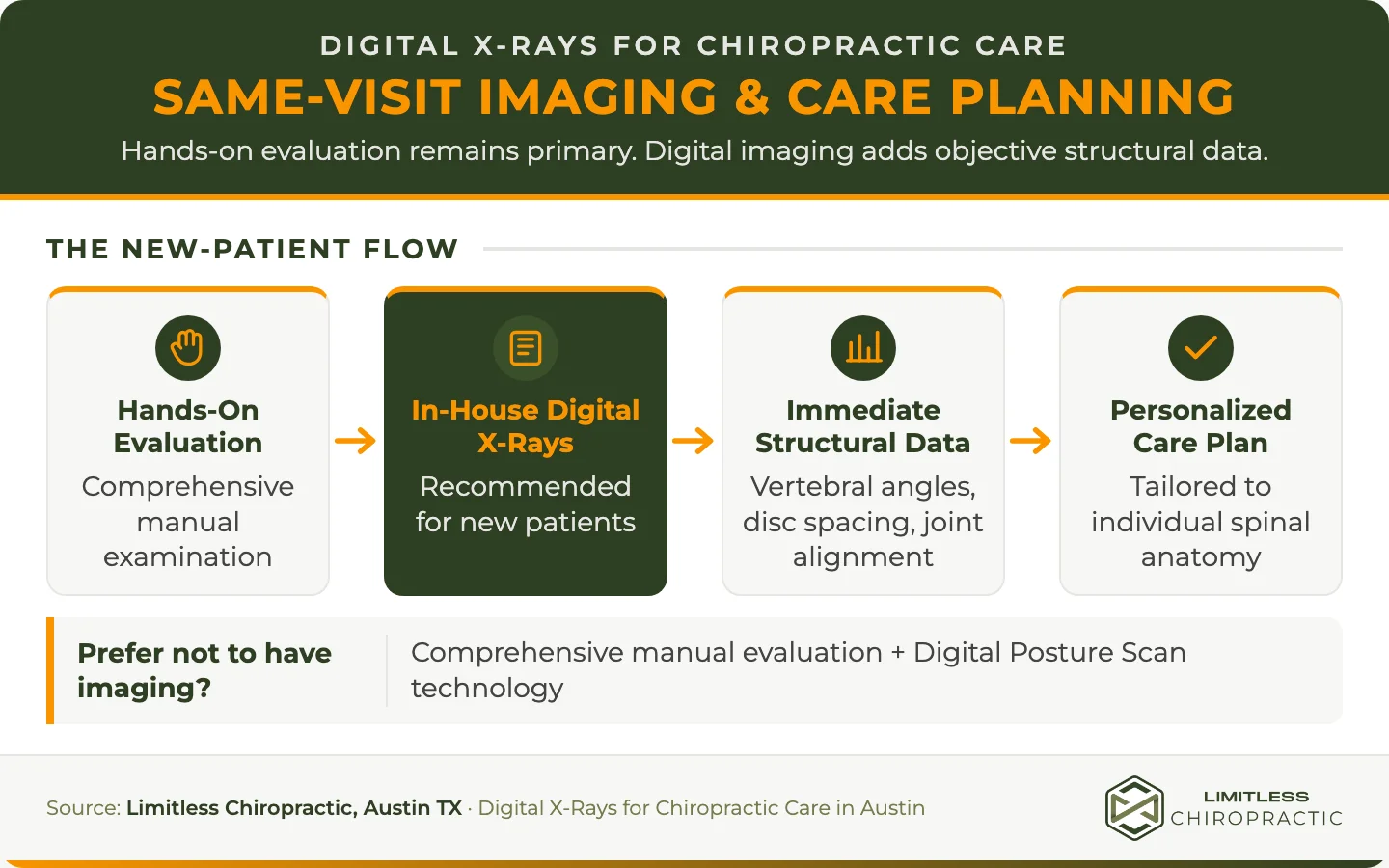
Limitless Chiropractic added in-house digital X-ray imaging to a practice that already produced strong outcomes through manual assessment. The decision came from analyzing patient outcomes, reviewing chiropractic research, and identifying specific diagnostic limitations that hands-on examination alone could not resolve. Digital radiography now provides an objective layer of structural data that complements palpation and refines treatment planning for every new patient.
Disc spacing and alignment data informs spinal decompression protocols on the Triton Chattanooga table.
Why Limitless Chiropractic Added Digital X-Ray Imaging
Limitless Chiropractic operated successfully for several years in Austin without X-ray technology. The clinic helped thousands of patients achieve pain relief, posture improvement, and spinal health through manual assessment and hands-on techniques. The decision to add digital imaging came from analyzing patient outcomes, reviewing chiropractic research, and identifying specific diagnostic limitations.
Dr. Scott Mitchell and the Limitless Chiropractic team recognized that strategic imaging could enhance already-effective treatment protocols. Digital radiography provides objective data that complements manual palpation. The technology reveals hidden pathologies, structural abnormalities, and contraindications that affect treatment planning. This addition represents evolution, not revolution, in the clinic's approach to spinal care.
Need a chiropractor with in-house digital imaging in Austin?
Limitless Chiropractic offers same-visit X-ray results and personalized care planning.
Manual Assessment Remains Primary at Limitless Chiropractic
Hands-on evaluation continues as the foundation of patient assessment at Limitless Chiropractic. Skilled palpation detects subluxations, muscle tension, and joint restrictions with remarkable accuracy. The clinic's chiropractors maintain their commitment to thorough physical examination as the first and most important diagnostic step.
X-ray imaging now serves as a standard component of comprehensive new-patient care. Imaging is recommended for all new patients before their first adjustment to ensure the most complete assessment and optimal treatment outcomes. The structural information surfaced by imaging enhances clinical expertise and supports truly personalized care.
While X-rays are strongly recommended as part of the initial evaluation, patient choice remains important. Patients who prefer not to have imaging can decline. The clinic still proceeds with comprehensive manual examination and Digital Posture Scan analysis when imaging is declined, though the diagnostic benefits of imaging meaningfully improve treatment effectiveness and safety.
This combined approach pairs traditional chiropractic assessment with modern diagnostic technology, ensuring each patient receives a treatment plan tailored to individual spinal anatomy and health needs.
What X-Rays Reveal That Hands Cannot
Digital imaging exposes spinal pathologies that manual examination cannot detect. Bone spurs hide within joint spaces, causing nerve irritation without obvious palpable signs. Early arthritis develops silently before producing clinical symptoms.
Disc degeneration often progresses asymptomatically until reaching advanced stages. Compression fractures from forgotten injuries remain undetected through physical assessment alone. Subtle scoliosis curves can escape detection during postural evaluation.
A recent Limitless Chiropractic patient presented with lower back pain suggesting a simple subluxation. Clinical intuition prompted an X-ray, which revealed an old compression fracture from teenage gymnastics. That single image completely altered the treatment approach — and the outcome.
Congenital abnormalities and anatomical variations significantly impact adjustment techniques. Digital radiography identifies these variations, allowing customized treatment that respects individual spinal anatomy. For deeper context on degenerative findings, see Disc Herniations: Prevention to Recovery.
Precision Adjustments Through Digital Imaging
Spinal uniqueness demands individualized treatment. Digital X-rays provide anatomical blueprints that guide precise adjustments. The technology reveals vertebral angles, disc spacing, and joint alignment with millimeter accuracy.
Limitless Chiropractic chiropractors analyze:
Vertebral positioning and rotation patterns
Disc height and hydration status
Joint degeneration severity
Spinal curve measurements
Biomechanical compensation patterns
This diagnostic data enables technique modification for each patient's structural reality. Post-surgical patients benefit from imaging that shows hardware placement and fusion sites — relevant context covered in Failed Back Surgery Syndrome: Chiropractic Relief Options. Car accident patients receive targeted care based on injury-specific findings.
The precision approach mirrors GPS navigation versus a traditional paper map — both reach the destination, but one optimizes the route. Limitless Chiropractic delivers customized adjustments that match individual spinal needs.
Safety Protocols Enhanced by X-Ray Technology
Chiropractic care has an excellent safety record. Digital imaging adds another layer of information to already safe procedures. Limitless Chiropractic uses X-rays to optimize treatment approaches for each individual patient.
Imaging helps identify structural variations that benefit from modified techniques. Congenital differences such as transitional vertebrae or anatomical variants guide treatment decisions. Previous injuries or surgical history become clearly visible, allowing for appropriate care modifications.
Digital radiography ensures every treatment decision considers individual anatomical characteristics. Congenital abnormalities like block vertebrae or hemivertebrae change adjustment parameters. Patient safety remains paramount.
Same-visit imaging plus precise care planning.
Walk in with pain, walk out with answers — and a treatment plan grounded in your actual anatomy.
Austin car accidents generate complex insurance claims that require objective evidence. Digital X-rays provide irrefutable documentation of spinal injuries. Insurance carriers and personal injury attorneys rely on imaging evidence for claim validation.
Limitless Chiropractic works with numerous Austin attorneys who appreciate comprehensive documentation. Digital imaging demonstrates:
Ligament damage from whiplash trauma
Vertebral misalignment patterns
Disc herniation indicators
Soft tissue swelling measurements
I-35 accidents frequently result in disputed claims. One Limitless Chiropractic patient faced claim denial for "minor whiplash." X-ray evidence revealed significant ligament damage and vertebral displacement, resulting in full compensation.
Objective imaging transforms subjective complaints into measurable injuries. Digital documentation expedites claim processing and improves settlement outcomes. For the full Austin post-accident protocol — Texas PIP coverage, treatment timing, and provider selection — see the Personal Injury Chiropractor in Austin guide and Spinal Decompression After a Car Accident in Austin.
Where X-Rays Help Most in PI Cases
Scenario
X-Ray Contribution
Whiplash with delayed symptoms
Loss of cervical lordosis and segmental misalignment quantified for the record.
"Minor" rear-end collision
Imaging often reveals damage that adjusters initially dismiss as soft-tissue only.
Disputed pre-existing condition
Comparative views document what is acute vs. chronic — central to PIP claim defense.
Ongoing care plan
Sequential imaging supports the medical necessity of continued treatment.
Progress Tracking Through Comparative Imaging
Spinal correction requires objective measurement. Digital X-rays document structural change over time, providing visual proof of treatment effectiveness. Limitless Chiropractic patients see their spinal transformation through comparative imaging.
Progress imaging benefits:
Scoliosis patients monitoring curve reduction
Posture correction program participants
Disc rehabilitation cases
Trauma recovery patients
Degenerative condition management
Comparative imaging helps patients understand their progress and stay motivated with their care plans. Visual evidence validates the chosen approach and guides future care decisions. Teenage scoliosis patients particularly benefit from progress documentation — growth periods affect spinal development and require ongoing monitoring for optimal outcomes.
Limitless Chiropractic X-Ray Protocol for New Patients
Comprehensive diagnostic imaging is the foundation for optimal patient care at Limitless Chiropractic. Digital X-rays are a standard component of new patient evaluations, ensuring complete information about spinal health before treatment begins. Imaging establishes a baseline understanding of structural status and identifies underlying conditions that might influence the care plan.
This proactive approach allows the team to develop the most effective strategy from day one, ensure safety during all chiropractic adjustments, and document initial alignment for progress tracking.
While digital X-rays are recommended for all new patients, individual preferences and concerns are respected. Patients who prefer not to have X-ray imaging can simply say so. Examination then proceeds with comprehensive manual evaluation and Digital Posture Scan technology, which provides detailed biomechanical analysis and postural assessment without imaging exposure.
The digital X-ray system represents current medical imaging technology — superior image quality and immediate results for more accurate diagnosis and precise treatment planning.
Digital Technology Advantages Over Film
Traditional film X-rays represent older technology. Limitless Chiropractic chose digital radiography for image quality and patient safety. The technology delivers instant results without chemical processing.
Digital advantages include:
Roughly 80% radiation reduction versus traditional film
Immediate image availability — no waiting on a developer
Enhanced visualization through digital manipulation
Electronic storage and sharing capabilities
Environmental sustainability — no chemical waste
Radiation exposure from a digital X-ray series is minimal. Image enhancement allows detailed analysis of joint spaces and soft tissue shadows. Electronic transmission enables specialist consultation and patient access. Limitless Chiropractic patients receive digital copies for personal records or second opinions, supporting collaborative care with other healthcare providers.
Specific Conditions Benefit from X-Ray Diagnosis
Arthritis Detection and Management
X-ray imaging reveals arthritis progression before symptoms develop. Joint space narrowing indicates cartilage loss. Bone spur formation shows degenerative changes. Limitless Chiropractic chiropractors modify adjustment techniques based on arthritis severity.
Degenerative Disc Disease Evaluation
Disc height loss appears clearly on lateral X-rays. Vertebral spacing changes indicate disc dehydration. Endplate sclerosis suggests advanced degeneration. Treatment planning incorporates disc status for optimal outcomes.
Herniated Disc Indicators
While MRI better visualizes disc herniations directly, X-rays show indirect signs. Narrowed disc spaces suggest herniation. Vertebral alignment changes indicate compensatory patterns. Limitless Chiropractic refers for advanced imaging when X-ray findings suggest disc pathology requiring it.
Scoliosis Measurement and Monitoring
Cobb angle measurements require standing X-rays. Curve progression monitoring guides treatment intensity. Teenage patients need frequent assessment during growth periods. Digital measurement tools provide precise tracking.
Whiplash Documentation
Cervical lordosis loss indicates whiplash injury. Vertebral alignment changes document trauma severity. Soft tissue swelling appears as increased spacing. Insurance claims require this objective evidence.
Bone Spur Identification
Osteophytes cause nerve impingement without palpable findings. X-rays locate spur formation affecting adjustment safety. Limitless Chiropractic chiropractors avoid direct manipulation of affected segments.
X-Ray Guided Spinal Decompression Therapy
Digital X-ray imaging provides crucial diagnostic information for identifying disc degeneration and developing precise spinal decompression protocols. X-rays reveal disc space narrowing, vertebral alignment changes, and degenerative patterns that inform decompression therapy recommendations.
With radiographic analysis, the team can determine the exact spinal segments requiring decompression treatment and identify the specific vertebral levels most affected by disc degeneration. This precision allows decompression therapy to target areas that will provide maximum therapeutic benefit for each individual patient.
X-ray-guided decompression enables calculation of the optimal decompression angle and pull direction based on each patient's unique spinal anatomy and disc pathology. By visualizing the intervertebral spaces and vertebral positioning, the protocol on the Triton Chattanooga decompression table can be customized to specific structural needs.
The diagnostic imaging also helps determine the appropriate frequency and duration of decompression sessions based on the severity of disc degeneration and spinal alignment issues. This evidence-based approach to spinal decompression results in more targeted treatment and improved outcomes for patients with degenerative disc disease, herniated discs, and related spinal conditions. For the full clinical picture, see the Spinal Decompression in Austin: Complete Guide.
Ready to see what your spine actually looks like?
Schedule your evaluation at Limitless Chiropractic. In-house digital X-rays, same-visit results, treatment planning grounded in your structural reality.
Digital X-rays at Limitless Chiropractic use minimal radiation exposure. Safety protocols include protective equipment and pregnancy screening. Digital technology reduces radiation by roughly 80% compared to traditional film.
Is X-ray affordable at Limitless Chiropractic?
Limitless Chiropractic is known for some of the most affordable chiropractic rates in Austin. Imaging is included in the new patient evaluation; cash-pay only, with HSA and FSA accepted.
Do I need X-rays before my first adjustment?
Digital X-rays are included in the initial evaluation. If a patient prefers not to have imaging, or if the chiropractor determines imaging isn't necessary, the team uses Digital Posture Scan technology to assess postural distortions and spinal alignment instead.
Can I get copies of my X-rays?
Limitless Chiropractic provides digital copies uploaded directly to your patient account. The images belong to the patient. Many patients share with other healthcare providers or maintain personal health records. Electronic access ensures convenient retrieval.
How long does X-ray imaging take?
A complete X-ray series takes about 10 minutes. Digital capture itself takes about 5 seconds. Patient positioning ensures diagnostic quality. Immediate viewing allows same-visit treatment planning — no development waiting with digital technology.
Will my X-rays support a personal injury claim?
Yes. Digital imaging produces objective documentation that Austin attorneys and insurance carriers rely on for claim validation. Comparative views and clear segmental measurements strengthen the medical record. The full post-accident workflow is covered in the Personal Injury Chiropractor in Austin guide.
Experience Advanced Care at Limitless Chiropractic
Years of clinical results built Limitless Chiropractic's reputation. Adding digital X-ray imaging enhances an already successful treatment approach. The technology provides diagnostic precision when clinical findings indicate benefit.
Austin residents dealing with chronic pain, accident injuries, or spinal concerns benefit from comprehensive evaluation. Limitless Chiropractic combines traditional expertise with modern technology for individualized outcomes.
Limitless Chiropractic | 2800 S I-35 Frontage Rd, Ste 175 | Austin, TX 78704 | Serving Downtown Austin, South Austin, Round Rock, Cedar Park, and Pflugerville
Dr. Scott Mitchell
About the author
Dr. Scott Mitchell, a Boston-accented chiropractor with a passion for holistic health,dedicates his life to helping people unlock their LIMITLESS potential through personalized chiropractic care.