Car accidents commonly cause whiplash, disc herniations, bulging discs, and nerve compression
These injuries often respond better to non-surgical decompression than to medication or surgery
Spinal decompression creates negative pressure inside the disc using a computerized table
Herniated material can retract and discs can rehydrate without invasive procedures
Sessions on the Chattanooga decompression table typically run 15 minutes each
Treatment fits a normal week and stays comfortable enough that many patients fall asleep on the table
Care combines decompression with adjustments and corrective work, not decompression alone
Treating the disc without correcting alignment leaves the cause of the problem in place
Chiropractic documentation supports personal injury insurance claims after a crash
You get clinical care plus the records you need to navigate coverage
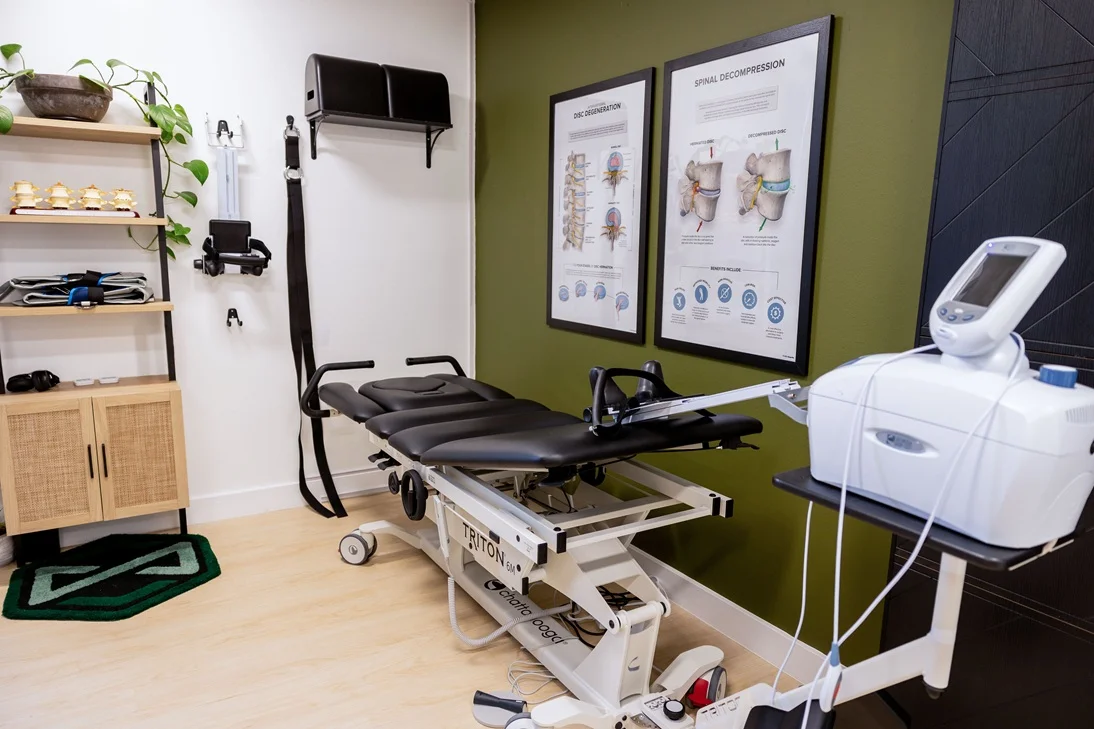
Limitless Chiropractic in Austin uses the Triton Chattanooga table and digital X-rays in-house
Diagnosis and treatment happen under one roof, not across multiple referrals
The Pain That Shows Up After the Accident
Car accidents leave behind injuries that don't always announce themselves at the scene. Days or weeks after the crash, lingering neck pain, low-back pain, headaches, or numbness running into the arms or legs start showing up. The cause is almost always the same: the sudden force of the collision pushed the spine, the discs, and the surrounding soft tissue out of alignment, and the body has been trying to compensate ever since.
Whiplash and spinal misalignments are the two most common drivers. Both interfere with daily activity. Both can quietly turn into chronic problems if they're not addressed at the source. Spinal decompression therapy is built to address that source: it relieves pressure on injured discs and irritated nerves so the tissue actually has a chance to heal instead of just being medicated.
Decompression is a gentle, non-surgical therapy. It involves stretching the spine in a controlled, computerized cycle to relieve pressure on discs and nerves. It's effective for the disc herniations, bulging discs, and nerve compression that show up after car accidents. Combined with chiropractic adjustments, it offers a holistic, drug-free recovery path with personalized treatment plans built around the specific injury pattern.
Lingering neck or back pain after a crash in Austin? We evaluate the spine before recommending any treatment.
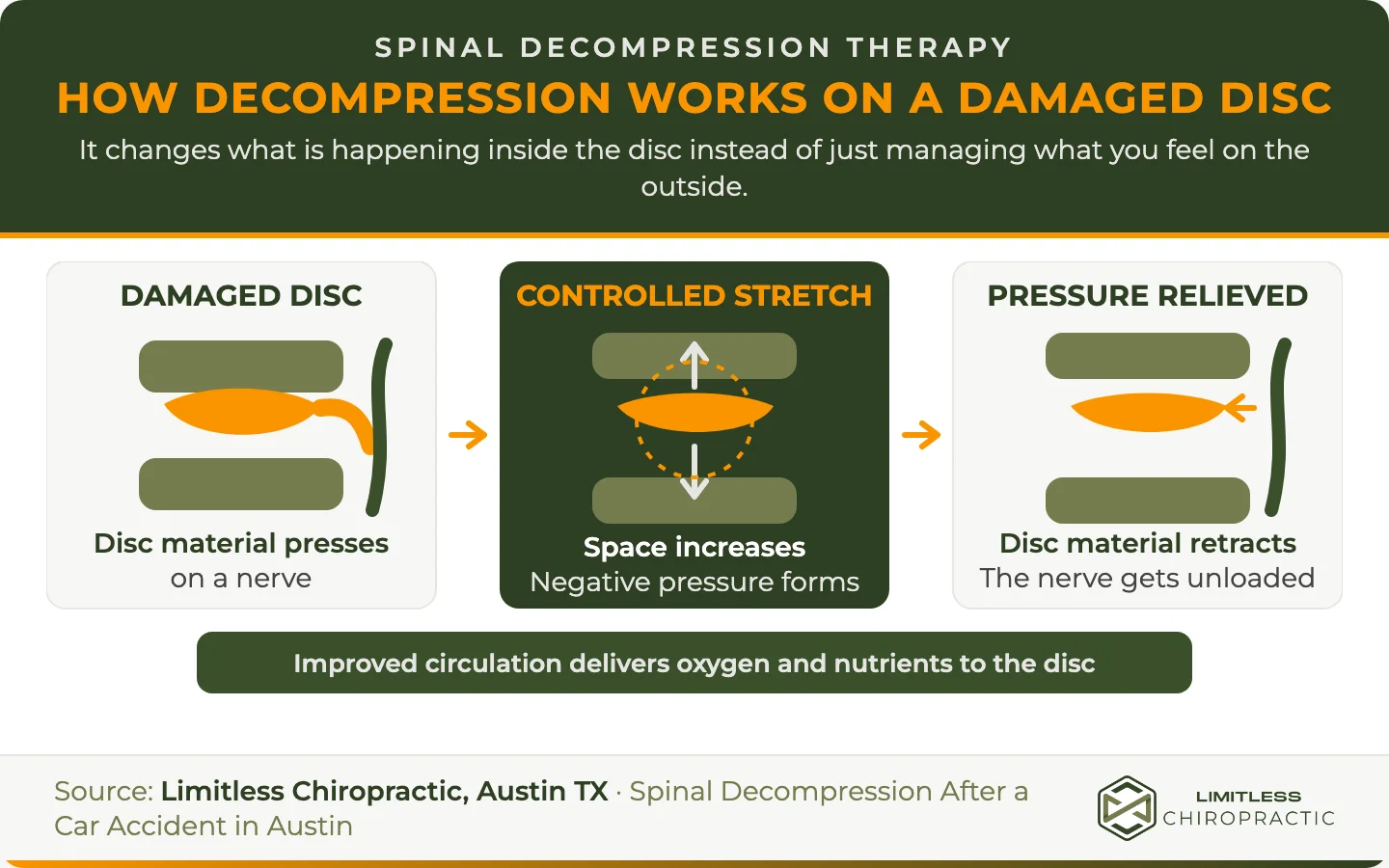
Spinal decompression therapy is a non-invasive technique that gently stretches the spine to alleviate pressure on spinal discs and nerves. Using specialized equipment, the chiropractor creates negative pressure within the discs, encouraging bulging or herniated discs to retract. That negative pressure also enhances the flow of healing nutrients into the disc, restores spinal function, and relieves pain.
Definition and Purpose
The therapy is built to address spinal discomfort by targeting the underlying mechanics, not just the symptoms. By elongating the spine using a motorized table, the pressure inside the disc drops. Displaced disc material gets drawn back toward its normal position. Alignment improves, inflammation eases, and mobility starts coming back.
That's the difference between decompression and most other approaches to back pain after a crash: it changes what's happening inside the disc instead of just managing what you feel on the outside. For the full clinical picture of how decompression treats disc injuries, you can also read the spinal decompression complete guide.
Conditions It Treats After a Crash
Not every post-accident pain is a decompression case. The therapy is built for conditions where the disc is the problem, which describes a large share of injuries that follow a collision.
Post-Accident Injuries Decompression Targets
Injury
What's Happening
How Decompression Helps
Disc herniations
Disc material protrudes through the outer ring and presses on a nerve, causing pain or numbness
Negative pressure draws the herniated material back, easing nerve compression
Bulging discs
The outer ring expands without rupturing and may contact nearby nerves
Disc shape gets restored, reducing nerve contact and irritation
Degenerative disc disease
Crash trauma can accelerate age-related disc deterioration
Improved hydration and nutrient exchange slows the degeneration
Sciatica and nerve compression
Compressed nerves send pain, tingling, or weakness down the leg or arm
Space is created between vertebrae, relieving the compressed nerve root
Whiplash-related disc injury
Cervical disc strain or herniation from the snap of the head during impact
Cervical decompression eases pressure in the neck without forceful manipulation
The thread connecting these injuries: the disc is damaged, compressed, or dehydrated, and the resulting pressure is irritating a nerve or joint. Decompression addresses the disc directly. If you're recovering from a crash and you've been told you have a herniated disc, see disc herniations: prevention to recovery for the full breakdown of how these injuries heal.
The Chattanooga Decompression Table
The Chattanooga decompression table sits at the front of spinal decompression technology. Its design allows precise control over every variable in the decompression cycle, which is what separates therapeutic decompression from generic traction.
By incorporating adjustable settings, the chiropractor can specifically target affected segments of the spine, raising the precision of the therapy and supporting better healing outcomes.
The table's mechanisms let the practitioner manipulate the angle of traction, the amount of force applied, and the duration of each decompression cycle. That level of customization is critical for the spinal conditions left behind by a car accident, where one disc level is often the pain generator while the segments above and below are doing fine.
Whether the case is acute injury from a recent crash or chronic spinal issues that surfaced months after, the Chattanooga table provides the flexibility to adjust treatment in real time, so each session contributes to the patient's recovery instead of repeating the same generic stretch.
Treatment for Lumbar and Cervical Pain
The versatility of the table makes it effective for both lower back (lumbar) and neck (cervical) pain. For lumbar discomfort, the table targets the lumbar vertebrae through gentle stretching and decompression.
That process eases pressure on compressed discs and nerves in the lower spine, leading to reductions in pain and improvements in mobility. By creating negative pressure within the disc, the therapy encourages the retraction of bulging or herniated material, which lets the disc do the actual work of healing.
Lower back (lumbar) pain. Decompresses lumbar vertebrae to alleviate lower back pain and improve mobility.
Neck (cervical) pain. Gently stretches cervical vertebrae to relieve neck pain from whiplash or disc herniation.
How Decompression Works on a Damaged Disc
Increasing Space Between Vertebrae
Gentle, controlled spinal stretching increases the space between vertebrae. That separation creates the negative pressure that retracts herniated or bulging material. The nerve gets unloaded. Alignment starts coming back.
Enhancing Disc Health
Improved circulation delivers oxygen and nutrients to the disc. That matters because the disc itself has limited blood supply: it relies on movement and pressure changes to bring nutrients in and waste out. Decompression restores that exchange and supports the disc's own repair process.
Reducing Inflammation and Nerve Pressure
Decompression reduces swelling around injured discs and lessens the pressure on the nerves running through the area. As inflammation calms and the nerve gets more space, pain and neurological symptoms (numbness, tingling, weakness) ease alongside it.
Pain has a source. The disc has a treatment. Decompression doesn't mask the symptom. It changes the mechanics that produced the symptom in the first place.
Chiropractic Care for Personal Injury Recovery
What Personal Injury Chiropractic Care Is
Personal injury chiropractic is specialized care for individuals injured in accidents. The focus is diagnosing and treating musculoskeletal injuries using non-invasive techniques that support the body's natural healing without drugs or surgery. For the broader picture of how this care works in Austin, see the personal injury chiropractor in Austin guide.
Specialized Care for Crash Victims
Crash victims often present with unique injury patterns that require focused, individualized treatment plans. A chiropractor who specializes in personal injury is trained to assess and address those specific patterns.
Focused treatment plans. Tailored strategies for injuries like whiplash and spinal misalignments.
Comprehensive approach. Combines therapies to treat symptoms and underlying issues at the same time.
Techniques Used in Treatment
The chiropractor uses several techniques designed to restore proper function, alleviate pain, and support the body's natural healing.
Spinal adjustments. Realign vertebrae to relieve pressure and improve mobility.
Soft tissue therapies. Address muscle tension contributing to pain and restricted motion.
Decompression therapy. Targets disc-related injuries to reduce nerve compression and support healing.
How Chiropractic Care Helps After a Car Accident
After a crash, individuals often deal with a stack of musculoskeletal injuries that affect their daily life. Chiropractic care offers a non-invasive approach focused on the root causes of those injuries instead of just the symptoms they produce.
Correcting Spinal Misalignments
Car accidents frequently produce sudden jolts that knock the spine out of alignment. These misalignments, also called subluxations, can disrupt the normal functioning of the nervous system and lead to pain, stiffness, and reduced mobility.
Whiplash treatment. Realigns cervical vertebrae to reduce nerve irritation and prevent the issue from becoming chronic.
Realigning vertebrae. Prevents long-term problems associated with untreated misalignments.
Pain Relief and Inflammation Reduction
Pain and inflammation are natural responses to injury, but if they aren't managed they hold the healing process back. Chiropractic care reduces both through targeted, non-pharmacological care.
Targeted pain management. Treats pain at the source without medication.
Reducing swelling. Techniques that decrease inflammation and support healing.
Restoring Mobility and Preventing Chronic Issues
Regaining full mobility after an accident is the difference between getting back to normal and carrying the injury forward. Chiropractic care plays a central role in restoring movement and function to the affected areas.
Range of motion. Improves flexibility and reduces re-injury risk.
Preventive care. Early intervention to avoid chronic conditions, including arthritis-type changes that can follow joint trauma.
Personal Injury Care and Insurance
Dealing with the aftermath of a car accident usually involves insurance to cover medical care. Understanding how chiropractic fits into a personal injury claim is important for accessing treatment without unnecessary financial pressure.
Coverage of chiropractic treatment. Many car insurance policies recognize chiropractic care for accident-related injuries and provide coverage accordingly.
Documentation support. The chiropractor provides the clinical reports insurers expect.
Claims assistance. Guidance through the process so the right treatments stay covered.
Advantages Over Medication and Surgery
Chiropractic care after a car accident offers several distinct advantages compared to traditional approaches like medication and surgery. By emphasizing natural healing, chiropractic focuses on restoring the body's optimal function without invasive procedures or pharmaceutical dependence. That approach addresses immediate pain and supports long-term health at the same time.
Addressing root causes. Holistic care focused on underlying issues, with longer-lasting relief than symptom-only approaches.
Non-invasive and low risk. Avoids the risks of surgery and reduces reliance on medication.
Preventing future complications. Maintains spinal health and lowers the likelihood of degenerative changes later.
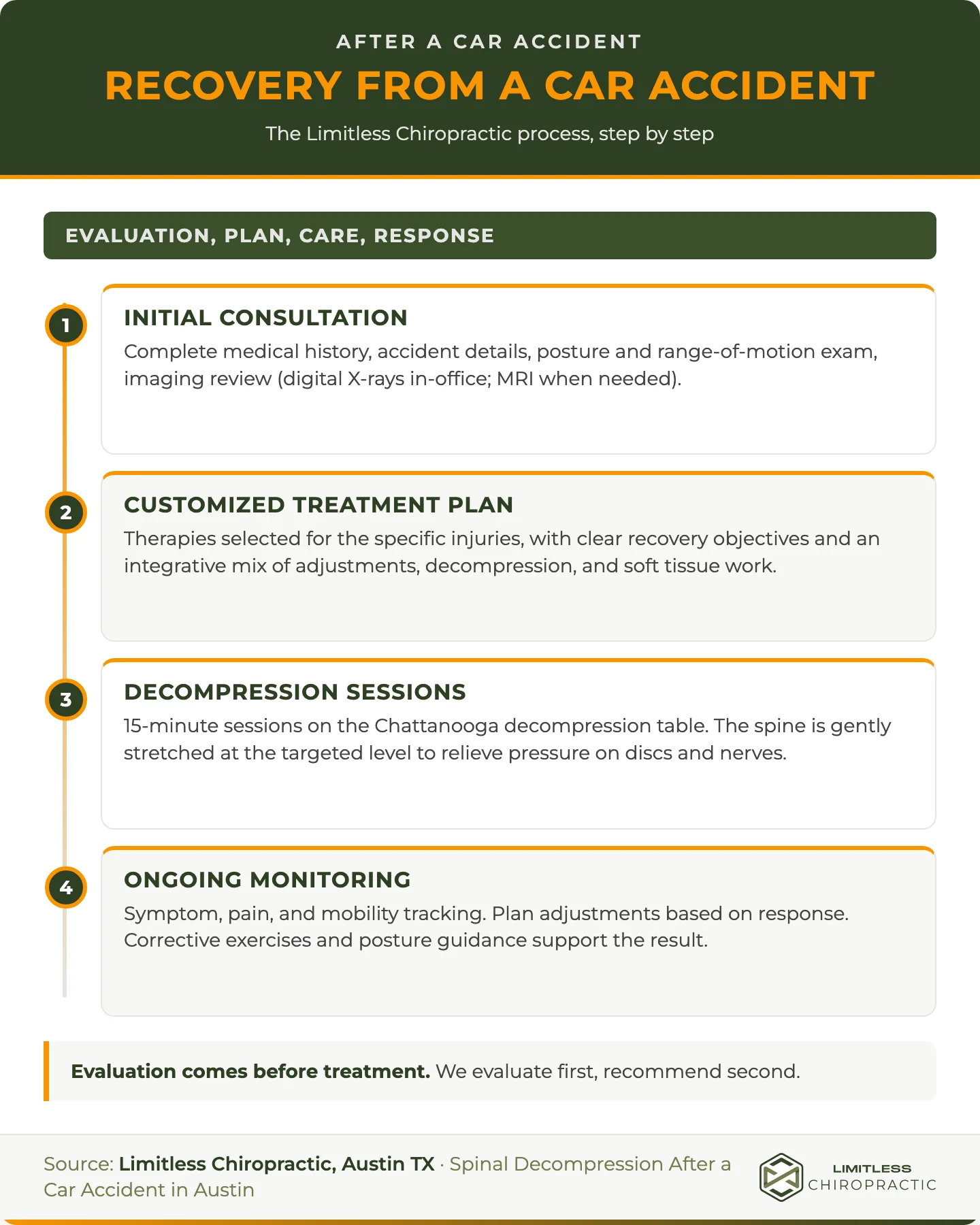
At Limitless Chiropractic, recovery from a car accident is structured around the patient's specific injury pattern. The process isn't a template applied to every case. It's an evaluation, a plan, and an iterative course of care that gets adjusted as the body responds.
The Personal Injury Process at Limitless Chiropractic
Step
What Happens
1. Initial consultation
Complete medical history, accident details, posture and range-of-motion exam, imaging review (digital X-rays in-office; MRI when needed)
2. Customized treatment plan
Therapies selected for the specific injuries, with clear recovery objectives and an integrative mix of adjustments, decompression, and soft tissue work
3. Decompression sessions
15-minute sessions on the Chattanooga decompression table, with the spine gently stretched at the targeted level to relieve pressure on discs and nerves
4. Ongoing monitoring
Symptom, pain, and mobility tracking. Plan adjustments based on response. Corrective exercises and posture guidance assigned to support the result
Step 1: Initial Consultation
The journey starts with a thorough assessment of the patient's condition. The chiropractor conducts a complete medical history review to understand prior health issues and current symptoms, then gathers detailed information about the accident itself to identify potential injuries tied to the incident.
A physical examination follows: posture analysis to check for visible misalignments and range-of-motion testing to assess movement limitations. Diagnostic imaging (X-rays in-office or MRI when needed) gives a clear picture of any internal injury that wouldn't show up on physical exam alone.
Step 2: Customized Treatment Plan
Based on the consultation findings, a customized plan is developed. That plan involves selecting the therapies best suited to the patient's condition and setting clear recovery objectives.
The integrative approach combines spinal adjustments, decompression therapy, and soft tissue work to address all aspects of the injury. The plan accounts for the physical injury and the lifestyle factors that may affect healing, which is what keeps recovery from getting derailed by the same desk posture or sleep habits that contributed to the problem.
Step 3: Decompression Sessions
Decompression sessions are a central component of the plan. During typical 15-minute sessions on the Chattanooga decompression table, the spine is gently stretched to decompress the affected level. That controlled stretching relieves pressure on spinal discs and nerves, which is what allows healing to actually start.
Patients often find the therapy comfortable and experience a sense of relief and relaxation during the session. Notable improvements are frequently observed after a few sessions as pain diminishes and mobility increases.
Step 4: Ongoing Monitoring and Adjustments
Recovery progress gets tracked through the entire course of care. The chiropractor follows changes in symptoms, pain levels, and mobility, and the treatment plan is adjusted based on the patient's response. Additional recommendations may include corrective exercises to strengthen the spine and support recovery, plus posture guidance to help prevent re-injury after the formal course of care ends.
Looking for crash recovery in Austin that addresses the disc, not just the pain? We evaluate first, recommend second.
Decompression therapy is a vital tool after a car accident because it provides accurate diagnosis and targeted treatment, which is what effective recovery actually requires.
Accurate Diagnosis and Targeted Treatment
A thorough examination ensures that hidden injuries (the ones that don't announce themselves at the scene) are identified. That prevents misdiagnosis and ensures the right treatment gets applied to the right injury. By addressing root causes rather than just the symptoms, decompression delivers pain relief that goes beyond temporary fixes.
Comprehensive Recovery Approach
Decompression sits inside a broader recovery approach that combines several treatments to enhance overall effectiveness. The integrated therapies create synergistic effects, addressing multiple aspects of the injury at the same time. Personalized care recognizes that each individual's needs are unique, and the treatment is built around the patient's specific recovery instead of being templated.
Pain Relief and Faster Healing
Disc injuries. Directly addresses herniated or bulging discs that are causing pain.
Vertebral misalignments. Corrects misalignments contributing to ongoing discomfort.
Whiplash recovery. Eases persistent neck pain associated with whiplash injuries.
Long-term relief. Helps with pain that has resisted other treatments by addressing the underlying mechanics.
Improved blood flow and disc rehydration. Increases circulation to support healing and encourages fluid absorption back into the disc.
Accelerated recovery. Quicker symptom improvement when the disc gets the mechanical environment it needs.
Reducing Nerve Irritation
Sciatic relief. Eases compression on the sciatic nerve, reducing leg pain that follows crash-related disc injuries.
Numbness and tingling. Alleviates the sensations caused by nerve impingement.
Improved sensation and mobility. Restoring nerve function brings back normal feeling and improves muscle control in the affected area.
Non-Invasive and Safe
Drug-free approach. Avoids medication risks and dependency.
Low risk of complications. Minimal risk compared to surgery, generally painless, well tolerated.
Improved Mobility
Spinal decompression therapy doesn't just ease pain. It improves mobility for individuals recovering from a car accident. Gentle stretching of the spine enhances flexibility, allowing patients to experience an increased range of motion. The reduction in muscle and joint stiffness lets them move more freely and perform daily activities with less effort. Decompression also helps relax involuntary muscle contractions, which means fewer spasms and more comfort during recovery.
Long-Term Health
The long-term value of decompression therapy is what it prevents. Maintaining spinal health and reducing degeneration risk means sustained relief and a lower chance of future issues. Addressing injury promptly and effectively decreases the likelihood that today's crash becomes tomorrow's chronic pain. Better mobility lets patients return to an active lifestyle, and the physical recovery has positive effects on confidence and outlook as well.
Frequently Asked Questions
Should I see a chiropractor right after a car accident, even if I feel fine?
Yes. Many crash injuries (whiplash, disc strain, soft tissue injury) don't produce symptoms for days or weeks. An evaluation soon after the accident establishes a clinical baseline, catches injuries that haven't surfaced yet, and creates the documentation insurers will expect later. Waiting until pain becomes chronic makes both the recovery and the claim harder.
Is spinal decompression painful?
No. Most patients describe the sensation as a deep, comfortable stretch. The Chattanooga table is computerized, so traction force is delivered in controlled cycles rather than as a single pull. Many patients find the session relaxing enough to fall asleep on the table.
How long is each session, and how many will I need?
Each session runs about 15 minutes. The total number of sessions depends on the injury, how chronic it has become, and how the patient responds. The chiropractor reassesses through the course of care and adjusts the plan based on progress.
Will my insurance cover chiropractic care after a car accident?
Many car insurance policies cover chiropractic care for accident-related injuries. The clinic supports the claim with documentation and reports for insurers, and walks patients through the process so the necessary treatments stay covered.
Can decompression help if I have a herniated disc from the accident?
Yes. Decompression is one of the most direct conservative treatments for herniated and bulging discs. It draws displaced disc material back toward the disc center and rehydrates the disc, which reduces nerve compression and supports healing without surgery.
What if my pain doesn't go away with decompression?
If a course of decompression isn't producing the expected progress, the plan gets adjusted. Re-examination, additional imaging, or a different treatment combination may be appropriate. Decompression isn't right for every condition, which is why evaluation comes before treatment in the first place.
Get Out of Pain. Get Back to Life.
The injuries left behind by a car accident don't fix themselves. Whiplash that gets ignored becomes chronic neck pain. A herniated disc that gets medicated instead of treated becomes a long-term limitation. Every day the disc stays compressed is another day the nerve stays irritated and the body keeps adapting around the injury.
Spinal decompression therapy gives the disc the mechanical environment it needs to actually heal. Combined with chiropractic adjustments, soft tissue work, and corrective exercise, it addresses the injury at every level: the disc, the alignment, and the muscle stability that keeps the result in place.
Limitless Chiropractic in Austin evaluates every patient before recommending decompression. We use digital X-rays in-house, the Triton Chattanooga decompression table, and a combined care approach so the disc and the spine around it both get treated.
The pain has a source. The source has a treatment.
Limitless Chiropractic | 2800 S I-35 Frontage Rd, Ste 175 | Austin, TX 78704 | Serving Downtown Austin, South Austin, Round Rock, Cedar Park, and Pflugerville
Dr. Scott Mitchell
About the author
Dr. Scott Mitchell, a Boston-accented chiropractor with a passion for holistic health,dedicates his life to helping people unlock their LIMITLESS potential through personalized chiropractic care.