The first 72 hours after a crash determine your recovery trajectory
Adrenaline masks pain; inflammation peaks at 48–72 hours, after most ER visits end
You don't need a lawyer to start chiropractic care in Texas
PIP and MedPay coverage pay for treatment regardless of fault
Whiplash, disc herniation, headaches, concussion, and SI joint dysfunction are common after low-speed collisions
Vehicle damage doesn't predict injury; ligaments and discs lack bumpers
In-house digital X-rays at Limitless Chiropractic eliminate referral delays
Same-day imaging means same-day treatment decisions
Texas PIP, MedPay, and liability coverage each pay differently
Knowing the coverage stack determines what gets billed and when
Limitless Chiropractic handles personal injury cases without becoming a personal injury mill
Healthcare-first documentation supports any future legal claim better than a lawyer's intake form
The first 72 hours after a car accident determine whether you recover fully or develop chronic pain.
Most people don't know this. They walk away from a fender bender at a stoplight feeling shaken but intact. The airbags didn't deploy. The car still runs. The EMTs ask if they're hurt, and they say no.
Three days later, they can barely turn their neck.
This delay is not unusual. It's the norm. Adrenaline masks pain at the scene. Inflammation builds slowly over the next two to three days. By the time you realize something is wrong, you've already missed the critical window where early intervention makes the biggest difference.
If you've been in a car accident in Austin, whether on I-35, MoPac, or a parking lot on South Lamar, the decisions you make in the next few days will shape your recovery for months or years to come.
This guide covers what actually happens to your body in a collision, what to do in the first 72 hours, how Texas car accident insurance works, and why seeing a chiropractor before a lawyer often makes more sense than you'd expect.
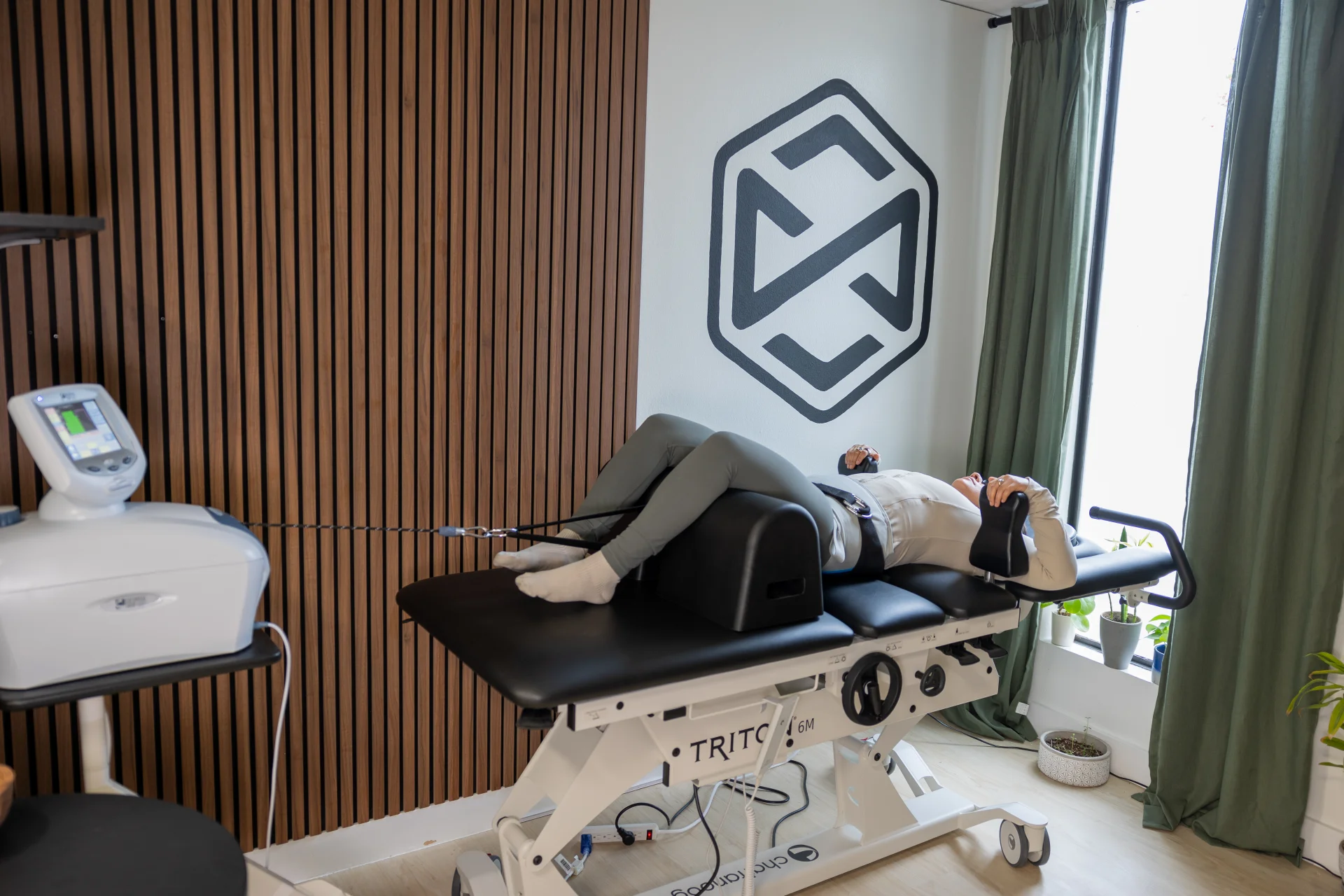
At Limitless Chiropractic, we treat Austin car accident patients with in-house digital X-rays, spinal decompression therapy on a Triton Chattanooga table, and direct coordination with insurance companies and attorneys. We're healthcare providers first, not a personal injury mill.
If your symptoms are building after a recent collision, we verify your insurance coverage before your first visit and offer same-day appointments for acute injuries.
When another vehicle strikes yours, your car decelerates instantly. Your body doesn't. It continues moving at pre-impact speed until your seatbelt catches you, your headrest stops your skull, or your muscles absorb the force, whichever comes first.
This mismatch between your body's momentum and your vehicle's sudden stop generates forces that travel through your spine. The cervical region — seven small vertebrae supporting a 10–12 pound head — absorbs the worst of it. But the lumbar spine, thoracic spine, and pelvis all participate in the energy transfer.
Injury-producing forces have been documented at very low collision speeds. Your car may show no damage at all. The bumper did its job. Your ligaments and discs had no such protection.
Commonly Affected Systems
A car accident is not a single injury. It's a pattern of injuries across multiple systems:
Cervical spine: Whiplash mechanics stretch ligaments beyond their normal range and compress discs.
Lumbar spine: Seatbelt restraint creates a fulcrum point that loads the lower back.
Ligaments: Connective tissues between vertebrae stretch, micro-tear, or fully tear under impact forces.
Intervertebral discs: The shock absorbers between vertebrae compress, bulge, or herniate.
Nervous system: Spinal nerve roots become irritated as swelling increases pressure in tight spaces.
Each of these structures has a different healing timeline. Muscles recover in weeks. Ligaments need months. Discs may never fully regenerate. This layered recovery schedule is why car accident symptoms evolve over time rather than appearing all at once.
Why Pain Is Often Delayed (24–120 Hours)
Two biological mechanisms conspire to hide your injury from you in the first day or two:
Why Car Accident Symptoms Are Delayed
Mechanism
What It Does
Duration
Adrenaline surge
Suppresses pain signaling between injury site and brain; keeps you alert during emergency
24–48 hours post-impact
Delayed inflammation
Immune response builds gradually as tissue damage triggers swelling; pressure on nerve roots mounts over days
Peaks at 48–72 hours
Adrenaline is your body's emergency broadcast system. It prioritizes survival over sensation. While it's active, you feel alert and capable, not injured.
Meanwhile, your immune system dispatches inflammatory cells to damaged tissue. Swelling accumulates. Pressure on nerve roots mounts. By the time adrenaline recedes, inflammation has built a wall of pain that wasn't there the day before.
This is why the emergency room clears you and sends you home. They ruled out fractures and internal bleeding, the genuine emergencies. They did not assess ligament integrity, disc compression, or neurological irritation. Those injuries reveal themselves on a different timeline.
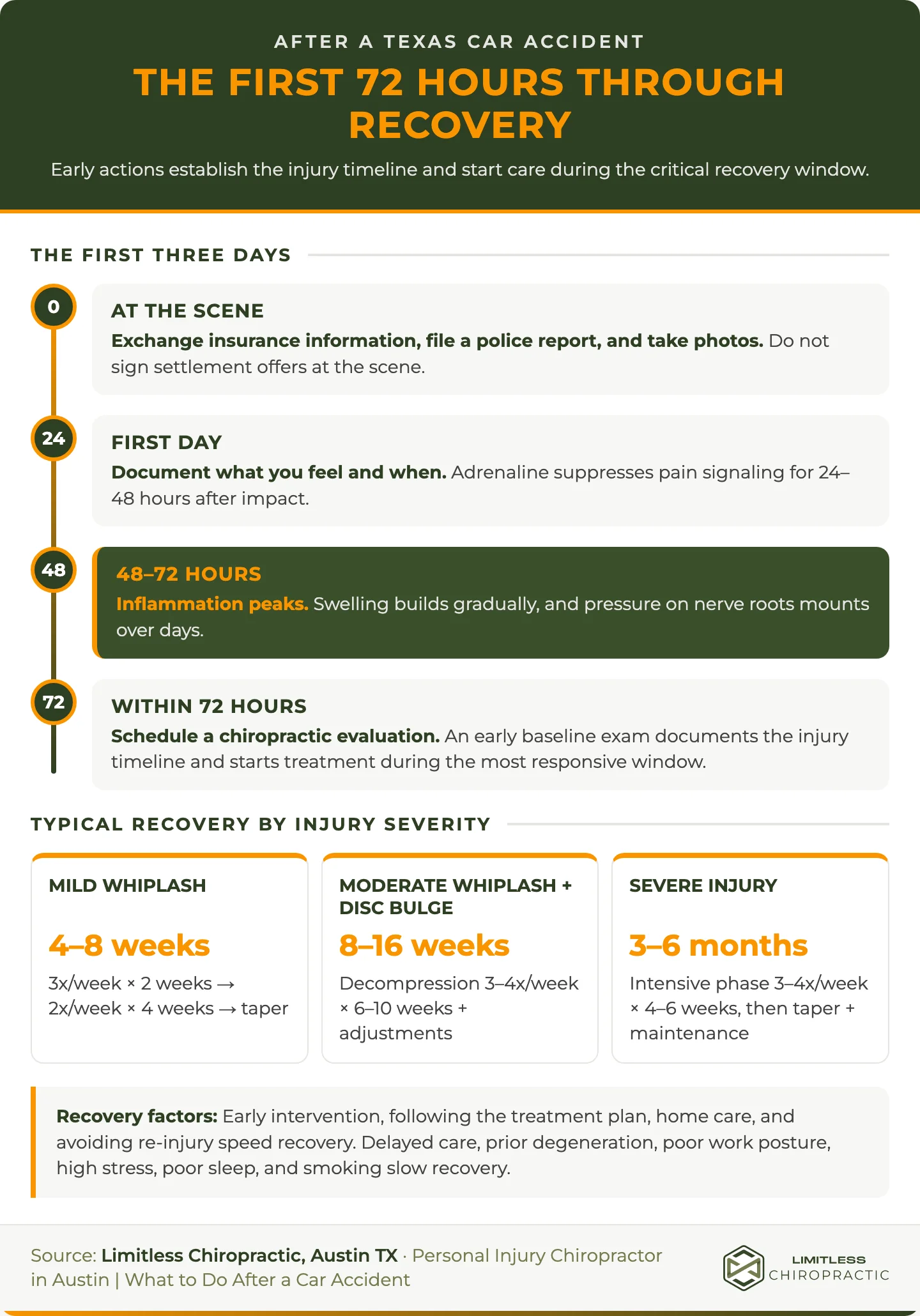
The First 72 Hours After a Texas Car Accident: What to Do
The actions you take in the first three days after an accident determine the strength of your medical documentation, the quality of your treatment, and the trajectory of your recovery.
First 72 Hours Checklist
Action Item
Why It Matters
Exchange insurance information
Driver name, policy number, insurance company, phone — you need this to file a claim or access PIP coverage
File a police report
Official documentation supports your claim; some insurance policies require it within 24–72 hours
Take photos of vehicles, damage, and scene
Visual evidence of impact angle, road conditions, and damage location strengthens your claim
Do NOT sign settlement offers at the scene
Insurance adjusters work for their company; signing too early can cap your treatment coverage before symptoms appear
Monitor for symptoms (neck, shoulders, headache)
Document what you feel and when — delayed symptoms are normal and legally valid
Schedule chiropractic evaluation within 72 hours
Early baseline exam establishes injury timeline and starts treatment during the critical recovery window
Document everything in writing
Write down what happened, how you felt, and how symptoms evolved — this becomes medical and legal evidence
Avoid posting about the accident on social media
Insurance companies monitor social media; photos of you "looking fine" can be used to deny your claim
Why Seeing a Chiropractor Before a Lawyer Makes Sense
This surprises people. The conventional wisdom says: get in an accident, call a lawyer, let them handle everything.
That sequence gets it backwards.
Healthcare establishes the facts. Legal strategy comes second.
Here's why seeing a chiropractor first makes more sense:
1.You don't need a lawyer to start treatment. Texas offers Personal Injury Protection (PIP) coverage that pays for chiropractic care regardless of who caused the crash. Many policies also include Medical Payments (MedPay) coverage. You can start treatment immediately using your own insurance.
2.Medical records strengthen any future legal claim. If you eventually hire an attorney, they work better with medical documentation already in progress. A chiropractic evaluation from Day 2 is worth more than a lawyer consultation on Day 10 with no medical records yet.
3.Waiting to start treatment shrinks your recovery window. The first two weeks after an accident are critical. Inflammation is setting in. Scar tissue is forming. Early adjustments and decompression therapy can prevent acute injuries from becoming chronic conditions.
4.Chiropractors document causation better than ERs. Emergency rooms rule out life-threatening injuries. They don't document how your cervical spine shifted or how your disc compressed. A chiropractic exam establishes those details, which insurance companies and attorneys need to see.
You can always hire a lawyer later if the at-fault driver's insurance denies your claim or if your injuries turn out to be severe. But you can't go back in time and capture baseline data from the week after your accident.
At Limitless Chiropractic, we verify your insurance coverage before your first visit. If you have PIP or MedPay, we'll coordinate billing so you can start treatment without paying out of pocket.
Same-day appointments available for acute injuries
Common Car Accident Injuries We Treat at Limitless Chiropractic
Whiplash and Cervical Spine Injuries
Whiplash is the most common car accident injury, and the most misunderstood.
It's not just a sore neck. It's a ligament injury with measurable structural changes on imaging. When your head whips forward and back during impact, the ligaments connecting your cervical vertebrae stretch beyond their normal range. Some micro-tear. Some fully tear.
On X-rays, we look for:
Loss of cervical curve (military neck or reversed curve).
Ligament hypermobility (vertebrae shifting too far during movement).
Lateral misalignment (head tilted to one side).
Symptoms often appear 3–7 days after the accident: neck stiffness and reduced range of motion, headaches at the base of the skull, shoulder and upper back tightness, jaw tension or TMJ discomfort. Untreated whiplash can lead to chronic pain, accelerated disc degeneration, and persistent loss of cervical curve. Patients with straightened neck curves after whiplash are more likely to have lingering symptoms years later.
The discs between your vertebrae act as shock absorbers. When impact forces compress them suddenly, the outer ring (annulus fibrosus) can tear, allowing the inner gel (nucleus pulposus) to bulge or rupture.
Three types of disc injuries:
Protrusion: Disc bulges but the outer ring stays intact.
Extrusion: Disc material breaks through the outer ring but stays connected.
Sequestration: Disc material fully separates as a fragment.
Symptoms that indicate disc involvement: pain radiating down your arms (cervical disc) or legs (lumbar disc), numbness or tingling in fingers or toes, weakness in specific muscle groups, pain that worsens with bending, twisting, or prolonged sitting.
At Limitless Chiropractic, we use in-house digital X-rays to assess spinal alignment and identify areas of disc stress. If imaging suggests herniation or bulge, we may recommend spinal decompression therapy, a non-surgical treatment that creates negative pressure in the disc to draw herniated material back into place.
Many car accident patients develop headaches days or weeks after the crash. These aren't tension headaches from stress. They're cervicogenic headaches — headaches that originate from the cervical spine.
When your upper cervical vertebrae (C1, C2, C3) misalign, they irritate the nerves that connect to your head and face. The greater occipital nerve, which runs from the base of your skull to your forehead, becomes compressed. The result: headaches that don't respond to typical medication.
TMJ dysfunction is also common after accidents. Your jaw muscles share neurological pathways with your neck muscles. When your cervical spine shifts, your jaw mechanics follow. Patients develop clicking, popping, facial pain, and difficulty chewing.
We treat these conditions by correcting the underlying cervical misalignment, not by prescribing muscle relaxers or bite guards.
Concussion and Post-Concussion Syndrome
Mild traumatic brain injury (TBI) is often missed in emergency rooms. If you didn't lose consciousness and your CT scan was clear, the ER assumes you're fine.
But concussion symptoms can linger for weeks or months: dizziness and balance problems, brain fog and difficulty concentrating, sleep disturbances, sensitivity to light and sound.
What most people don't realize: your cervical spine plays a critical role in concussion recovery. The upper cervical vertebrae house proprioceptors that tell your brain where your head is in space. When those vertebrae misalign after impact, your brain receives faulty position data. The result: dizziness, balance issues, and "brain fog" that's actually a proprioceptive problem.
Chiropractic adjustments to the upper cervical spine can meaningfully improve post-concussion symptoms. If neurological deficits persist (weakness, vision changes, severe cognitive decline), we coordinate referrals to neurology for advanced imaging and co-management.
Lower Back Pain and SI Joint Dysfunction
Your lumbar spine and sacroiliac (SI) joints absorb large forces during a collision. The seatbelt creates a fulcrum point across your pelvis and lower back. Rear-end impacts compress your lumbar discs. Side impacts shear your SI joints.
Symptoms that indicate lumbar or SI involvement:
Lower back pain that worsens with standing or walking.
Pain in the buttocks or hips (SI joint referral pattern).
Stiffness after sitting for prolonged periods.
Pain that radiates into the thighs (sciatica pattern).
We treat lower back injuries with a combination of lumbar adjustments, pelvic stabilization, and decompression therapy when disc involvement is present. Recovery timelines range from 6–12 weeks depending on severity.
Texas Car Accident Insurance 101: How to Get Your Treatment Covered
One of the biggest barriers to care after a car accident isn't the injury — it's confusion about who pays for treatment.
Texas Is an At-Fault State
In Texas, the driver who caused the accident is financially responsible for injuries and damages. Their liability insurance is the primary source of compensation for your medical treatment, lost wages, and pain and suffering.
But liability claims take time. The at-fault driver's insurance company doesn't write you a check the day after the crash. They investigate. They delay. They negotiate.
Meanwhile, your symptoms are building and your recovery window is closing.
This is where your own insurance policy becomes critical.
Texas Car Accident Coverage Types
Coverage Type
Who Pays
Fault Required?
Typical Limits
What It Covers
PIP (Personal Injury Protection)
Your own policy
No, pays regardless of fault
$2,500 minimum (Texas default)
Medical bills, lost income, essential services
MedPay (Medical Payments)
Your own policy
No, pays regardless of fault
$1,000–$10,000+ (varies by policy)
Medical bills only
Liability (Bodily Injury)
At-fault driver's policy
Yes, must prove other driver caused it
$30,000 per person / $60,000 per accident (Texas minimum)
Medical bills, lost wages, pain and suffering
What Limitless Chiropractic Handles for You
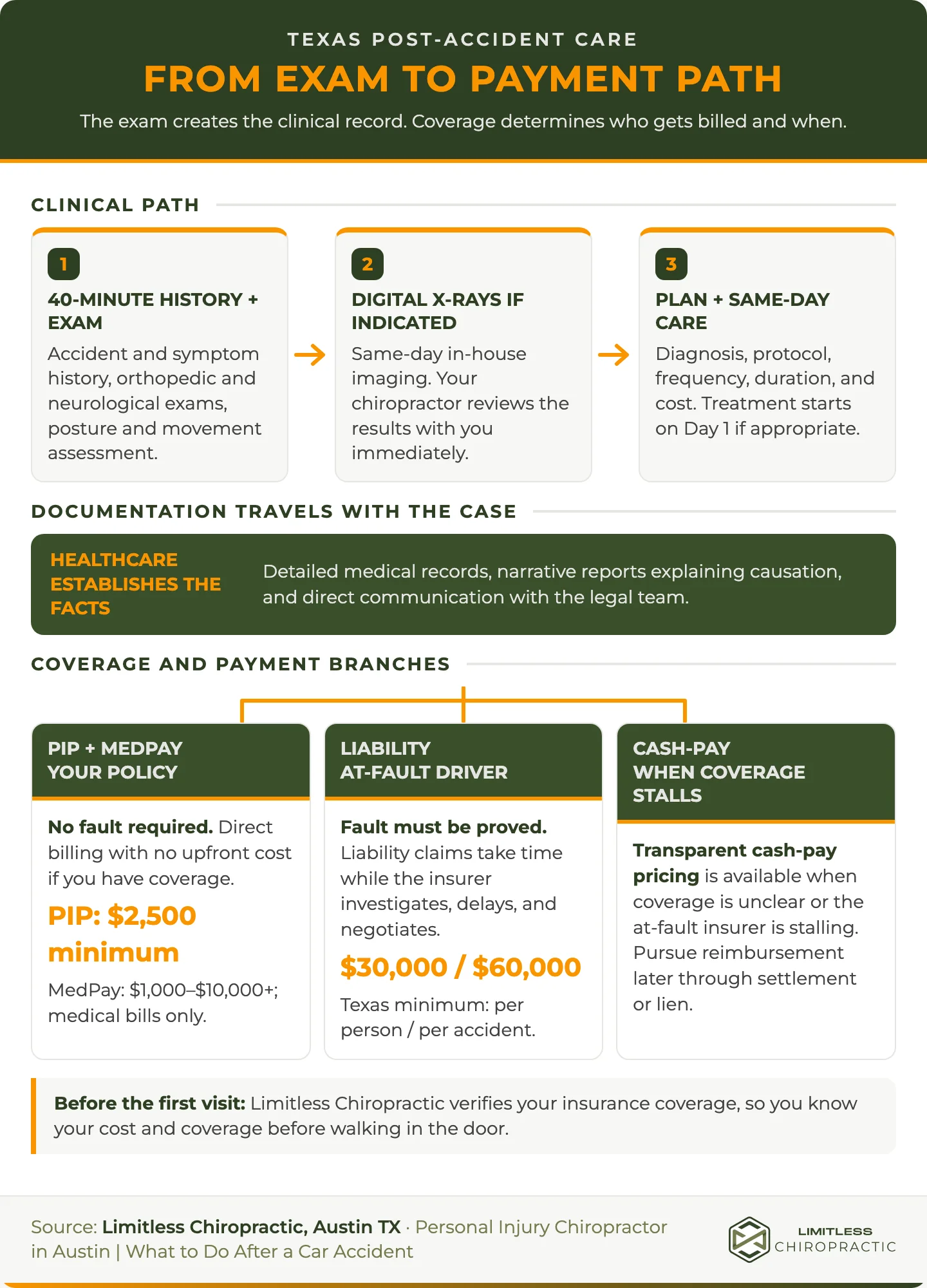
We verify your insurance coverage before your first visit. You'll know your cost and coverage before walking in the door.
We coordinate with:
PIP and MedPay carriers: Direct billing, no upfront cost if you have coverage.
Liability insurers: Documentation and communication with the at-fault driver's insurance.
Personal injury attorneys: We provide medical records, narrative reports, and causation documentation.
If your coverage is unclear or if the at-fault driver's insurance is stalling, we offer transparent cash-pay pricing. You can pursue reimbursement later through settlement or lien.
Posture and movement assessment: How your body is compensating for the injury.
This isn't a 10-minute consultation. We take the time to understand what happened and how it's affecting you.
Step 2: In-House Digital X-Ray Imaging (If Indicated)
Most Austin chiropractors don't have in-house imaging. If they suspect structural damage, they refer you out to a radiology center. You schedule another appointment, drive across town, wait for the radiologist to read the images, and hope the results get sent back in time.
At Limitless Chiropractic, we eliminated that delay. We have digital X-ray equipment right here in the office. If imaging is indicated based on your exam, we take X-rays the same day. Your chiropractor then reviews the results with you immediately. No waiting, no referrals, no guesswork.
What we look for on post-accident X-rays:
Spinal alignment and curvature loss (military neck, reversed curve).
Ligament instability (hypermobility between vertebrae).
Fractures or dislocations (rare but critical to rule out).
Degenerative changes (pre-existing vs. new).
Disc space narrowing (indicator of compression or herniation).
Frequency and duration: Realistic recovery timeline based on injury type.
Cost breakdown: Insurance coverage and cash-pay options.
We don't lock you into long-term contracts. We don't oversell unnecessary treatment. You get what you need based on clinical findings, not what maximizes revenue.
Step 4: Same-Day Treatment (If Appropriate)
If your condition allows, we start treatment on Day 1: a first chiropractic adjustment to reduce nerve pressure, acute-phase care (ice, electrical stimulation, or soft tissue work) to reduce inflammation, and home care instructions covering positioning, ice and heat protocols, and movements to avoid.
When Decompression, Advanced Imaging, or Specialist Referral Is Indicated
When We Recommend Spinal Decompression
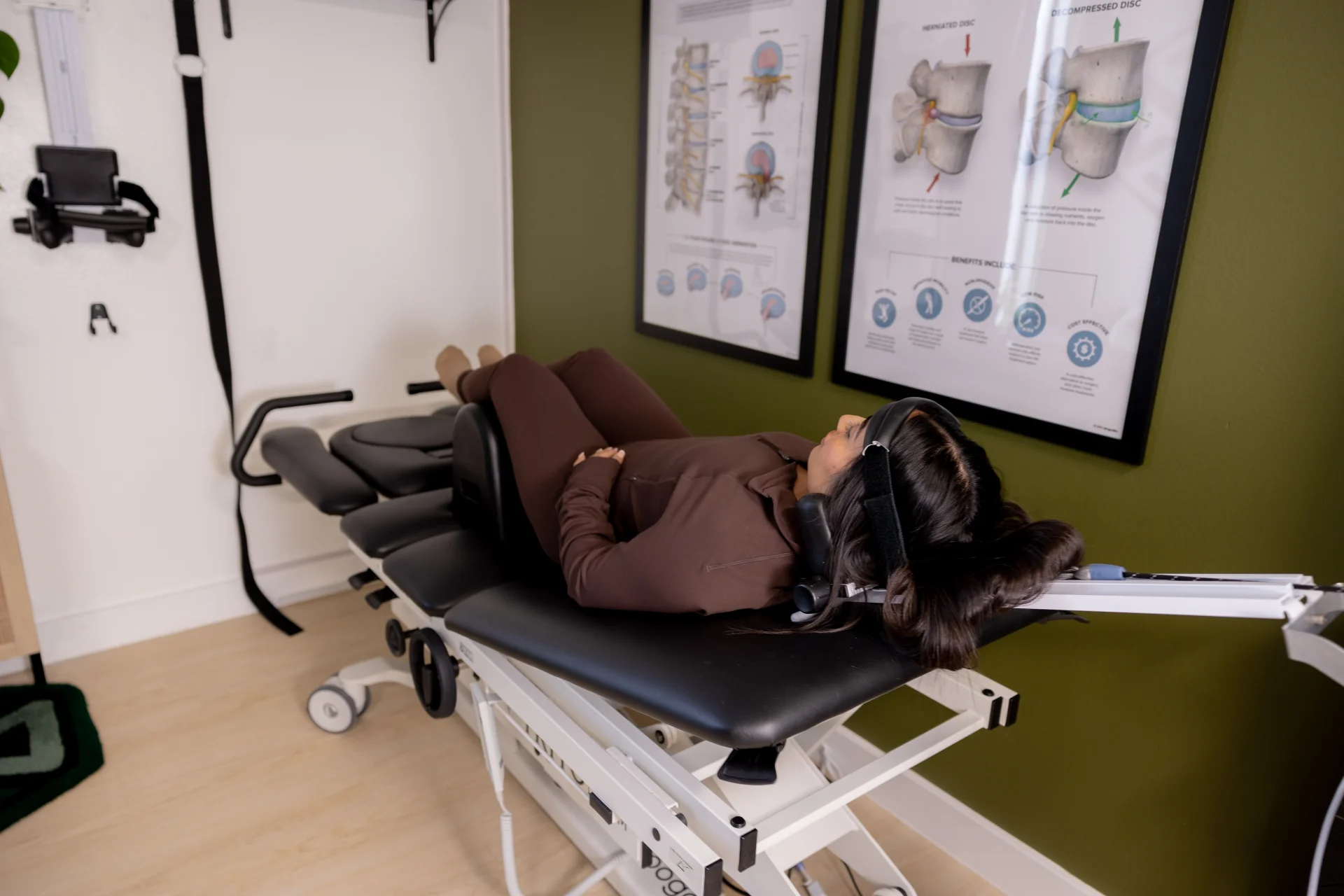
Spinal decompression therapy is a non-surgical treatment that uses mechanical traction to create negative pressure inside the disc. This negative pressure draws herniated or bulging disc material back toward the disc center and supports healing by improving nutrient flow.
We recommend decompression when:
X-rays or MRI confirm disc herniation or bulge.
You have radicular pain (shooting pain down arms or legs).
Standard adjustments alone haven't resolved nerve symptoms.
You want to avoid injections or surgery.
Typical decompression protocol at Limitless Chiropractic: 16 to 30 sessions over a 2 to 4 month period, with each session lasting 15 minutes. Combined with chiropractic adjustments and rehab exercises.
"Traditional traction applies a constant linear pull that the body often resists through muscle guarding, while spinal decompression uses controlled, variable distraction to reduce intradiscal pressure and facilitate fluid exchange without triggering that reflex. So it's not just stretching tissue — it's influencing disc physiology."
— Dr. Scott Mitchell, Limitless Chiropractic
When We Order Advanced Imaging (MRI)
X-rays show bone alignment. MRI shows soft tissue, discs, ligaments, spinal cord, nerve roots.
We order MRI when:
X-rays show severe instability or degeneration.
You have neurological deficits (weakness, numbness, loss of reflexes).
No improvement after 2–3 weeks of conservative care.
We need to confirm disc herniation before starting decompression.
When We Refer to Neurology or Orthopedics
We're healthcare-first, not revenue-first. If you need a specialist, we coordinate that referral.
We refer when:
Suspected spinal cord compression (myelopathy).
Cauda equina symptoms (bowel/bladder dysfunction — a medical emergency).
Coordination with Personal Injury Attorneys (Healthcare First, Not Legal First)
You Don't Need a Lawyer to Start Chiropractic Care
PIP and MedPay pay immediately. No fault determination required. No attorney needed. If you have Personal Injury Protection or Medical Payments coverage, you can start treatment today and your insurance pays the bills. You focus on healing. We handle the paperwork.
When an Attorney Makes Sense
An attorney becomes necessary when:
Fault is disputed and the at-fault driver's liability insurer denies your claim.
Your injuries exceed your PIP/MedPay limits and you need to pursue the at-fault driver's liability policy.
You have significant lost wages or permanent impairment.
The at-fault driver is uninsured or underinsured.
How Limitless Chiropractic Coordinates with Your Attorney
If you hire a personal injury attorney, we provide:
Detailed medical records with exam findings, imaging results, and treatment notes.
Narrative reports explaining causation (how the accident caused your injuries).
Direct communication with your legal team to answer medical questions.
Ethical documentation: We don't inflate treatment to pad claims.
We maintain relationships with personal injury attorneys in Austin who respect our clinical judgment. We don't accept kickbacks or referral fees. Ethics matter.
Why Limitless Chiropractic Is Different
In-house digital X-rays. Same-day imaging, no referral delays. We review results with you immediately.
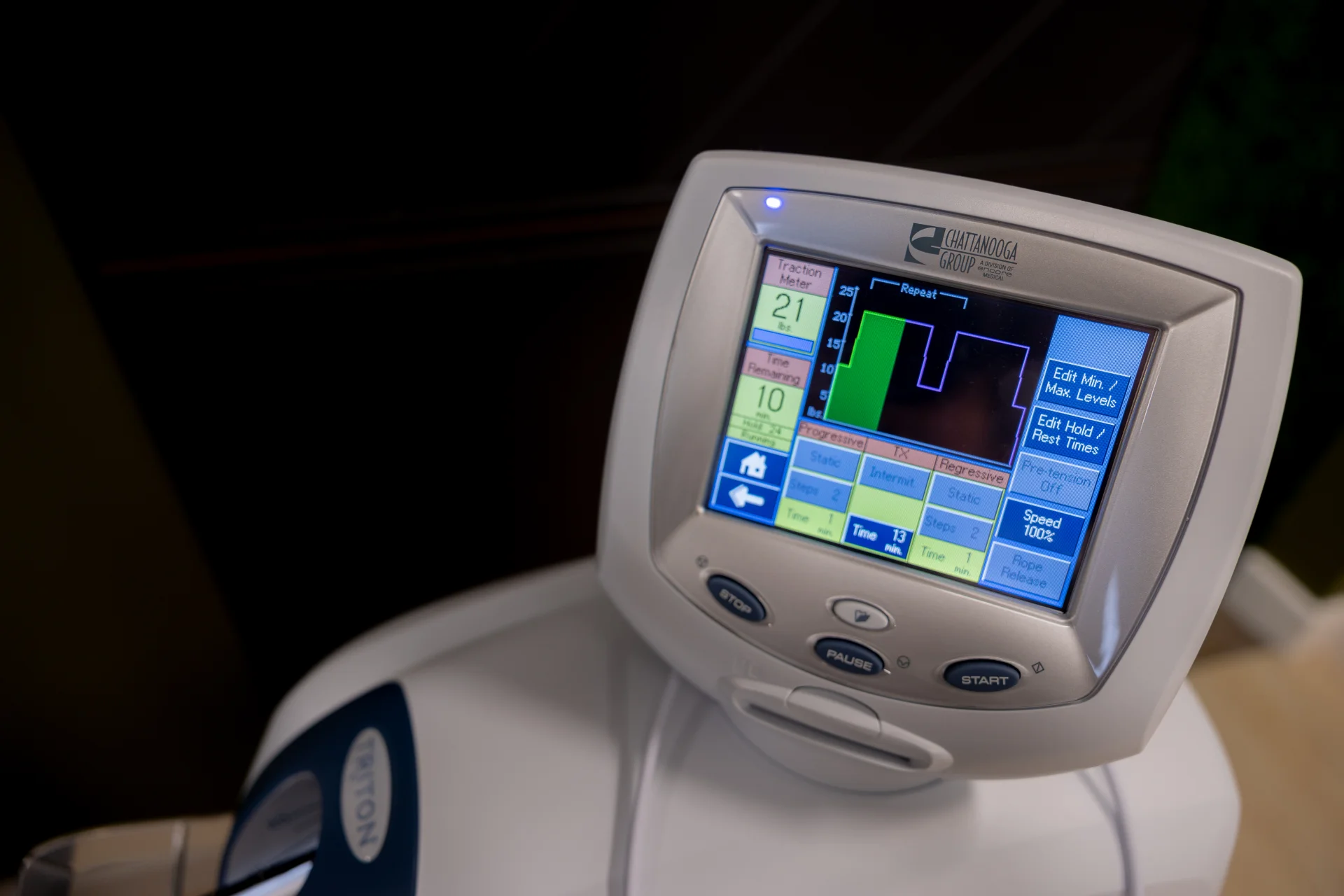
Spinal decompression equipment. We use the Triton Chattanooga decompression table — computerized, programmable, and built specifically for therapeutic spinal decompression. If your accident caused a herniation or bulge, you have options beyond injections and surgery.
Cash-based practice with insurance coordination. We're not dependent on insurers for treatment decisions, so you get what you actually need clinically. We still coordinate billing with PIP, MedPay, and liability carriers to minimize your out-of-pocket cost.
Personal injury experience. Dr. Scott Mitchell has treated motor vehicle accident patients in Austin since 2018. He knows what insurance companies and attorneys need to see in documentation, and he knows the difference between acute injury care and revenue-maximizing upsells.
Convenient South Austin location. 2800 S I-35 Frontage Rd, Ste 175, Austin, TX 78704. Easy access from I-35, MoPac, and South Lamar. Serving Downtown Austin, South Austin, Round Rock, Cedar Park, and Pflugerville.
Frequently Asked Questions
How soon should I see a chiropractor after a car accident?
Within 72 hours if possible. Adrenaline and delayed inflammation hide most car accident injuries for the first day or two. An early evaluation establishes your baseline, documents the injury timeline, and starts treatment during the most responsive window.
Do I need a lawyer before I start chiropractic treatment?
No. Texas PIP and MedPay coverage pay for chiropractic care regardless of fault. You can start treatment immediately using your own policy. Hire an attorney later if liability is disputed or if your injuries exceed your coverage.
What if the ER said I was fine?
Emergency rooms rule out fractures and internal bleeding. They don't assess ligament integrity, disc compression, or cervical curve loss. A chiropractic evaluation looks at the structural injuries the ER doesn't screen for.
Will my insurance cover chiropractic care after an accident?
Often, yes. Texas PIP and MedPay typically cover chiropractic care after a motor vehicle accident. Liability coverage from the at-fault driver may also reimburse care, though those claims take longer to settle. We verify your coverage before your first visit.
How long does recovery take?
It depends on injury severity. Mild whiplash typically resolves in 4–8 weeks. Moderate whiplash with disc involvement often runs 8–16 weeks. Severe injuries (herniation, ligament tear, concussion) may take 3–6 months. Early intervention shortens every category.
Do you take walk-ins for accident evaluations?
Yes. Walk-ins are welcome for urgent post-accident evaluation, and we offer same-day and next-day appointments through online booking. Call ahead when possible so we can verify your insurance coverage before you arrive.
What does a personal injury chiropractic exam cost?
If you have PIP or MedPay, your initial exam and imaging are typically billed directly to your policy with no out-of-pocket cost. Cash-pay pricing is also available — our new patient first visit special is $97 (versus $200 normal). We discuss exact costs before treatment begins.
Schedule Your Post-Accident Evaluation
Car accident injuries are real, even when vehicle damage is minimal.
The first 72 hours determine your recovery trajectory.
Healthcare before legal strategy.
At Limitless Chiropractic, we handle the medical side with in-house imaging, insurance coordination, and evidence-based treatment protocols. You focus on healing.
Limitless Chiropractic in South Austin verifies your coverage before the first visit, takes same-day X-rays in-house, and coordinates directly with PIP, MedPay, liability carriers, and your attorney if needed.
Same-day and next-day appointments available · Walk-ins welcome
Don't wait for the pain to get worse.
Limitless Chiropractic | 2800 S I-35 Frontage Rd, Ste 175 | Austin, TX 78704 | Serving Downtown Austin, South Austin, Round Rock, Cedar Park, and Pflugerville
Dr. Scott Mitchell
About the author
Dr. Scott Mitchell, a Boston-accented chiropractor with a passion for holistic health,dedicates his life to helping people unlock their LIMITLESS potential through personalized chiropractic care.