Tech neck is a structural problem, not a posture problem
Telling yourself to sit up straight does not reverse mechanical adaptations that have already built up
Carpal tunnel can have a cervical driver
Wrist-only treatment can miss upstream nerve compression from the neck and shoulder region
Forward head posture changes breathing mechanics
Shallow upper-chest breathing keeps the recovery system under unnecessary strain
A small chiropractic study measured salivary cortisol changes during spinal manipulative therapy
The desk-worker stress-sleep cycle has a structural component worth evaluating honestly
Chiropractic care is a keystone modality, not a standalone fix
The strongest outcomes combine structural care with ergonomics, movement, sleep, and recovery work
Limitless Chiropractic offers in-house digital X-rays and onsite corporate options
Desk-worker teams can evaluate the real loading pattern instead of guessing from symptoms
You're working 50-plus hour weeks at a screen. Your shoulders sit forward of your hips. Your neck angles down toward a monitor that's sitting two inches too low. By 4 PM your traps are tight. By 8 PM your forearms are aching. By bedtime you can't quite figure out why you're exhausted but can't fall asleep.
This isn't a personal failure of posture or a sign that you need to "just stretch more." It's a predictable, mechanical consequence of how the modern desk job loads the human spine and nervous system. Austin's tech corridor (Oracle, Tesla, Apple, Meta, Indeed, Dell) is built on workers whose primary occupational hazard is sitting still while staring forward, and the chronic-pain patterns that show up in that population are tighter and more consistent than you'd expect.
This guide covers what actually happens to your body during a tech career, why "tech neck" is a structural problem and not a posture problem, how carpal tunnel often originates in your neck rather than your wrist, what role chiropractic care plays in the bigger recovery picture, and when the symptoms you're managing stop being manageable.
If you're already dealing with tech-job pain in Austin and want a structural assessment, call (512) 999-6115 or book online. We'll evaluate your spine, posture, and movement patterns before recommending anything.
Dealing with tech-job pain in Austin? We evaluate the structure behind the symptoms before recommending a care plan.
Digital X-rays in-house | Same-day appointments often available
Tech Neck: It's Not Just Posture
The term "tech neck" gets thrown around like it's a behavior problem you can fix with willpower. It isn't. By the time most desk workers feel it, their cervical spine has structurally adapted to spending hours in a forward-head position. The adaptation is real, measurable on imaging, and not reversible by deciding to sit up straight at lunch.
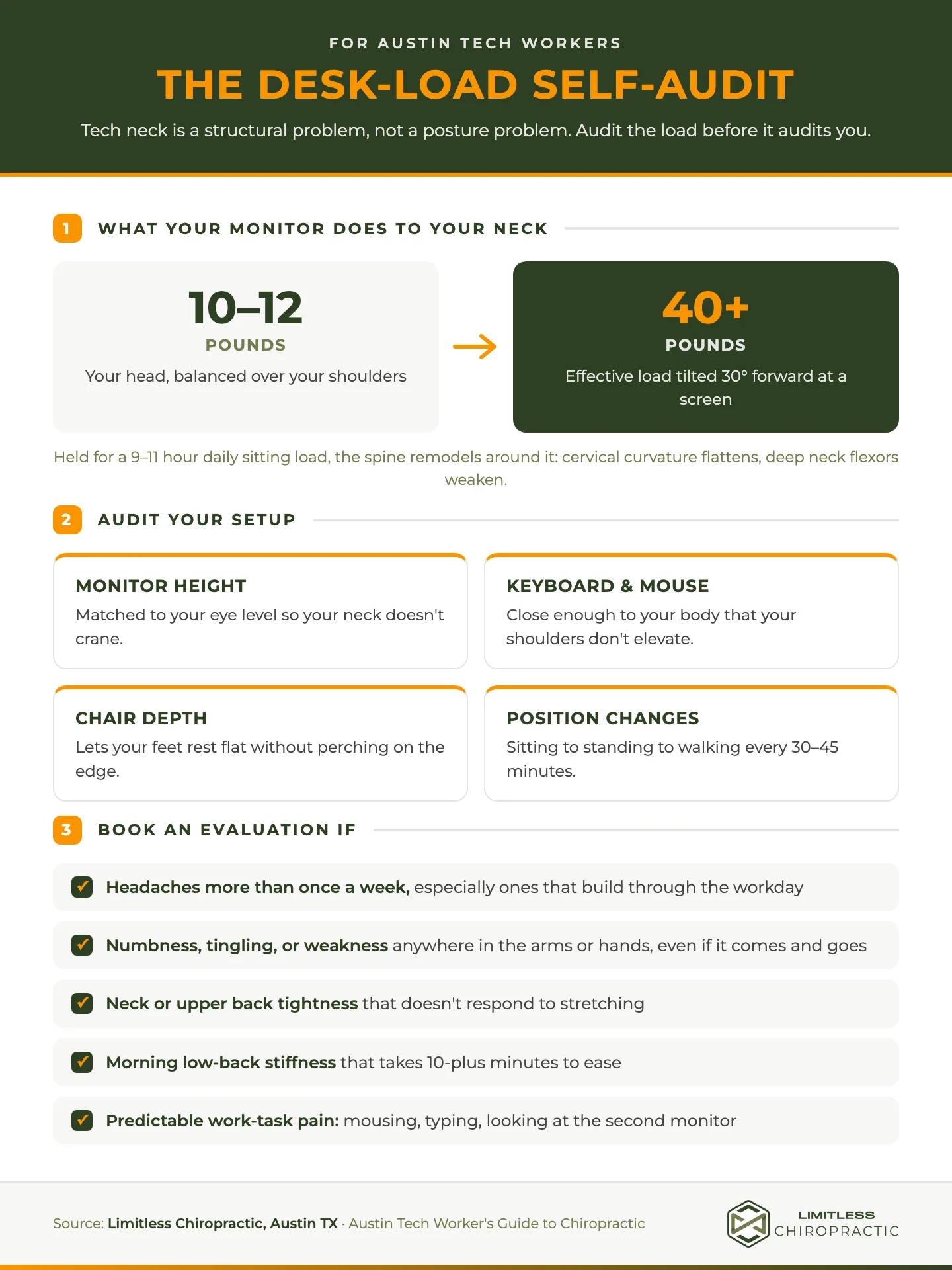
Here's what's happening mechanically. Your head weighs roughly 10 to 12 pounds when it sits balanced over your shoulders. Tilt that head 30 degrees forward to look down at a monitor or phone, and the effective load on your cervical spine climbs to 40-plus pounds. Hold that load for hours per day, every day, for years, and your body responds by remodeling. Cervical curvature flattens. The deep neck flexors weaken. The upper trapezius and levator scapulae compensate by holding tension. The thoracic spine starts rounding to support a head that no longer wants to balance over the shoulders.
What you experience: stiffness, headaches at the base of the skull, a constant tightness across the upper back, the feeling that your neck "needs to crack" but the cracks don't relieve much. What's actually happening: the nerves exiting your cervical spine are being compressed by the new architecture. The muscles supporting your head are overworked. The discs between your vertebrae are unevenly loaded.
Telling someone to "fix their posture" is like telling someone with a fever to "stop being warm." Posture is the symptom. The structural adaptation is the cause. Adjustments restore the mobility and alignment that the desk-job loading pattern stole. Corrective exercises retrain the deep stabilizers that stopped firing when bigger muscles took over compensation. Without addressing both, posture cues fail.
The clinical concept is double crush syndrome: a peripheral nerve can be compressed at two points along its path, and the cumulative compression produces symptoms that don't appear when only one site is affected. The median nerve, which is the one implicated in classic carpal tunnel, originates in the cervical spine at C5 through T1. It travels through the brachial plexus, down the arm, through the elbow, and into the wrist. Compression at any of those sites adds to the total nerve burden.
Tech workers are particularly susceptible because their cervical compression (from the forward-head posture) and their wrist compression (from keyboard and mouse use) compound. By the time symptoms appear at the wrist, the cervical contribution has often been brewing for years. Surgical release of the carpal tunnel without addressing the cervical component leaves a lot of patients with persistent symptoms after recovery.
A proper exam screens both ends. We look at cervical range of motion, neurological function in the upper extremities, and orthopedic tests that differentiate cervical-origin symptoms from local wrist pathology. If imaging confirms cervical involvement, the treatment plan addresses the upstream source rather than just the downstream symptom. For some patients, that means adjustments and corrective exercise resolve the issue without surgery. For others, surgery on the wrist is genuinely indicated, but conservative care on the neck still belongs in the plan to prevent recurrence.
Forward Head Posture and Your Breathing
Here's the connection that catches most patients off guard. Forward head posture doesn't just affect your neck. It changes how you breathe, and improper breathing mechanics impacts your entire health, not just the area between your shoulders.
When your head sits forward of your shoulders, your sternocleidomastoid and scalene muscles get recruited as accessory breathing muscles. These are not designed to be primary breathers. They're stabilizers and head rotators. When you press them into respiratory duty, you shift toward apical, shallow breathing in the upper chest. The diaphragm, which is supposed to be doing 70 to 80 percent of the work, becomes underused.
The downstream effects are not subtle. Shallow chest breathing is sympathetically dominant, meaning it keeps your nervous system in a low-grade fight-or-flight state. Heart rate variability drops. Cortisol stays elevated longer than it should after stress events. Sleep quality suffers because the body never fully shifts into parasympathetic recovery mode. Digestion gets sluggish for the same reason. Mental clarity declines because your brain isn't getting the same oxygen exchange it would with full diaphragmatic breathing.
This is why the chronic-fatigue, brain-fog, and sleep-disturbance patterns you see across desk-bound populations are so consistent. The breathing pattern is broken upstream of all of them. Restoring cervical and thoracic alignment lets the diaphragm work the way it was built to work, which lets the rest of the system reset.
Improve cervical and thoracic mechanics so diaphragmatic breathing can return
Cortisol, Sleep, and Spinal Alignment
The relationship between spinal care and the body's stress-recovery system is a domain where the clinical observation is stronger than the published evidence. It is worth discussing, but it needs to be discussed honestly.
A 1998 prospective case series by Peter J. Tuchin followed nine corporate workers through a six-week chiropractic spinal manipulative therapy study. The study established baseline salivary cortisol, delivered four treatments over two weeks, and continued saliva sampling during a two-week post-treatment period. After excluding one apparent outlier, the study reported a statistically significant reduction in salivary cortisol across the five-week measured period, while also finding no apparent immediate change between samples taken just before treatment and 15 minutes after treatment. The author's conclusion was cautious: the initial evidence was inconclusive and needed further investigation.
What the clinical pattern shows with desk-worker patients: when the cervical and thoracic alignment improves, the chronic 3 AM wake-ups often resolve. The "wired but tired" feeling at end of day softens. Resting heart rate drops a few beats. People stop reaching for caffeine to push through afternoons because the afternoons stop feeling like a wall.
The honest claim is not that one study proves chiropractic care fixes cortisol or sleep. It does not. The claim is narrower: cortisol has been studied in relation to chiropractic spinal manipulative therapy, early findings are interesting but preliminary, and the stress-recovery system is one more reason desk-worker care should look beyond the single painful joint. Chiropractic care doesn't replace stress management, sleep hygiene, strength training, or the rest of the recovery work that desk workers need. It addresses the structural input layer that may be keeping the body from fully downshifting.
The Austin Tech Worker Commute and Sitting Load
Austin's tech belt has a specific physical loading pattern that compounds the desk-job damage. The drive-in workers along MoPac, I-35, and 183 spend an additional one to two hours per day in a seated position with a steering wheel forward of the body. The remote workers may save the commute but often end up with longer single sessions at the desk because they don't have meeting walks or hallway transitions.
Either way, the sitting load typically runs 9 to 11 hours per day for a working tech professional. That's significantly more than what the human spine evolved to tolerate. Your discs are designed to be loaded and unloaded, hydrated through movement, and decompressed by walking and varied activity. Hours of static sitting compress the lumbar discs, dehydrate them, and load the same vertebral segments over and over without giving them recovery time.
The Limitless Chiropractic patient population skews heavily Oracle, Tesla, Apple, Meta, Indeed, Dell, and the smaller startups in the Domain and East Austin. The presenting complaints are remarkably consistent across companies: cervical stiffness, lumbar tightness, headaches that build through the workday, mid-back tension, hip flexor shortening, and shoulder rounding. The structural pattern is the same. The treatment approach is the same. The lifestyle modifications and ergonomic recommendations are the same.
If your team is losing focus to neck pain, headaches, wrist symptoms, and sitting-load fatigue, Limitless Chiropractic can discuss onsite chiropractic options for Austin offices.
For tech employers in Austin, the math on workplace musculoskeletal complaints is significant. Lost productivity, escalation to medical leave, prescription pain medication, surgery referrals, and the indirect cost of disengaged workers in chronic discomfort all add up.
Limitless Chiropractic offers an onsite corporate chiropractic option for Austin teams that want to bring care directly to the office. The setup runs as a recurring on-premise visit cycle (weekly, biweekly, or monthly depending on team size) where employees can book brief assessments, adjustments, and movement consultations during the workday without leaving the building.
For workers, the friction barrier of "find a chiropractor, schedule a visit, take a half day, drive across town" disappears. For employers, the program is genuinely preventive instead of reactive. The cervical and lumbar issues get addressed before they become surgical referrals, lost workdays, or workers' comp claims.
If you're an Austin tech HR lead, ops manager, or founder reading this and the math sounds right for your team, contact us at (512) 999-6115 to discuss the onsite program structure.
Ergonomic Corrections That Actually Help
Most ergonomic advice ignores the difference between symptom management and structural correction. A lumbar pillow can make sitting more tolerable without changing whether your spine is loading correctly. A standing desk gives variety without addressing why your body needed the variety in the first place.
The corrections that move the needle for desk workers are the ones that change loading patterns rather than just adding cushioning. Monitor height matched to your eye level so your neck doesn't crane. Keyboard and mouse position close enough to your body that your shoulders don't elevate. Chair depth that lets your feet rest flat without forcing you to perch on the edge. Frequent position changes (sitting to standing to walking) every 30 to 45 minutes rather than holding any single position for hours.
Beyond positioning, the desk worker who's already in pain benefits more from movement work than from buying better equipment. Specific mobility for the thoracic spine, cervical retraction work to fight forward head posture, scapular setting drills to reverse the rounded-shoulder pattern, and hip flexor lengthening to address the hours of seated shortening. None of these are revolutionary. The difficulty is consistency. We assign home-care movement protocols to every desk-worker patient and follow up on adherence at re-examinations.
Where Chiropractic Fits in the Broader Recovery Routine
Chiropractic care is one tool in the recovery toolkit, not the entire toolkit. Tech workers who get the best long-term results stack it with other modalities.
Sleep is non-negotiable. Without 7 to 9 hours of quality sleep, no recovery modality compensates. Movement of any kind, daily, even if it's a 20-minute walk, prevents the sitting load from accumulating. Strength training one to three times weekly reverses the postural weakening pattern that desk work creates. Recovery modalities like infrared sauna, cold plunge, and red light therapy support tissue healing and parasympathetic recovery between work sessions.
Chiropractic fits in this stack as the structural keystone. The other modalities work better when the spine is mobile and aligned because the nervous system is in a better position to respond to recovery input. Chiropractic alone, without the rest of the recovery stack, can produce real improvement but plateaus faster. The stack with chiropractic produces compounding gains.
For a deeper breakdown of how the recovery modalities sequence and how they're priced in Austin, see our Austin Recovery Stack guide.
When to Come In
Threshold
Why It Matters
First Step
Weekly headaches
Headaches that build through the workday often have a cervical driver
Evaluate upper cervical mechanics and workstation load
Arm or hand symptoms
Numbness, tingling, or weakness means nerve involvement needs sorting out
Screen cervical and extremity regions together
Morning low-back stiffness
Static sitting load can compress lumbar segments before it becomes acute pain
Check lumbar mobility and desk-position habits
Sleep disruption from discomfort
Position-dependent sleep issues often reflect unresolved structural stress
Assess spine, breathing mechanics, and recovery routine
When to Come In: Symptom Thresholds
Most desk workers wait too long. The pattern is to manage discomfort with caffeine, ibuprofen, and heating pads until something tips over into acute pain. By that point, the structural changes that drove the acute event have been building for years.
The thresholds that should put you in for an evaluation:
Headaches more than once a week, especially headaches that build through the workday or originate at the base of the skull
Numbness, tingling, or weakness anywhere in the arms or hands, even if it comes and goes
Persistent neck or upper back tightness that doesn't respond to stretching
Lower back stiffness that takes 10-plus minutes to ease in the morning
Sleep disruption tied to physical discomfort (turning to find a comfortable position, waking with stiffness)
A feeling that your "posture has gotten worse" when you catch a reflection
Specific work-task pain (mousing, typing, looking at the second monitor) that's predictable and reproducible
Coming in earlier in the pattern means shorter treatment courses, less aggressive intervention, and better outcomes. Waiting until acute pain forces the issue means longer recovery and higher likelihood that some structural changes are permanent.
Frequently Asked Questions
Is tech neck reversible?
The structural changes are partially reversible depending on how long the pattern has existed and what tissue adaptations have occurred. Patients in their 20s and 30s who address tech neck early often see substantial cervical curve restoration. Patients with decades of forward head posture see meaningful symptom relief and functional improvement, though some structural change may be permanent.
Does chiropractic actually help carpal tunnel?
For carpal tunnel cases driven by cervical-origin nerve compression (a sizable portion of desk-worker presentations), yes. For cases that are purely local wrist pathology, chiropractic may not be the right tool. Proper evaluation determines which scenario applies.
How often do I need to come in if I work a desk job?
The acute phase typically runs 8 to 12 visits over 4 to 6 weeks. Maintenance for active desk workers is usually one visit every 3 to 6 weeks once the corrective phase is complete. The exact frequency depends on how heavily you load your spine the rest of the week.
Can a chiropractor help with my sleep?
Indirectly, yes. The mechanism is structural rather than direct: cervical alignment supports better breathing mechanics and autonomic function, which supports better sleep. Patients with sleep complaints tied to physical discomfort or breathing pattern issues often see meaningful sleep improvements during care.
Do I need imaging before treatment?
For desk-worker presentations with persistent symptoms, in-house digital X-rays are part of the standard first visit. They confirm the structural pattern, rule out anything more serious, and give us a baseline to track progress against.
Is the onsite corporate program expensive?
The program is structured so the per-employee cost is significantly lower than the equivalent care booked individually. For employers, the math typically works out as a net cost reduction once you factor in productivity gains and reduced medical leave. We discuss the specifics with HR or ops leads who reach out.
What's the first visit like for a tech worker?
Standard first visit: full intake on your work setup, symptoms, and history. Orthopedic and neurological exam. Movement and posture assessment. Digital X-rays if indicated. Initial adjustment and home-care recommendations. The first visit is normally $200 and currently runs at the $97 new-patient special at Limitless Chiropractic.
For accident-related versions of the same neck, back, and nerve symptoms
Get a Structural Assessment of Your Tech-Job Spine
The chronic patterns desk workers manage with caffeine, ibuprofen, and heating pads are not just inconveniences. They're the early symptoms of structural changes that compound over a career. Catching them early means shorter treatment courses and better long-term outcomes.
Limitless Chiropractic in Austin treats tech-worker chronic pain with the same protocol approach we use for personal injury and decompression cases: full intake, in-house imaging, structural diagnosis, and a treatment plan tailored to the loading pattern that drove the problem.
Call (512) 999-6115 or book online to schedule your evaluation. Same-day appointments often available. Onsite corporate program inquiries handled separately by phone.
Ready to stop guessing whether your desk setup, neck, wrist, or low back is the actual driver? Start with a structural assessment.
Hours:
Monday & Wednesday: 8:00 AM to 6:30 PM
Tuesday & Thursday: 11:00 AM to 6:30 PM
Friday: 8:00 AM to 3:30 PM
Saturday & Sunday: Closed
Cash-pay practice. We accept cash, credit, HSA, and FSA. The desk-job pattern is fixable. The fix starts with a structural assessment.
Limitless Chiropractic | 2800 S I-35 Frontage Rd, Ste 175 | Austin, TX 78704 | Serving Downtown Austin, South Austin, Round Rock, Cedar Park, and Pflugerville
Dr. Scott Mitchell
About the author
Dr. Scott Mitchell, a Boston-accented chiropractor with a passion for holistic health,dedicates his life to helping people unlock their LIMITLESS potential through personalized chiropractic care.