You've been to a chiropractor before. The visit lasted two minutes. They put you face-down, applied two adjustments to your neck and lower back, said "you're all set," and sent you home. Your spine felt slightly better for a day or two. Your shoulder, the actual reason you walked in, was untouched.
This is the standard chiropractic experience in Austin. It isn't because chiropractors can't adjust shoulders, elbows, hips, knees, wrists, ankles, or ribs. It's because the business model most clinics run on does not have time to.
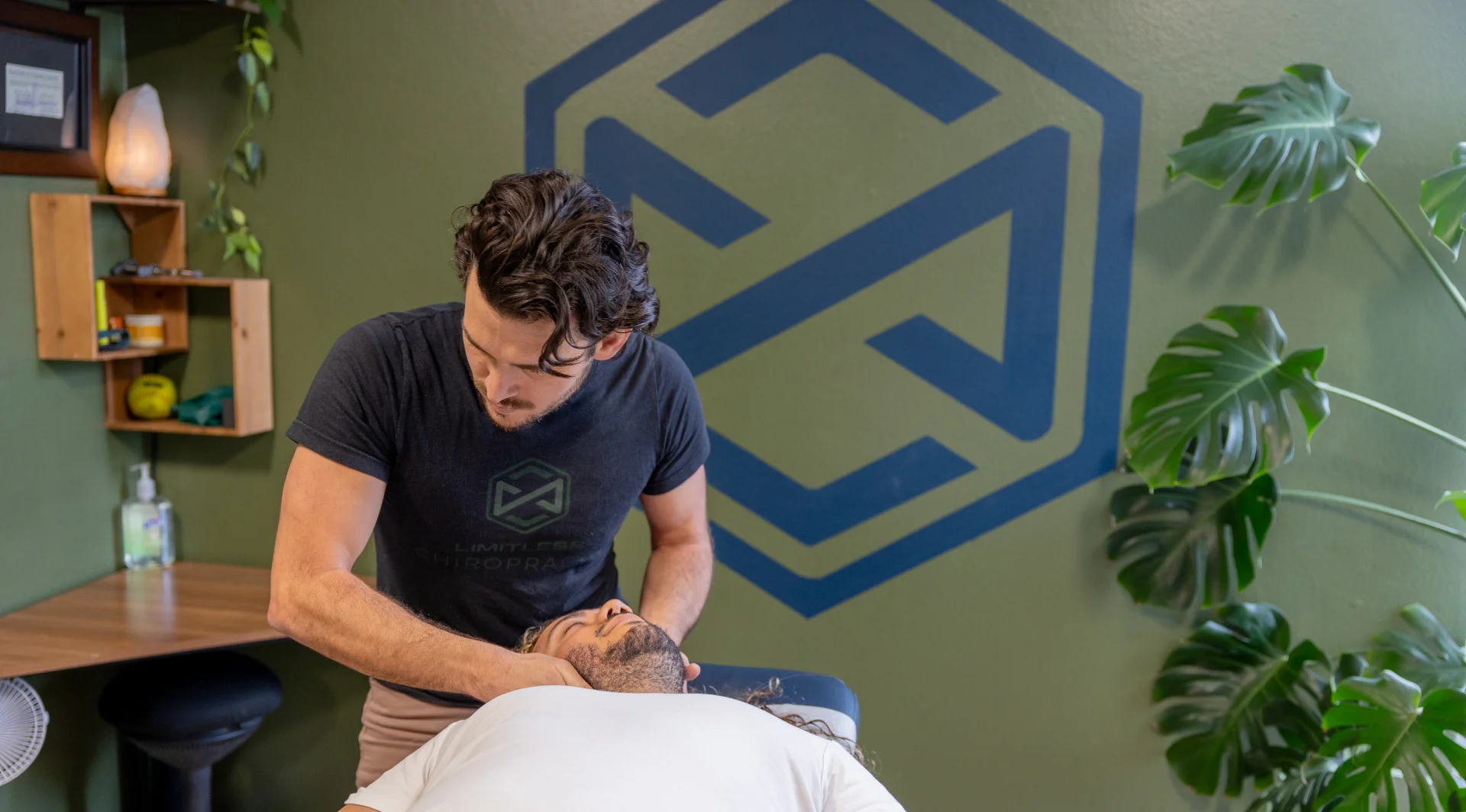
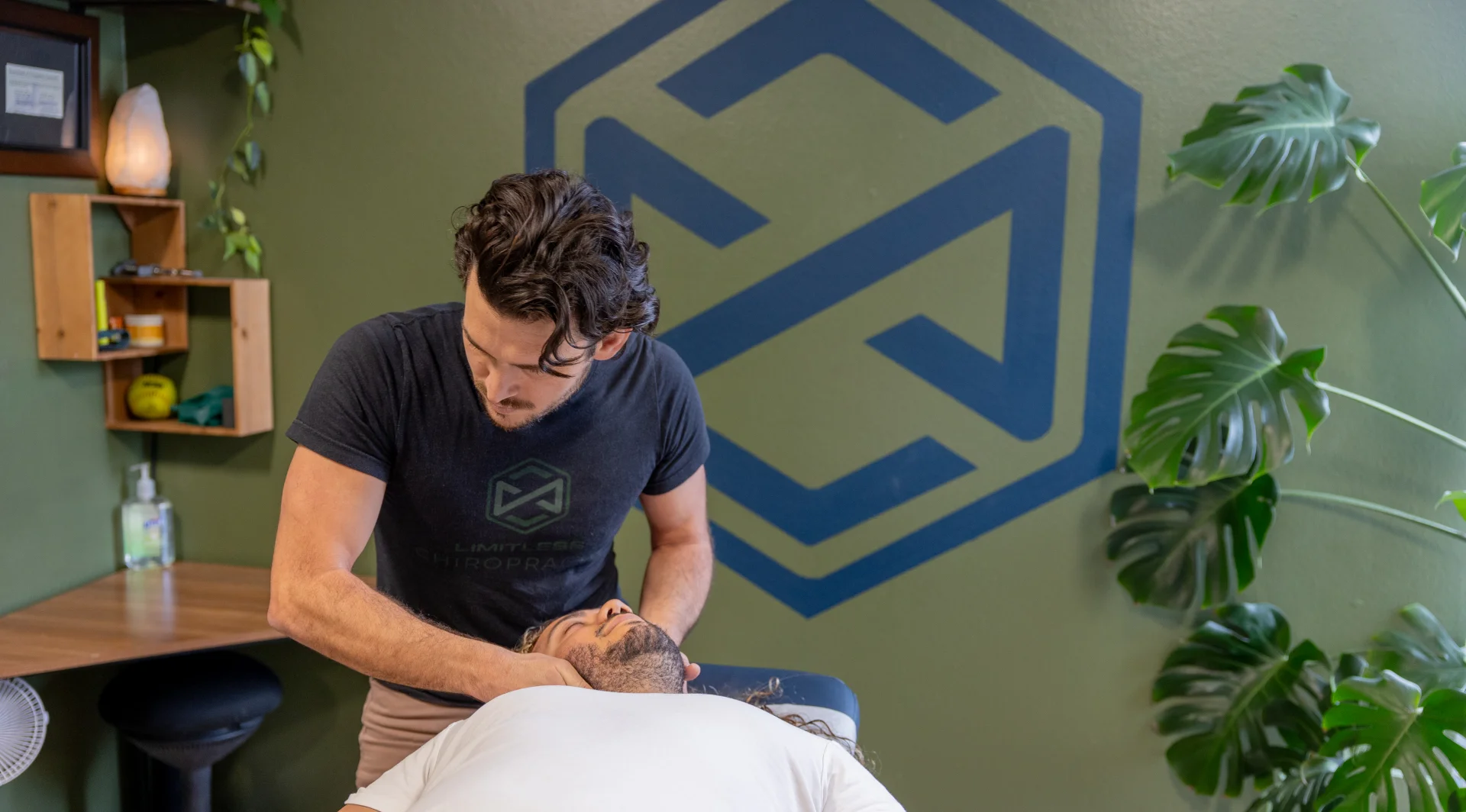
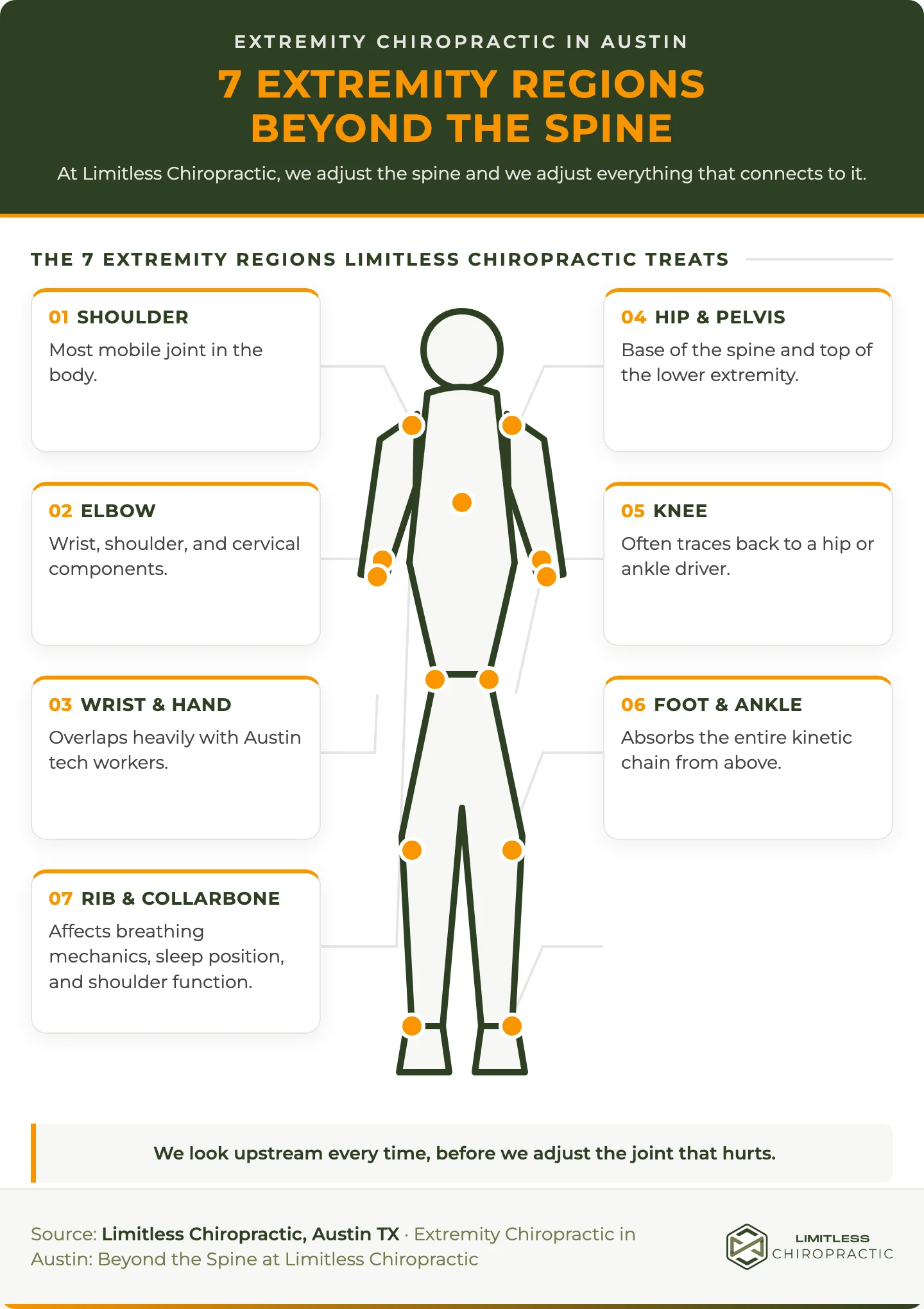
At Limitless Chiropractic, we adjust the spine and we adjust everything that connects to it. The 7 extremity regions Dr. Scott Mitchell treats in-house cover the joints, soft tissue patterns, and nerve drivers that the volume-model practices skip. If you've cycled through chiropractors who never touched the joint that actually hurts, this is the article that explains why and what we do differently.
If you want a thorough exam for an extremity complaint in Austin, we evaluate the joint, the spine above it, and the upstream drivers in the same visit.
One provider, one visit, one coordinated treatment plan
Many extremity problems are driven by spinal misalignment upstream
Adjusting the joint without addressing the driver is why prior care didn't hold
Extremity adjustments use different mechanics than spinal adjustments
Technique training and visit length both matter
Limitless Chiropractic visits run 10 minutes, not 2 minutes
Full-body care without driving to a second specialist
Extremity adjusting is a cash-pay specialty
Pricing transparent up front, no surprise denials
Why Most Chiropractors Don't Adjust Extremities
The honest answer is structural. Many Austin chiropractic offices don't adjust extremities because they're optimized for volume. The visit is 2 to 3 minutes, the patient is on the table for one round of spinal adjustments, and the schedule moves on to the next person. There is no time inside that model to evaluate a shoulder, isolate the rotator cuff, screen the AC joint, and apply a specific adjustment to it. So extremity work does not happen.
That isn't the same as saying those chiropractors can't do it. Most of them learned extremity adjusting in school. The difference is that the practice model they joined doesn't reimburse the visit length needed to do it well. Insurance billing codes for "chiropractic manipulation, extraspinal" exist, but the reimbursement is low relative to spinal codes, and the documentation overhead is heavier. Volume practices skip the hassle and stick to the spine, leaving the rest of the body unaddressed.
The downstream effect for patients: a knee problem walks into a chiropractic office, gets a lower-back adjustment, and walks back out with the knee untouched. The patient assumes "chiropractic doesn't treat knees." The actual statement should be "the chiropractor I went to didn't treat knees." Different sentence, very different conclusion.
Volume Model vs. Limitless Chiropractic Model
Visit Element
Volume Practice
Limitless Chiropractic
First visit length
10 to 15 minutes
40 minutes
Follow-up visit length
2 minutes
10 minutes
Joints adjusted
Spine only (cervical, thoracic, lumbar)
Spine plus 7 extremity regions
Upstream/downstream screening
Skipped due to time
Standard for every extremity exam
Soft tissue work
Rare or referred out
Integrated into the visit
Pricing model
Insurance-billed, opaque to patient
Cash-pay, transparent up front
Limitless Chiropractic was built on a different model. We're cash-based, our visits are 10 minutes, and the visit length means there is actual time to evaluate the joint that hurts, the joint above it, the joint below it, and the spinal segment that drives the nerve to the area. That's the entire reason extremity adjustments work as care, the practitioner has to look at more than one thing.
Why Spinal Alignment Alone Misses These
A working spine is necessary for extremity health. It is not sufficient.
Your body's joints are connected through fascial chains, nerve pathways, and muscular kinetic chains. A misaligned cervical spine can produce a numb hand. A torsioned pelvis can rotate the femur and irritate the patellar tracking pattern in the knee. A locked rib can change shoulder mechanics. Adjusting the upstream driver is part of the solution. But the downstream joint, the actual injured tissue at the elbow, knee, or shoulder, often needs its own targeted intervention. Mechanical input applied to the joint itself produces something the spinal adjustment alone cannot.
The rotator cuff was inflamed because the shoulder mechanics were wrong, the shoulder mechanics were wrong because the cervical nerve supply was compressed, and the cervical nerve was compressed because of a C5-C6 misalignment that was never adjusted. Treat the rotator cuff in isolation and the patient feels better for two weeks, then it comes back. Treat the cervical spine in isolation and the local tissue irritation lingers. Treat both, in the same visit, and the result holds.
The flip side is also real. An extremity adjustment without addressing the upstream cervical or lumbar driver tends to relapse. Treating both, in the same visit, is the entire point of the Limitless Chiropractic model.
The 7 Extremity Regions Limitless Chiropractic Treats
7 Extremity Regions Adjusted at Limitless Chiropractic
Region
Common Cases
Upstream/Downstream Driver
Shoulder
Rotator cuff, AC joint sprain, frozen shoulder, subacromial impingement
Knee above, foot bone restrictions inside the chain
Rib & Collarbone
First rib hypertonicity, costovertebral restriction, sternoclavicular dysfunction, thoracic outlet
Cervical, thoracic, shoulder mechanics
Shoulder
The shoulder is the most mobile joint in the body and one of the most frequently misadjusted in chiropractic care. Real shoulder evaluation looks at the glenohumeral joint, the AC joint, the scapulothoracic articulation, and the cervical drivers above it.
Common shoulder cases at Limitless Chiropractic:
Rotator cuff dysfunction, supraspinatus and infraspinatus impingement under the acromion, often with associated cervical involvement at C5-C6.
AC joint sprains, fall on outstretched arm, contact sport injury, or seatbelt mechanism in a car accident.
Frozen shoulder (adhesive capsulitis), a slow-onset capsular restriction that responds best to early mobilization.
Subacromial impingement, chronic overhead use patterns, swimmers, painters, anyone with a desk job that creates forward head posture.
The adjustment varies by joint and pathology. A rotator cuff case gets soft tissue release plus glenohumeral mobilization plus a cervical adjustment to address the nerve driver. An AC joint sprain gets a different approach. A frozen shoulder gets capsular work first. The point is that "shoulder adjustment" isn't one technique, it's the application of the right technique to the actual finding.
Elbow
Elbow pain almost always has a wrist component, a shoulder component, and a cervical component. Treating the elbow as a stand-alone joint is why most elbow cases stall.
The cases we see most often:
Tennis elbow (lateral epicondylitis), repetitive wrist extension and gripping, often with C6 or C7 involvement.
Pronator teres syndrome, median nerve compression at the forearm, can mimic carpal tunnel.
Olecranon bursitis, sometimes traumatic, sometimes overuse, responds to local mobilization plus muscle work.
The elbow adjusts in flexion-extension and in supination-pronation. Both go through during a thorough visit. We also screen the wrist below and the cervical-thoracic junction above because pronator teres entrapment and tennis elbow both reference cervical involvement in the literature.
Wrist and Hand
Wrist and hand cases overlap heavily with the Austin tech worker population. Long days at a keyboard load the wrist flexors, narrow the carpal tunnel, and stress the thumb CMC joint over years of phone use.
Carpal tunnel syndrome, median nerve compression at the wrist, often with a cervical "double crush" component at C6-C7. Many carpal tunnel cases at Limitless Chiropractic resolve without surgical release once the cervical and wrist mechanics both get addressed.
TFCC injury, triangular fibrocartilage complex tears from a fall or weight-bearing twist, common in CrossFit and gymnastics.
Thumb CMC joint arthritis, base-of-thumb pain that worsens with pinching and gripping.
De Quervain's tenosynovitis, radial-side wrist pain, common in new parents and texting-heavy workers.
Wrist adjustments are small, precise, and need clinical attention to the carpal bones individually. The lunate and scaphoid each have their own mobility patterns. A generic "wrist mobilization" misses the specific bone that's actually restricted.
If a previous chiropractor only adjusted your spine and the joint that hurts is still hurting, that's the gap we built our visit length to close.
40-minute first visit, full extremity exam included
Hip and Pelvis
The hip and pelvis form the base of the spine and the top of the lower extremity. Dysfunction here radiates upward (low back pain) and downward (knee, ankle, foot problems). Pelvic asymmetry alone is responsible for a large share of "I don't know what's wrong with my back" presentations.
Labral issues and FAI (femoroacetabular impingement), anterior hip pain, restricted internal rotation, common in runners and CrossFit athletes.
Glute dysfunction, gluteus medius weakness combined with chronically tight hip flexors creates the "dead butt" pattern that drives runner's knee, IT band syndrome, and lower back pain.
SI joint dysfunction, pelvic asymmetry, often with one side hypermobile and one side restricted.
Piriformis syndrome, piriformis spasm compressing the sciatic nerve, often misdiagnosed as a disc-driven sciatica when the disc is actually fine. See our sciatica guide for the full diagnostic distinction.
A thorough hip exam screens internal and external rotation in flexion and extension, palpates the SI joints bilaterally, evaluates the lumbar spine above, and tests glute and hip flexor activation. The adjustment can be supine, prone, or side-lying depending on the finding.
Knee
Knee pain in chiropractic-eligible patients almost always traces back to a hip or ankle driver. Direct trauma cases (a torn ACL, a meniscus tear from a twist) need surgical or PT consultation. Mechanical knee pain is different and responds well to extremity chiropractic work.
Patellar tracking dysfunction, kneecap drifting laterally, IT band tension, hip abductor weakness driving the issue.
Meniscus compensation, degenerative changes that aren't surgical yet but produce pain with twisting and loaded flexion.
IT band syndrome, lateral knee pain from running or cycling, almost always a hip driver.
Runner's knee (patellofemoral pain syndrome), broad category covering several mechanisms, all linked to load distribution above and below the joint.
Pes anserine bursitis, medial knee pain, often with a hip rotation component.
The knee adjusts in subtle ways. Tibial rotation, patellar mobility, fibular head positioning. Combined with soft tissue work on the IT band, glute activation drills, and a hip mobilization, knee cases respond fast.
Foot and Ankle
The foot and ankle absorb the entire kinetic chain from above. When the foot mechanics are wrong, everything upstream compensates. When the foot is right, the upstream work holds.
Plantar fasciitis, heel pain on first steps in the morning, calf tightness, often with cuboid or talus restrictions.
Turf toe, first MTP joint sprain, common in field-sport athletes, runners on uneven terrain.
Foot bone restrictions, the navicular, cuboid, and talus each have their own mobility patterns. A restriction in any of them changes how the entire foot loads.
Ankle sprains, chronic instability after multiple inversion sprains, often improves dramatically with talocrural and subtalar mobilization.
Foot adjustments are precise and matter for runners, hikers, and anyone whose feet load aggressively. They also matter for office workers whose feet have spent a decade in dress shoes.
Rib and Collarbone
The least-treated extremity region in chiropractic and one of the most clinically interesting. Rib and collarbone restrictions affect breathing mechanics, sleep position, and shoulder function.
First rib hypertonicity, cervical pain referring down the arm, often with thoracic outlet involvement. See our thoracic outlet syndrome guide for the full pattern.
Costovertebral and costotransverse joint restrictions, sharp upper-back pain on deep breath, sleeping wrong on the shoulder, lifting odd.
Sternoclavicular joint dysfunction, chest-side discomfort, often misread as cardiac when the pattern is fully musculoskeletal.
Thoracic outlet patterns, the cluster of cervical, first rib, and pectoral involvement that produces hand numbness, forearm fatigue, and grip weakness.
Rib adjustments are subtle, often supine with respiration cueing. The patient inhales, the chiropractor mobilizes the rib head at end-expiration. Done well, the difference is immediate.
When Extremity Issues Are Actually Cervical or Lumbar Drivers
The clinical pattern most missed in extremity work is the upstream source. A long list of "extremity" complaints are driven by spinal segment dysfunction.
Extremity Symptoms with Spinal Drivers
Symptom Pattern
What Looks Like
Actual Spinal Driver
Hand numbness, thumb-index-middle
Carpal tunnel
C6-C7 nerve root
Lateral leg pain
IT band syndrome
L5 nerve root irritation
Anterior shoulder pain
Rotator cuff strain
C5 nerve root, post-whiplash
Burning lateral foot pain in a runner
Foot stress reaction
S1 distribution
Posterior thigh pain
Hamstring strain
L5-S1 disc, piriformis
A few examples in plain language:
Hand numbness from C6-C7, fingertip numbness in the thumb-index-middle distribution often originates at the cervical spine, not at the wrist. Traditional carpal tunnel surgery on a cervically-driven case does not fix the problem.
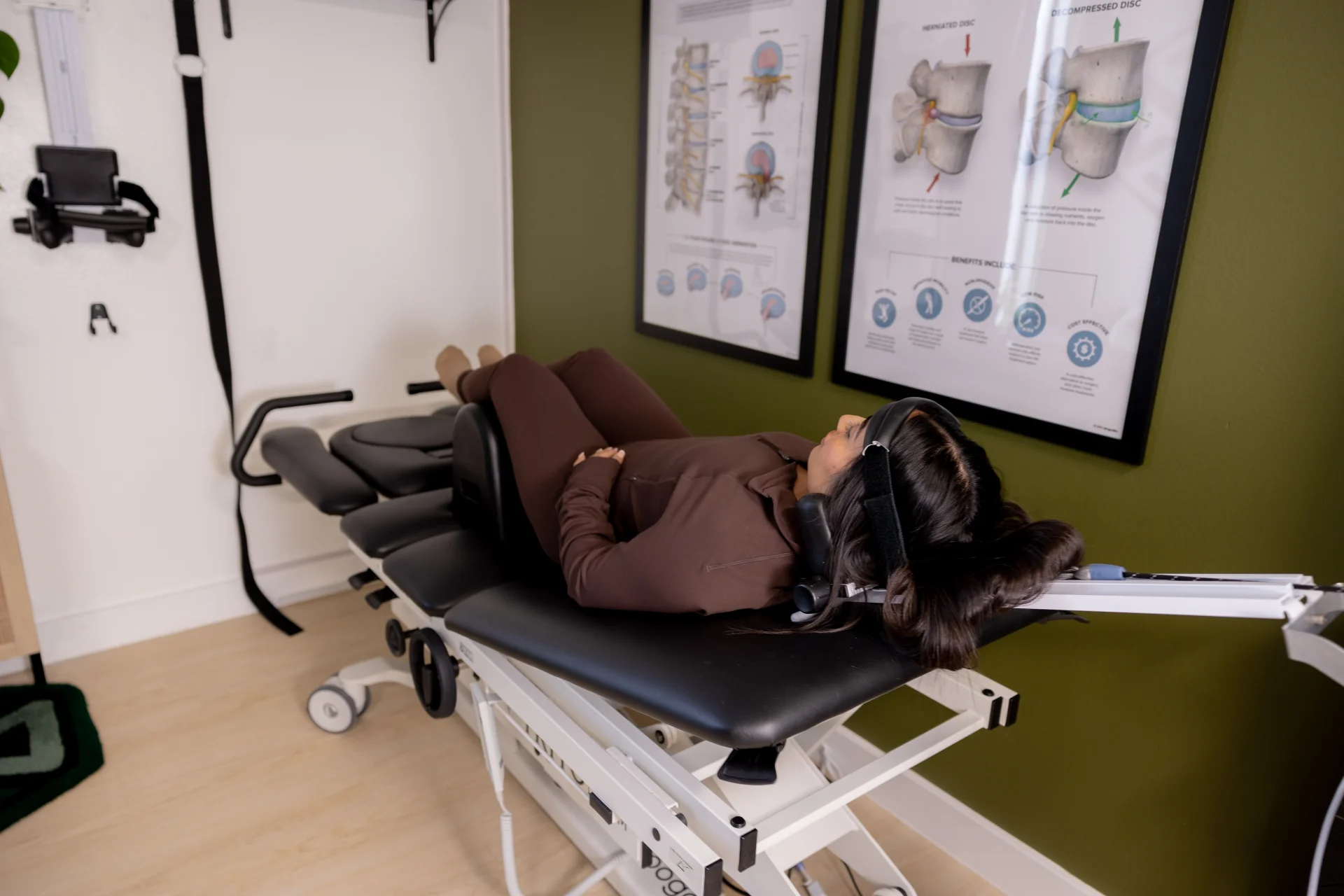
Lateral leg pain from L5, what looks like an IT band issue can be an L5 nerve root irritation referring laterally. A knee MRI looks clean. The lumbar disc is the actual driver. Spinal decompression therapy is one of our primary tools for that pattern.
Anterior shoulder pain from C5, supraspinatus and deltoid pain can refer from a C5 nerve root, especially after a whiplash mechanism. The shoulder MRI shows mild changes that don't account for the pain.
Lateral foot pain from S1, burning lateral foot pain in a runner that imaging cannot localize is sometimes an S1 distribution problem.
Screening the spine before treating the extremity is the difference between resolving the issue and chasing the wrong tissue for six months. Limitless Chiropractic screens both, every visit.
When to Come In for an Extremity-Specific Complaint
Reasonable Triggers for an Extremity Evaluation
Trigger
What's Going On
Joint hurts more than 2 to 3 weeks without improving
Past the natural recovery window for soft tissue
Pain limits a specific activity (lifting, running, sleeping on that side)
Mechanical pattern, not a passing strain
Prior chiropractor only adjusted your spine
The joint that hurts has never been touched
Surgery candidate diagnosis you'd like to evaluate non-surgically
Conservative care window before committing to a procedure
Injury from a fall, sport, or car accident not fully assessed
Hidden compensation patterns left over after the obvious injury healed
Hand or foot numbness, tingling, or weakness in a specific nerve distribution
Possible cervical or lumbar driver, needs a full screen
If the pain is sharp, sudden, and accompanied by trauma, swelling, deformity, or loss of function, get medical evaluation first. Chiropractic is not the right entry point for an obvious fracture or a torn ligament that requires surgical assessment.
How Limitless Chiropractic Approaches Extremity Work
The Limitless Chiropractic extremity protocol is built around three things: visit length, technique specificity, and full-body screening.
1.Visit length. First visits run 40 minutes. Follow-up visits are 10 minutes. This is not a 2 minute spinal pop, this is the visit length needed to actually evaluate and treat extremities. Volume-model practices cannot run this schedule, which is the entire reason extremity work doesn't happen there.
2.Technique specificity. Each extremity region has its own technique set. Shoulder work is different from elbow work which is different from wrist work. Dr. Scott Mitchell trained on extremity adjusting at the doctorate level and continues to add specific technique work for body regions where the literature evolves. Generic "extremity mobilization" is not the same thing.
3.Full-body screening. Every extremity exam at Limitless Chiropractic includes a cervical screen for upper-extremity cases and a lumbar screen for lower-extremity cases. Many extremity problems are upstream-driven. We look upstream every time, before we adjust the joint that hurts.
Pricing is transparent and cash-pay. Insurance does not consistently cover extremity adjusting in Texas, especially after deductibles and visit caps. We discuss the full plan up front so you know what care actually costs before you commit. See our 2026 cash-pay cost guide for the full pricing breakdown.
Frequently Asked Questions
Do chiropractors actually adjust extremities, or only the spine?
Chiropractors are trained and licensed to adjust spinal and extremity joints. Whether the chiropractor you visit actually does adjust extremities depends on the practice model. Volume practices that run 2 to 3 minute visits don't have time for extremity work. Cash-based practices like Limitless Chiropractic are built around the visit length needed to do it.
Can a chiropractor help my shoulder pain?
Yes, when the shoulder pain has a mechanical or nerve-driven component. Rotator cuff dysfunction, AC joint sprains, frozen shoulder, and impingement all respond to combined extremity adjusting and cervical work. Acute traumatic injuries (full rotator cuff tears, dislocations) need orthopedic assessment first.
Do chiropractors treat knee pain?
Yes for mechanical knee pain (patellar tracking, IT band, meniscus compensation, runner's knee). No as a first-line treatment for traumatic ligament tears (ACL, MCL) which need orthopedic evaluation. The knee work at Limitless Chiropractic includes hip and ankle screening because knee pain almost always has an upstream or downstream driver.
Can chiropractic fix carpal tunnel without surgery?
Many carpal tunnel cases resolve without surgical release when both the wrist and the cervical spine are addressed. Carpal tunnel often has a "double crush" component at C6-C7 that gets missed in a wrist-only evaluation. Severe, long-standing cases with thenar muscle atrophy may still need surgery.
How long is a typical extremity visit at Limitless Chiropractic?
First visit: 40 minutes including history, exam, imaging if indicated, and treatment. Follow-ups: 10 minutes. This is the visit length needed to evaluate the joint, screen the upstream drivers, and apply specific adjustments. Volume practices that run 2 to 3 minute visits cannot deliver this scope.
Does insurance cover extremity chiropractic work?
Coverage varies by carrier and plan, and most Texas plans either don't cover extremity adjusting or impose visit caps that won't sustain a full plan of care. We're cash-pay, transparent on pricing, and accept HSA and FSA cards. Most patients find that cash-pay extremity care is cheaper than the insurance route once deductibles and copays are factored in.
Should I see a chiropractor or a physical therapist for extremity pain?
Both can help, with different tools. Chiropractic is the right starting point when there's a clear joint mechanical issue or nerve driver. Physical therapy is the right starting point for muscle weakness, post-surgical rehab, or movement pattern retraining. Many cases benefit from both. See Chiropractor or Physical Therapist in Austin? Which Do You Need? for the full breakdown.
Get Your Extremity Issue Evaluated
A spine-only chiropractic visit is not going to address the joint that actually hurts. We built Limitless Chiropractic around the visit length, technique specificity, and full-body screening that extremity work requires.
Schedule a comprehensive extremity evaluation. We'll examine the joint, screen the upstream drivers, and walk you through a treatment plan with transparent pricing before you commit to anything.
Limitless Chiropractic | 2800 S I-35 Frontage Rd, Ste 175 | Austin, TX 78704 | Serving Downtown Austin, South Austin, Round Rock, Cedar Park, and Pflugerville
Dr. Scott Mitchell
About the author
Dr. Scott Mitchell, a Boston-accented chiropractor with a passion for holistic health,dedicates his life to helping people unlock their LIMITLESS potential through personalized chiropractic care.