You're building a recovery routine. You've already started layering in modalities: a sauna session a few times a week, maybe a cold plunge, red light therapy, compression boots after long runs. You've watched the podcasts. You've read the protocols. Some of it works. Some of it doesn't. And you're not entirely sure why.
Here's the part most Austin recovery routines miss. Every modality on the list (sauna, cold plunge, red light, PEMF, hyperbaric, compression, massage) interacts with a body that is structurally aligned, partly aligned, or out of alignment. The systemic intervention only lands as well as the structural foundation underneath it allows. People who are getting consistent chiropractic care benefit more from every other recovery modality they use, because the alignment is the substrate. Dr. Scott Mitchell calls it spinal hygiene. The framing is correct. You wouldn't expect the rest of your wellness routine to perform optimally on neglected dental hygiene. The same logic applies to the spine and nervous system.
This guide breaks down what each recovery modality actually does mechanistically, when it fits in your week, where to find each in Austin, and why the chiropractic layer is the one most people skip and most people miss the most when it isn't there.
Running a recovery stack in Austin and want to know where chiropractic fits? We evaluate alignment first, then advise.
Each recovery modality has a specific mechanism, not all interchangeable
You can match the tool to the situation instead of hoping volume substitutes for fit
Sequencing matters: when you do cold plunge vs sauna changes the result
Wrong order can cancel out the adaptation you were chasing
Chiropractic is the keystone modality, not another optional add-on
Spinal hygiene determines how well the rest of your routine performs
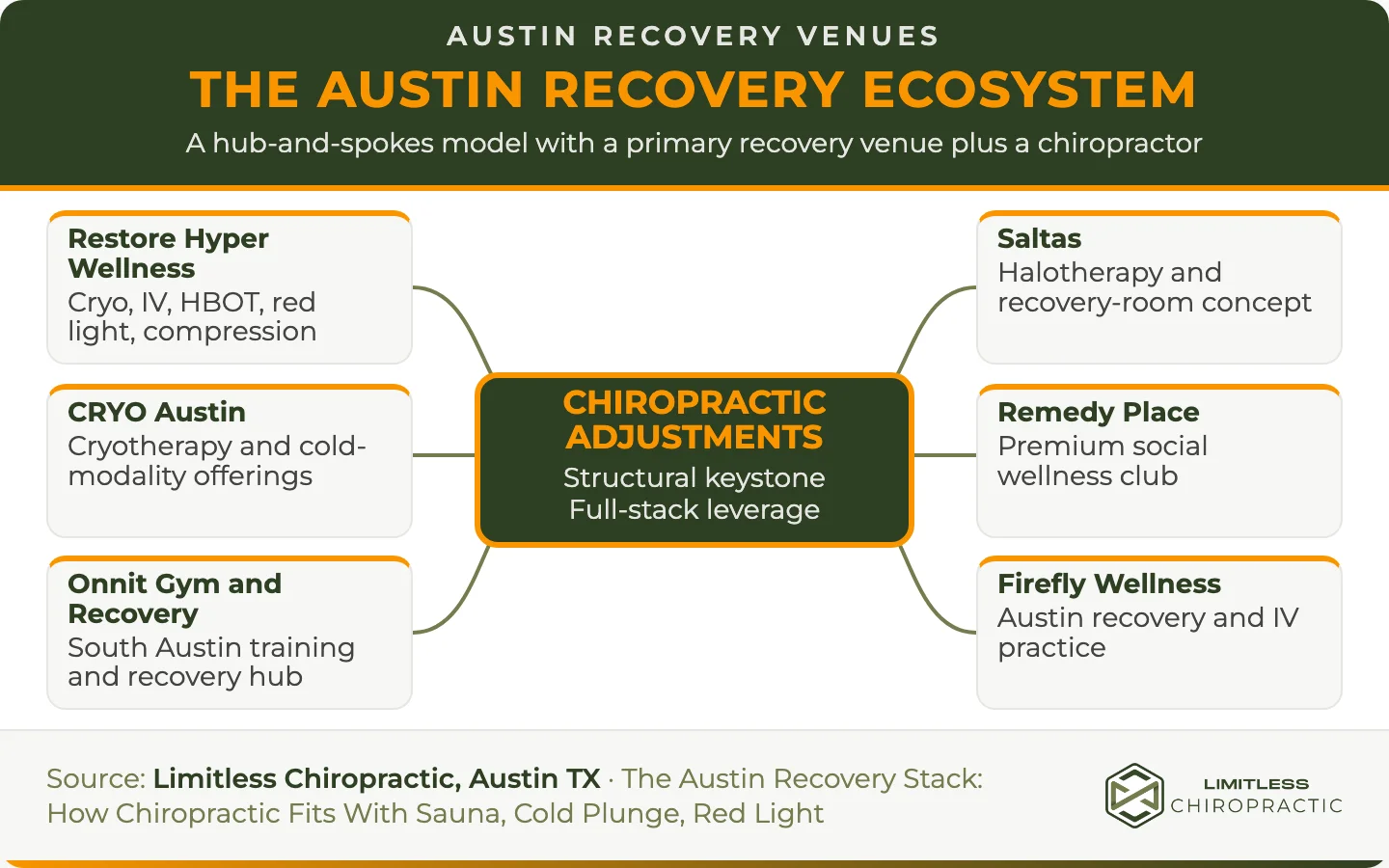
Austin has a deep recovery ecosystem (Restore, CRYO, Onnit, Saltas, Remedy, Firefly)
You don't need to build everything in your own home
Three sample weekly routines: desk worker, endurance athlete, strength athlete
A routine that fits your actual life is the one that compounds
Recovery-stack patients are usually cash-pay anyway
The economics of premium recovery already align with cash-pay chiropractic
Why Spinal Hygiene Is the Keystone
There's a small phrase Dr. Scott Mitchell uses with patients who are running a serious recovery stack: spinal hygiene. The idea is direct. You wouldn't run a high-output health routine on top of neglected dental hygiene and expect to feel your best. The same logic applies to the structural foundation everything else sits on.
When the spine is aligned, the autonomic nervous system runs cleaner. Sympathetic and parasympathetic tone balance more easily. Sleep quality improves. Heart rate variability moves up. The systemic interventions you're already using, sauna, cold plunge, red light, all of them, work on a body that responds appropriately to the input.
When the spine is misaligned, the same modalities still have effects, but those effects land on top of a nervous system that's already partly hijacked by mechanical irritation. Inflammation has a starting baseline that's higher than it should be. Recovery is asked to clean up two problems at once: the acute inflammation from training, plus the chronic inflammatory load from spinal dysfunction. People notice this as plateaus. The protocol that used to work stopped working. The recovery sessions that used to leave them feeling rebuilt now leave them feeling about the same.
"You wouldn't expect the rest of your wellness routine to perform optimally on neglected dental hygiene. The same logic applies to the spine and nervous system. Spinal hygiene is the substrate. Everything else is the layer on top."
— On the keystone role of structural alignment in a recovery stack
This is the leverage point. Get the structural foundation clean, and the rest of the stack delivers the result you were already paying for. That's the thesis of this entire article.
What Each Modality Actually Does
The recovery industry sells outcomes. The mechanisms get blurred. Here's what each modality actually does to your body, mechanistically, so you can match the tool to the situation.
Recovery Modality Mechanisms at a Glance
Modality
Primary Mechanism
Best For
Infrared sauna
Radiant heat, vasodilation, parasympathetic shift, heat shock protein expression
Infrared sauna delivers heat through radiant wavelengths that penetrate tissue more directly than conventional convection heat. The body responds with elevated core temperature, vasodilation, and a parasympathetic shift as the session progresses. Heat shock protein expression upregulates, which supports cellular repair and protein folding. Circulation improves systemically. For most people the felt experience is a deep, settled relaxation by the end of a 30 to 45 minute session.
Infrared is the modality of choice for nervous system downregulation, post-training parasympathetic recovery, and patients who don't tolerate the higher temperatures of traditional saunas well. It pairs cleanly with chiropractic care because the parasympathetic shift extends and deepens the post-adjustment relaxation response.
Traditional Sauna
Traditional Finnish-style saunas use convection heat, usually in the 170 to 200 degree range. Cardiovascular load goes up, heart rate climbs as if you were doing moderate exercise, and the body sweats heavily. The cardiovascular conditioning effect is real and well documented. Heat tolerance adapts over weeks. Endorphin release and norepinephrine modulation are part of the experience, which is why traditional sauna often pairs well with cold exposure to round out the autonomic swing.
Traditional sauna fits patients training for cardiovascular adaptation, anyone wanting the heat-tolerance training stimulus, and people who appreciate the higher-intensity session experience.
Cold Plunge and Cryotherapy
Cold immersion (whether tub, plunge, or cryotherapy chamber) drops skin and core temperature aggressively for short windows. Vasoconstriction is immediate. Norepinephrine spikes. Vagal tone activates as the body tries to manage the input. After the session, the rebound dilation and elevated alertness are part of why people use cold for mood and focus, not just inflammation.
The acute anti-inflammatory effect is debated in research. The autonomic-training effect is not. Used correctly, cold plunge is a tool for nervous-system resilience, mental clarity, and post-injury inflammation management when timed appropriately. Used badly, it can blunt training adaptations if done immediately after strength work.
Red Light and Photobiomodulation Therapy
Red light therapy (and the broader photobiomodulation category) uses specific wavelengths in the red and near-infrared spectrum to stimulate mitochondrial activity. The cytochrome c oxidase complex absorbs these wavelengths and increases ATP production. Soft tissue healing, skin quality, and inflammation modulation all show responses to consistent dosing.
Red light fits joint pain management, post-injury recovery, and patients dealing with skin or soft-tissue conditions. The dose response is real, which means under-dosing wastes the session and over-dosing has diminishing returns. Most therapeutic protocols sit in the 10 to 20 minute range, several times per week.
Compression Boots
Pneumatic compression boots cycle pressure through the legs to assist venous return and lymphatic drainage. The mechanical effect is real and immediate. Blood and lymph move out of the lower extremities, edema reduces, and the calf-pump function is augmented.
For runners, cyclists, and anyone with post-training leg fatigue, compression boots are a high-leverage tool. Sessions run 20 to 45 minutes. The honest framing: they don't accelerate tissue repair so much as restore circulation and reduce the perceived heaviness that delays return-to-training.
PEMF (Pulsed Electromagnetic Field)
PEMF delivers low-frequency electromagnetic pulses to tissue, which research suggests influences cellular voltage, ion exchange, and inflammatory signaling. Bone healing applications have the strongest evidence base. Soft-tissue and fatigue applications have growing but mixed evidence.
PEMF fits patients with chronic injury, slow-healing fractures, and athletes wanting an additional cellular-level recovery layer. Sessions are passive, which makes it easy to layer with other modalities (often run alongside red light).
Hyperbaric Oxygen Therapy
Hyperbaric oxygen therapy (HBOT) places the patient in a pressurized chamber and increases the partial pressure of oxygen dissolved in plasma. The effect is increased oxygen delivery to tissue, including tissue with compromised circulation. Concussion and TBI recovery are common applications. Wound healing and certain neurological conditions have strong evidence support.
HBOT is the highest-cost modality on this list, but for the right indication (post-concussion, slow-healing soft tissue, certain neurological conditions) it has a clinical effect that lower-tier modalities don't replicate. For Austin patients dealing with persistent post-accident symptoms, HBOT often layers with the structural work covered in our post-accident recovery guide.
Massage
Manual soft-tissue work releases adhesions, improves local circulation, downregulates the autonomic nervous system, and reduces pain perception. Different styles deliver different effects. Sports massage targets specific overload patterns. Myofascial work addresses fascial restriction. Deep-tissue work releases chronic adhesion. Lymphatic drainage moves fluid.
Massage pairs well with chiropractic care because it addresses the soft-tissue layer that chiropractic adjustments don't directly target. Combined, the soft-tissue work plus structural alignment produces a more complete result than either alone.
Chiropractic Adjustments (The Keystone)
Spinal and extremity adjustments restore joint mobility and alignment. The downstream effects on the autonomic nervous system are immediate and measurable. Heart rate variability often improves within the same visit. Sympathetic dominance reduces. Sleep, mood, and recovery markers respond over weeks of consistent care.
The reason chiropractic is the keystone, not another modality on the list: every other intervention on this page either works on a body that's structurally aligned or on a body that's compensating. The alignment determines whether you're spending your sauna session calming an already-clean nervous system, or spending it trying to dampen mechanical irritation that's still there when you walk out. Spinal hygiene is the substrate. Everything else is the layer on top. For deeper coverage on disc-related conditions where this principle compounds most, see our spinal decompression pillar guide. Extremity adjustments (shoulder, hip, knee, wrist) round out the structural picture; we cover them in detail in the extremity chiropractic adjustments guide.
Want a structural assessment to see where chiropractic fits in your existing recovery routine?
The single most common mistake we see in the Austin recovery population: cold plunge after every workout, including strength training, chasing the "anti-inflammatory" framing without understanding that for hypertrophy goals the same mechanism is working against the desired adaptation. Knowing what each modality does mechanistically lets you use it on purpose instead of by reflex.
Three Weekly Routines
The right routine is the one that fits your actual life. Three sample stacks: desk worker, endurance athlete, strength athlete. Adjust based on your training load and recovery capacity.
Weekly Recovery Stacks by Profile
Profile
Weekly Stack
Anchor
Desk worker (tech-neck, low back, sedentary)
Chiropractic 1-2x/wk, infrared sauna 2x, red light 3x, massage 2x/month
Chiropractic 1x/wk, massage weekly, sauna 2x, compression 2x, cold plunge 1-2x away from lifts, red light or PEMF layered
Chiropractic + soft tissue
The desk worker stack overlaps heavily with the patterns we cover in the chiropractic for millennials in fitness guide. The chiropractic anchor in every routine is intentional. It's not the variable you optimize last. It's the variable everything else compounds on top of.
Austin Recovery Venues Worth Knowing
Austin has one of the deepest recovery ecosystems of any U.S. metro. You don't need to build everything in your own home. A short list of the venues that consistently show up in patient stacks:
Restore Hyper Wellness: multiple Austin locations, broad modality menu (cryo, IV, HBOT, red light, compression).
CRYO Austin: focused cryotherapy and cold-modality offerings.
Onnit Gym and Recovery: South Austin training and recovery hub, the cultural anchor for the Austin wellness population.
Saltas (Salt Therapy): halotherapy and recovery-room concept.
Remedy Place: premium social wellness club with stack-style recovery experiences.
Firefly Wellness: established Austin recovery and IV practice with longstanding patient base.
You can build a strong recovery routine using any combination of the above. The point of the chiropractic layer at Limitless Chiropractic is that it's the structural anchor that makes whatever you're doing at those venues work harder, not a competitor to them.
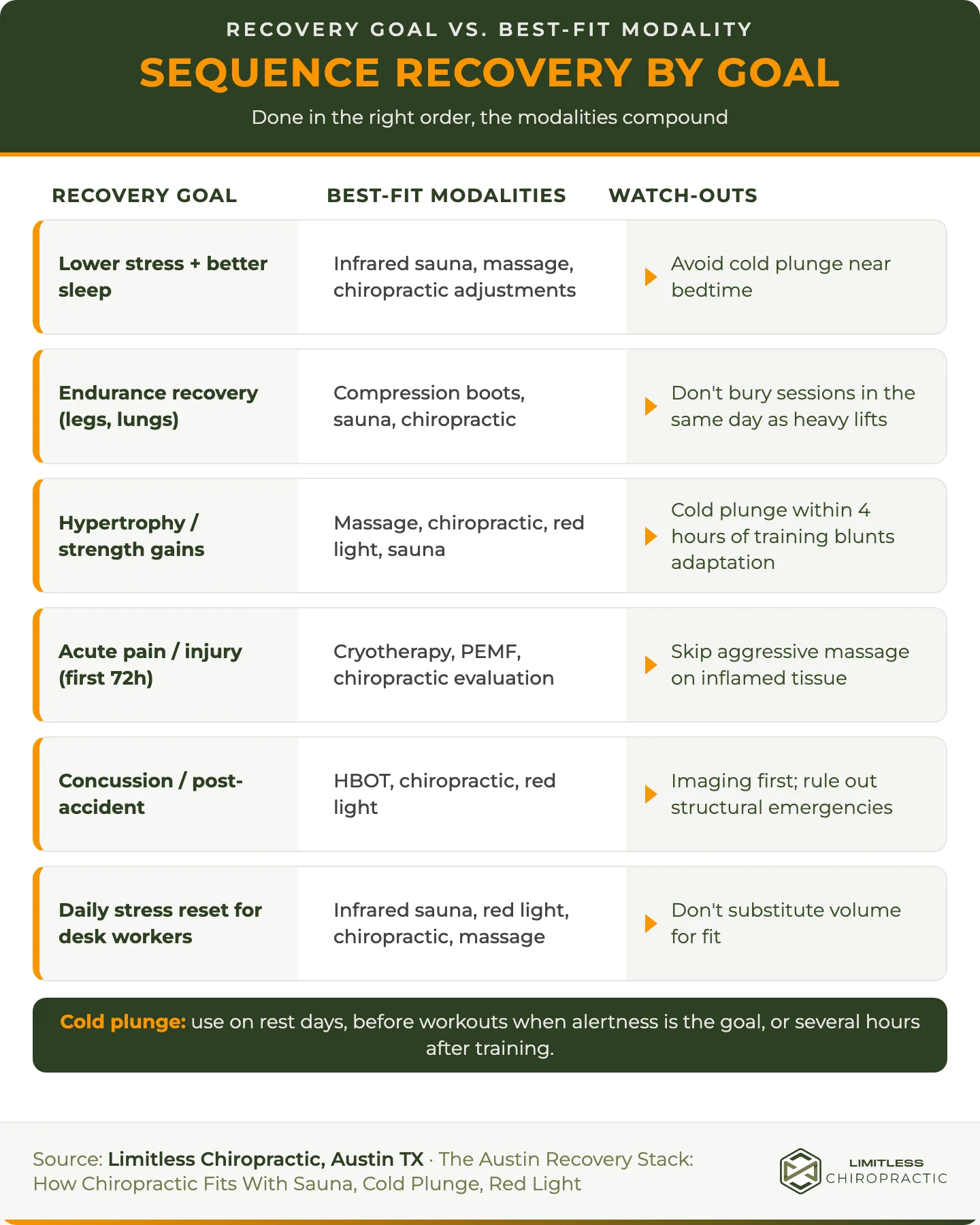
Recovery Goal vs. Best-Fit Modality
Recovery Goal
Best-Fit Modalities
Watch-Outs
Lower stress + better sleep
Infrared sauna, massage, chiropractic adjustments
Avoid cold plunge near bedtime
Endurance recovery (legs, lungs)
Compression boots, sauna, chiropractic
Don't bury sessions in the same day as heavy lifts
Hypertrophy / strength gains
Massage, chiropractic, red light, sauna
Cold plunge within 4 hours of training blunts adaptation
Acute pain / injury (first 72h)
Cryotherapy, PEMF, chiropractic evaluation
Skip aggressive massage on inflamed tissue
Concussion / post-accident
HBOT, chiropractic, red light
Imaging first; rule out structural emergencies
Daily stress reset for desk workers
Infrared sauna, red light, chiropractic, massage
Don't substitute volume for fit
The Cash-Pay Reality
There's an honest economic point in this conversation. The patients running serious recovery stacks are already, by definition, cash-pay healthcare consumers. Restore, CRYO, Onnit, Remedy, Saltas, and Firefly don't process insurance for recovery sessions. The economics of the recovery-stack lifestyle assume out-of-pocket spending on premium wellness.
The same population usually finds that cash-pay chiropractic care fits the same logic. Insurance coverage for chiropractic in Texas has been narrowing for years. Many plans cap visits at 12 to 20 per year, exclude decompression entirely, and put treatment decisions in the hands of a coverage adjuster instead of the practitioner. The patients who are already comfortable paying directly for high-quality recovery interventions usually find the cash-pay chiropractic model lines up with their preferences and gets them more thorough care.
What's the single highest-leverage modality if I had to pick one?
Chiropractic, by a meaningful margin, because every other modality on the stack performs better when the structural foundation is clean. The runner-up depends on training load. Compression boots for endurance, massage for strength, infrared sauna for sedentary stress.
Should I cold plunge after every workout?
No. Cold plunge after strength training in particular can blunt the hypertrophy adaptation. Use cold on rest days, before workouts when alertness is the goal, or several hours after training when the inflammation cascade is winding down.
How often should I see a chiropractor if I'm running a recovery stack?
Most patients running a serious stack benefit from weekly to bi-weekly visits during corrective phases, then monthly for maintenance. The exact cadence depends on training load, prior injury history, and how the spine is responding. We assess and adjust based on findings.
Is sauna or cold plunge better for inflammation?
Different mechanisms. Sauna upregulates heat shock proteins and improves circulation, which supports tissue repair over hours to days. Cold plunge produces immediate vasoconstriction and norepinephrine release, which manages acute inflammation in tighter windows. They're complements, not substitutes.
Can I get all of this at one place in Austin?
Some venues bundle most of the modalities (Restore is the closest to one-stop). Most patients use a hub-and-spokes model with a primary recovery venue plus a chiropractor. Limitless Chiropractic serves as the structural anchor for many of those stacks.
What's the cheapest entry point into a recovery stack?
Sauna and chiropractic. A home infrared blanket is in the $300 range one time. Chiropractic is per-visit. Skip the premium gear until the foundation is in place.
Does insurance cover any of this?
Generally no. Recovery-stack modalities are cash-pay across the board, and most chiropractic care in Austin is structured as cash-pay either by the clinic's choice or by the patient's insurance limitations.
Building Your Stack Around the Right Anchor
Recovery is one of the few categories where adding more isn't always the answer. Adding the right thing in the right order is. The framing that holds across every athlete and every desk worker we've worked with: get the structural layer right first, then layer the systemic interventions on top.
That's the spinal hygiene principle. The rest of your stack is the routine. The chiropractic layer is the substrate.
Limitless Chiropractic in Austin sees patients across the full range of recovery stacks, from elite endurance athletes to desk-bound tech workers to CrossFit competitors. We integrate with your existing routine, identify where alignment is the bottleneck, and build a care plan that complements what you're already doing at Restore, CRYO, Onnit, Saltas, Remedy, and Firefly.
The stack performs better when the spine is aligned. That's the leverage.
Limitless Chiropractic | 2800 S I-35 Frontage Rd, Ste 175 | Austin, TX 78704 | Serving Downtown Austin, South Austin, Round Rock, Cedar Park, and Pflugerville
Dr. Scott Mitchell
About the author
Dr. Scott Mitchell, a Boston-accented chiropractor with a passion for holistic health,dedicates his life to helping people unlock their LIMITLESS potential through personalized chiropractic care.