Most patients walking into a chiropractor's office with TMJ pain, migraines, or trigeminal neuralgia have already tried the obvious paths. They've seen a dentist for a bite guard. They've taken triptans, acetaminophen, prescription muscle relaxers. They've maybe been told it's stress and to meditate more. Some have had MRIs that came back normal, leaving them with a confirmed problem and no clear path forward.
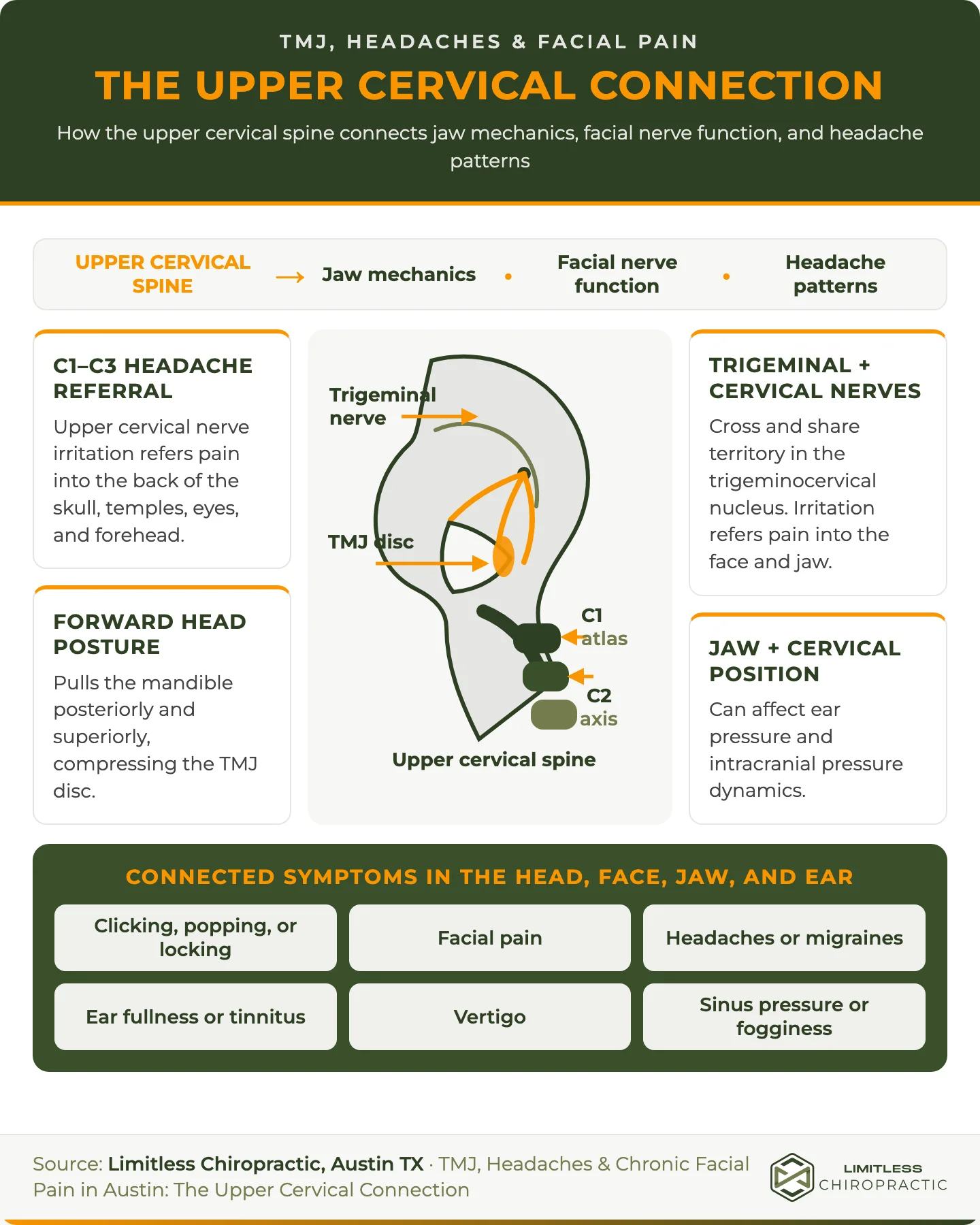
The pattern that explains most of these cases is the same one their ENT and dentist often miss: the upper cervical spine drives jaw mechanics, facial nerve function, and headache patterns more than almost any other structure in the body. When C1 (atlas) and C2 (axis) are misaligned, the jaw shifts, the trigeminal nerve gets irritated, blood flow and pressure dynamics in the head change, and pain shows up in places that don't seem related to the neck at all.
This guide explains what's happening upstream of the symptoms, why chiropractic care frequently produces dramatic relief where bite guards and medications fall short, and what treatment looks like at Limitless Chiropractic in Austin. Headaches and migraines get the deepest treatment in this article because they're one of the conditions our practice handles best.
If you're dealing with persistent TMJ pain, recurring headaches, migraine attacks, or facial pain in Austin, call (512) 999-6115 or book online. We'll evaluate your cervical spine, jaw, and cranial nerve function before recommending anything.
Persistent headaches, migraines, or TMJ pain in Austin? We evaluate the upper cervical spine before we treat the symptom.
TMJ pain, headaches, and trigeminal neuralgia often share a single upper cervical driver
One adjustment area can resolve symptoms three specialists couldn't
Cervicogenic headaches are misdiagnosed as migraines or tension headaches in most patients
The wrong diagnosis produces years of medication that wasn't going to work
Migraine frequency and intensity often drop when the upper cervical spine is corrected
This is one of the conditions chiropractic care handles best
Chiropractic adjustments change ear pressure and intracranial pressure in measurable ways
The mechanism explains why TMJ, vertigo, and headache resolve together
C1 and C2 misalignment irritates the trigeminal nerve directly
Facial pain that doesn't respond to neurology often resolves with cervical care
Limitless Chiropractic treats the upper cervical spine, jaw, cranial bones, and ears as one system
Patients get one coordinated treatment plan, not three referrals
Headaches and Migraines: One of the Conditions Limitless Chiropractic Handles Best
Headache and migraine work is the largest section of this article on purpose. It's one of the things our practice handles best, and the gap between what most patients try first and what actually works for them is wide.
The Three Headache Types Chiropractic Care Resolves
Headaches are not a single condition. They have different generators, and chiropractic care addresses some of them better than any other modality.
Cervicogenic headaches. These originate from the cervical spine, specifically the C1 to C3 vertebrae. The greater occipital nerve, lesser occipital nerve, and third occipital nerve all exit from this region and refer pain into the back of the skull, the temples, the eyes, and sometimes the forehead. When upper cervical vertebrae are misaligned or fixated, these nerves get irritated mechanically, and the result is a headache that medication cannot reach. Cervicogenic headaches respond directly to upper cervical adjustments because the adjustment removes the mechanical source of the nerve irritation.
Tension-type headaches. Tension headaches involve sustained muscle contraction in the upper trapezius, suboccipitals, and temporalis muscles. These muscles attach to the cervical spine and the skull. When alignment is off, they fire constantly to compensate, producing the band-around-the-head pressure that defines tension headaches. Adjustments unload the chronic compensation, soft tissue work releases the muscle holding pattern, and the headache pattern breaks.
Migraines. Migraines are more complex, with vascular, neurological, and inflammatory components. But the cervical contribution to migraine is real and underdiagnosed. Many patients with diagnosed migraines actually have a cervicogenic component driving frequency, intensity, or both. When the upper cervical spine is corrected, migraine frequency typically drops, intensity reduces, and the medication burden goes down. For some patients, full migraine resolution is possible. For others, the pattern shifts from disabling to manageable. Either way, addressing the cervical component is one of the highest-leverage interventions available.
Three Headache Types and the Chiropractic Response
Headache Type
Where It Comes From
Why Chiropractic Reaches It
Cervicogenic
C1–C3 vertebral irritation of the greater, lesser, and third occipital nerves
Adjustment removes the mechanical source of nerve irritation
Tension-type
Sustained contraction of upper trapezius, suboccipitals, and temporalis muscles
Adjustments unload the compensation; soft tissue breaks the holding pattern
Migraine
Vascular, neurological, and inflammatory drivers, often with a cervicogenic component
Correcting the upper cervical contribution typically drops frequency and intensity
Why Most Headache Patients Have Tried the Wrong Things First
The standard medical pathway for chronic headaches looks like this: over-the-counter pain medication, then prescription pain medication, then a trigger-point injection or Botox, then a referral to neurology for migraine prevention drugs. Each step targets the symptom, not the source.
If the source is mechanical (cervical misalignment, soft tissue restriction, postural strain), no amount of medication will fix it long-term. The pain returns as soon as medication wears off because the structural problem is still there. This is not a failure of medicine. It's a mismatch between diagnosis and actual driver. The first time many patients realize chiropractic could help is when a friend mentions getting their headaches resolved through cervical care.
What the Chiropractic Approach Looks Like for Headaches
A chiropractic approach to headaches is not a single adjustment. It's a structured evaluation followed by a treatment plan that addresses the structural drivers.
The evaluation includes a detailed history (when headaches started, frequency, triggers, character of pain, prior treatments), a postural and movement assessment, palpation of the cervical spine for misalignment and restriction, neurological screening (cranial nerve function, reflex testing, sensation), and digital X-rays in-house when imaging is indicated. The X-rays show whether the cervical curve has been lost, whether vertebrae have shifted, and whether degenerative changes are contributing to the pattern.
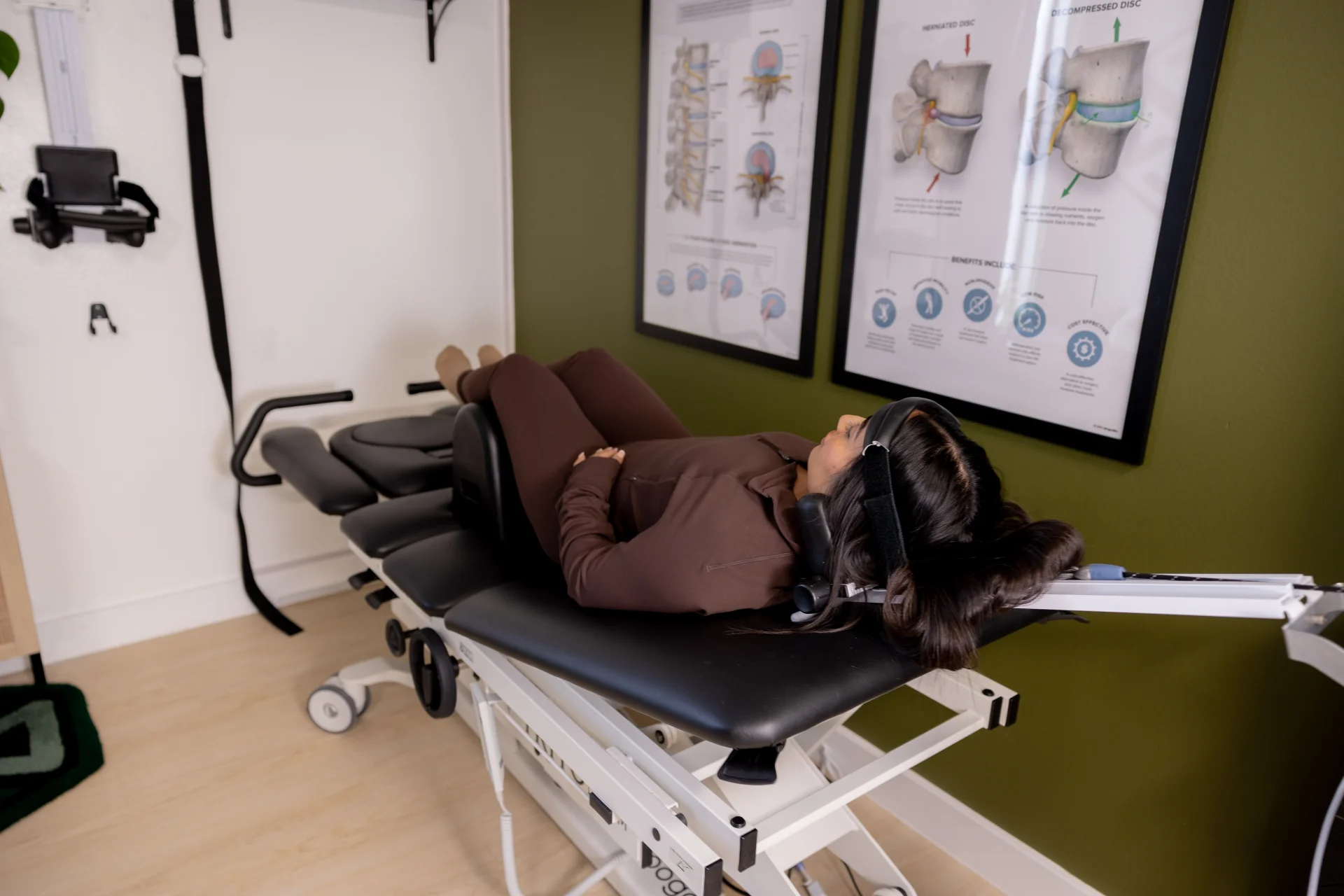
Treatment combines specific upper cervical adjustments, soft tissue work for the suboccipitals and temporalis muscles, postural correction (because forward head posture is one of the biggest drivers of cervicogenic headache), and home protocols that prevent the pattern from coming back. For chronic migraine patients, the treatment plan runs over several weeks and tracks frequency and intensity rather than expecting one-visit resolution.
Two migraine subtypes deserve specific mention because they map closely to upper cervical work:
Vestibular migraines. These produce vertigo and balance disturbance alongside or instead of head pain. The vestibular system sits in the upper cervical region and integrates with proprioceptive input from C1 and C2. When that input is faulty, the brain receives conflicting signals about head position, and migraine attacks with vertigo can result. Upper cervical correction often produces dramatic reduction in attack frequency.
Basilar migraines. These involve the basilar artery and produce neurological symptoms (vision changes, slurred speech, balance issues) along with head pain. They are less common but more debilitating. The cervical spine plays a structural role in basilar artery dynamics, and careful upper cervical work can be part of the treatment plan when neurology has cleared the patient for chiropractic care.
In both subtypes, co-management with neurology is appropriate. Limitless Chiropractic coordinates referrals when indicated and works alongside neurology rather than replacing it.
TMJ Anatomy and the Jaw-Neck Connection
The temporomandibular joint is a complex structure: a hinge and slide joint where the mandible (lower jaw) meets the temporal bone of the skull, with a cartilage disc between the two surfaces and ligaments stabilizing the joint capsule. Surrounding muscles (masseter, temporalis, pterygoids) move the jaw for chewing, talking, and swallowing.
The joint itself is surprisingly small for the load it carries. Every meal, every conversation, every swallow loads the TMJ thousands of times per day. When the joint is healthy, that load is distributed evenly across the disc and the cartilage surfaces. When the disc displaces, the joint capsule inflames, or the muscles fire asymmetrically, the result is the cluster of symptoms that define TMJ dysfunction: clicking, popping, locking, facial pain, headaches, and ear discomfort.
Why C1 and C2 Drive Jaw Mechanics
Most TMJ treatment focuses on the joint itself: bite guards to stop grinding, jaw exercises, occasionally surgery in severe cases. What it usually misses is upstream.
The upper cervical spine and the jaw share neurological and mechanical real estate. The trigeminal nerve, which provides sensation and motor function to the face and jaw, has its origin in the brainstem at the level of the upper cervical spine. The branches of the trigeminal nerve and the upper cervical nerves cross and share territory in a region called the trigeminocervical nucleus. When upper cervical vertebrae are misaligned, irritation in that nucleus produces referred pain into the face and jaw, and motor signals to the jaw muscles get distorted.
Mechanically, the position of the head on the upper cervical spine sets the resting position of the jaw. Forward head posture pulls the mandible posteriorly and superiorly, compressing the TMJ disc. Lateral cervical misalignment causes asymmetric jaw mechanics. Patients with chronic TMJ pain almost always have measurable cervical alignment issues, and addressing the cervical issues is often the missing piece in their treatment. Tech workers and desk-bound patients run particularly high risk; the postural pattern that produces TMJ overlap is covered in Chiropractic for Tech Workers: Ergonomics & Spinal Health.
What TMJ Symptoms Actually Tell You
What Your TMJ Symptoms Tell You
Symptom
What's Likely Happening
Treatment Direction
Clicking without pain
Disc is displaced but reducing during opening
Postural and cervical correction usually sufficient
Clicking with pain
Disc displacement plus capsule inflammation
Combined cervical, jaw, and soft tissue work
Locking (open or closed)
Disc dislocation that does not reduce
Hands-on disc reduction plus cervical correction
Ear pressure or fullness
Eustachian tube dysfunction from jaw or cervical drivers
Combined cervical and cranial work
Facial pain
Trigeminal nerve irritation from cervical or cranial source
Upper cervical adjustment plus cranial assessment
Chewing fatigue
Muscle imbalance from compensation
Soft tissue plus alignment correction
If your TMJ pain or headaches haven't budged with the obvious treatments, the upper cervical spine is usually the missing piece.
How Chiropractic Care Changes Ear Pressure and Intracranial Pressure
This is the mechanism most patients never hear about. It explains why TMJ, vertigo, ear fullness, and headache so often resolve together with chiropractic care.
Dr. Scott Mitchell on the Pressure Mechanism
"Chiropractic care produces measurable changes in ear pressure as well as intracranial pressure, whether we're adjusting the cervical spine, the cranial bones, the TMJ, or even the ears themselves. The structures of the head are not isolated. They share fascia, blood supply, lymphatic drainage, and neurological pathways. When you change the position of the cervical spine, you change the dynamics of fluid drainage from the head. When you adjust a cranial bone, you change the position of the dural membranes that compartmentalize the brain. When you address the TMJ, you change the tension in the temporal bone, which sits next to the inner ear. These are not separate treatments hitting separate problems. They're a single system being adjusted as a system."
— Dr. Scott Mitchell, Limitless Chiropractic
What This Means Clinically
Cerebrospinal fluid (CSF) drains from the cranium through pathways that pass through the upper cervical region. Venous blood returns through the jugular system, influenced by cervical position. The eustachian tube connects the middle ear to the throat and is mechanically affected by jaw and cervical position.
When any of those structures is misaligned or restricted, pressure dynamics shift. Patients experience this as ear fullness, ringing (tinnitus), vertigo, sinus pressure, pressure-type headaches, or "fogginess" without obvious neurological explanation.
Chiropractic care addressing the cervical spine, cranial bones, TMJ, and the ear itself can change those pressure dynamics in measurable ways. The result is symptom relief that often surprises patients because it doesn't fit the model they came in with. They came in for headache, and the ear pressure they had been ignoring for years also resolved. They came in for TMJ pain, and the tinnitus that nobody could explain quieted down. The system is connected, so the treatment hits the system.
Trigeminal Neuralgia and Cranial Nerve Involvement
Trigeminal neuralgia is one of the most painful conditions in clinical medicine. Sharp, electric-shock-like pain on one side of the face, often triggered by light touch, eating, or talking. Standard treatment is medication (carbamazepine, gabapentin) and, in severe cases, surgery (microvascular decompression). Both options come with significant downsides.
The trigeminal nerve has three major branches (ophthalmic, maxillary, mandibular) and a complex relationship with the upper cervical spine through the trigeminocervical nucleus described earlier. While trigeminal neuralgia has multiple causes (vascular compression of the nerve root, multiple sclerosis, tumor, post-herpetic neuropathy), a meaningful subset of patients have a cervical contribution that responds to chiropractic care.
This does not mean chiropractic replaces neurology consultation for trigeminal neuralgia. It means cervical and cranial work belong in the conversation alongside medical management. Patients with confirmed trigeminal neuralgia who add chiropractic care often see reduction in attack frequency or intensity, which can mean lower medication doses and better quality of life. We coordinate with neurology when patients are under active medical management. Patients dealing with concurrent neurogenic upper-extremity symptoms (numbness, tingling into the arm or hand) should also read Thoracic Outlet Syndrome: Causes & Treatment, which often shows up in the same cervical-driven cluster.
When Co-Management with Dental, ENT, or Neurology Is Indicated
Chiropractic care is not the right starting point for every TMJ, headache, or facial pain patient. We refer out when:
The TMJ pain is driven by a malocclusion or tooth alignment issue that requires dental or orthodontic correction
A bite guard (occlusal splint) is clinically indicated for nighttime grinding (bruxism) that is destroying tooth structure
Headache patterns include red flags suggesting secondary causes (sudden severe onset, fever, vision loss, neurological deficits) that require emergency evaluation
Sinus or ear infections need medical management before mechanical work
Trigeminal neuralgia hasn't been evaluated by neurology to rule out vascular compression or other neurological causes
Cluster headaches or other primary headache disorders need pharmacological co-management
Co-management is the rule, not the exception, for the more complex cases. Patients are best served when the dental, medical, and chiropractic teams talk to each other.
Who We Refer Out and Who We Co-Manage
Presentation
Specialist
Chiropractic Role
Malocclusion or bite alignment driver
Dentist or orthodontist
Cervical and postural support alongside dental work
Co-manage once vascular and neurological causes ruled out
Cluster or primary headache disorder
Neurology
Pharmacological co-management with cervical support
The Upper Cervical Protocol at Limitless Chiropractic
Treatment at Limitless Chiropractic follows a structured protocol that addresses the full system rather than chasing symptoms.
Comprehensive evaluation. Health history, postural assessment, cervical range of motion, palpation, neurological screening (cranial nerves, reflexes, sensation), and digital X-rays in-house when imaging is indicated. We confirm the cervical contribution before treating it.
Specific upper cervical adjustments. Targeted work on C1, C2, and C3 using techniques calibrated to the individual patient. Force, vector, and frequency are matched to the clinical findings, not delivered as a one-size-fits-one approach.
Cranial and TMJ work as needed. When the exam shows cranial bone restriction or TMJ involvement, we add cranial and jaw work to the protocol. Cranial Facial Release (CFR) is available as an adjunct service for patients whose presentation calls for it. CFR is not the editorial focus of standard chiropractic care, but the option exists at our office for patients who need it.
Soft tissue and postural correction. Suboccipital and temporalis release, postural retraining for forward head posture, and home exercises that prevent the pattern from coming back.
Progress tracking. Re-examinations measure objective changes (cervical range of motion, neurological findings) alongside subjective improvements (headache frequency, TMJ pain, ear pressure). The plan adjusts based on response.
For patients with overlapping conditions, the same treatment session may address cervical alignment, TMJ mechanics, and cranial work. One coordinated plan is more efficient and clinically more effective than three separate referrals. Where chiropractic care fits inside a broader recovery routine, see The Austin Recovery Stack. Cost expectations for this kind of care plan are mapped out in the Austin Cash-Pay Cost Guide.
What Treatment Looks Like Over Time
Treatment Timeline at Limitless Chiropractic
Phase
Sessions
What's Happening
Initial relief
1–6
Acute symptom reduction. Headache frequency typically drops first. TMJ pain begins to ease.
Corrective
7–16
Structural changes consolidate. Cervical curve restoration begins. Migraine frequency continues to drop.
Stabilization
17+
Maintenance frequency tapers to weekly, then monthly as patterns stabilize.
Most patients notice meaningful headache reduction within the first 4 to 6 sessions. TMJ symptoms (clicking, locking) often improve over 8 to 12 sessions as the joint capsule calms down and the disc finds a more stable position. Trigeminal neuralgia patients on co-management with neurology typically track attack frequency over weeks to months.
Patients who have been in a motor vehicle accident often present with concurrent whiplash, cervicogenic headache, and TMJ pain. The recovery sequence and PIP-compatible care path for that population is mapped out in the Austin Personal Injury Chiropractor Hub.
Frequently Asked Questions
Can a chiropractor help with migraines?
Yes. Many patients with diagnosed migraines have a cervicogenic component driving frequency or intensity. Upper cervical adjustments often reduce migraine frequency and severity, sometimes dramatically. This is one of the conditions chiropractic care handles best, and it is one of the most common reasons new patients come into our office.
Will chiropractic adjustments help my TMJ pain?
Often, yes. TMJ dysfunction frequently has an upper cervical driver that bite guards alone cannot address. The combination of cervical correction, TMJ work, and soft tissue release resolves a lot of TMJ cases that didn't respond to dental treatment alone.
What causes ear pressure during or after chiropractic care?
Cervical adjustments and cranial work change pressure dynamics in the head, including the eustachian tube and inner ear. Most patients who notice ear pressure changes during chiropractic care experience it as a normalization of pressure that had been chronically off, not as a new problem. If ear symptoms increase rather than improve, we adjust the protocol.
Is chiropractic safe for trigeminal neuralgia?
For most patients, yes, and it can meaningfully reduce attack frequency. We coordinate with neurology when patients are under active medical management, and we screen for red flags before treating.
What's the difference between cervicogenic headaches and migraines?
Cervicogenic headaches originate from cervical spine structures (vertebrae, joints, muscles, nerves) and refer pain into the head. Migraines have vascular and neurological components and present with throbbing pain, often unilateral, sometimes with aura, nausea, or light sensitivity. The two can overlap, and many patients have both contributing to their headache pattern.
Can chiropractic care help with vertigo or dizziness?
Yes, especially when the vertigo originates from upper cervical dysfunction or vestibular migraine. Proprioceptive input from C1 and C2 feeds into the vestibular system. When that input is faulty, the brain receives mixed signals about head position and produces vertigo. Cervical correction restores the input.
Do you offer Cranial Facial Release at Limitless Chiropractic?
Yes, CFR is available as an adjunct service for patients whose presentation calls for it. For most TMJ, headache, and facial pain patients, standard chiropractic care addressing the cervical spine, jaw, and cranial system is the primary treatment. CFR is added when clinically indicated, not as the default.
How long until I notice headache improvement?
Most patients notice meaningful reduction in headache frequency within the first 4 to 6 sessions. Migraine patterns often take longer to shift because they have multiple drivers, but reduction in frequency typically appears within the first month of consistent treatment.
Schedule Your Evaluation in Austin
You don't have to live with chronic headaches, persistent TMJ pain, or facial pain that nobody can explain. The upper cervical spine drives a lot more head and face symptoms than most patients realize, and addressing it directly is one of the highest-leverage interventions available.
Call (512) 999-6115 or book online to schedule your evaluation at Limitless Chiropractic. We'll review your history, assess your cervical spine and jaw, take digital X-rays in-house when indicated, and tell you whether the pattern we're seeing matches what chiropractic care can address.
Same-day appointments often available · New patient first-visit special $97
The pain has a source. The source is more often the upper cervical spine than most patients are ever told.
Limitless Chiropractic | 2800 S I-35 Frontage Rd, Ste 175 | Austin, TX 78704 | Serving Downtown Austin, South Austin, Round Rock, Cedar Park, and Pflugerville
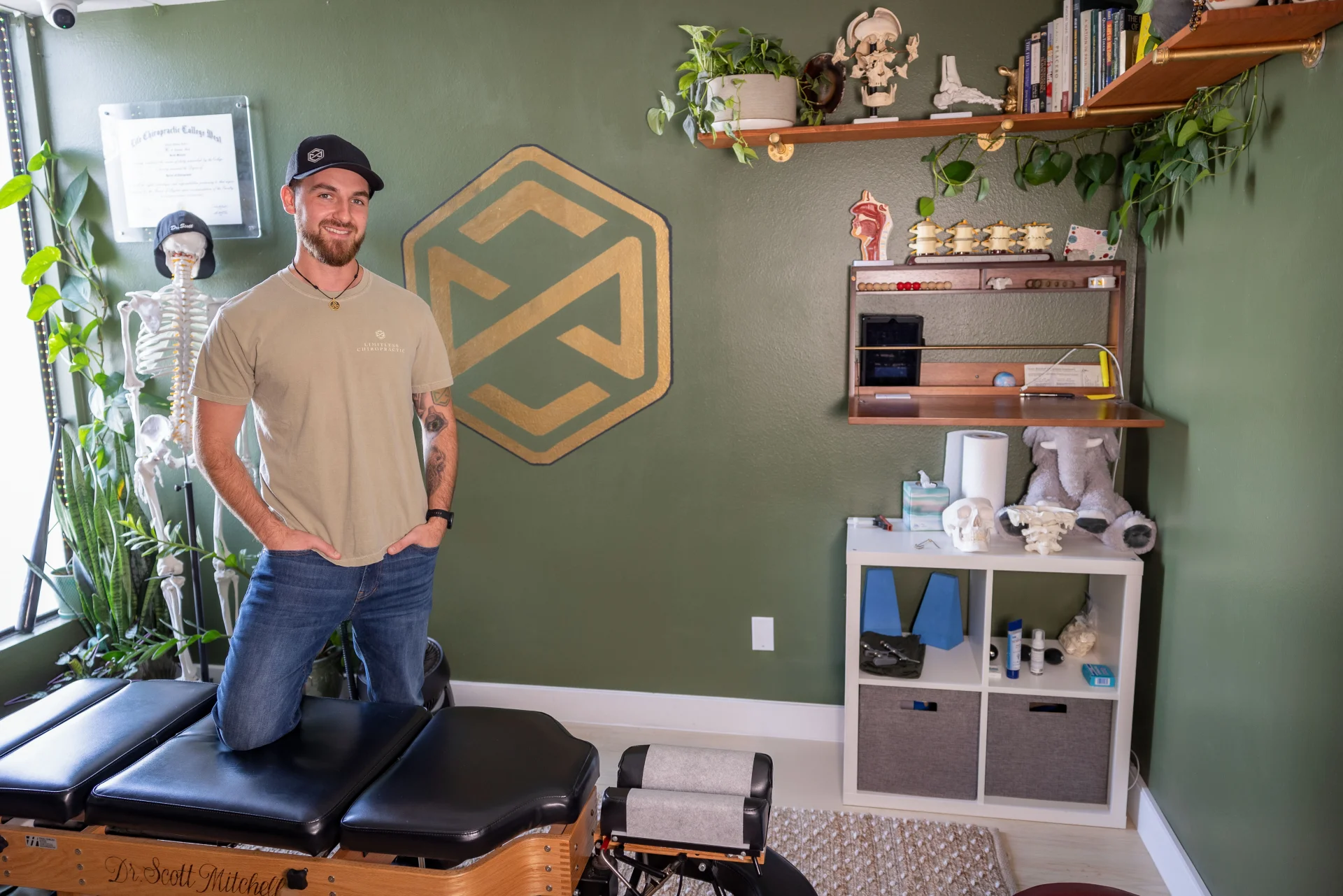
Dr. Scott Mitchell
About the author
Dr. Scott Mitchell, a Boston-accented chiropractor with a passion for holistic health,dedicates his life to helping people unlock their LIMITLESS potential through personalized chiropractic care.