Forward Head Posture: How It Affects Breathing, Sleep & Brain
What if your posture was slowly suffocating your body's ability to perform, recover, and stay calm? For millions of Americans hunched over screens, steering wheels, and smartphones, forward head posture isn't just causing neck pain. It's physically restricting airway space, limiting oxygen flow, and compromising brain function. This modern postural pattern creates a cascade of health issues that extends far beyond musculoskeletal discomfort, affecting sleep quality, cognitive performance, and overall vitality.
Forward head posture has become the defining postural dysfunction of the digital age. As technology dominates work and leisure, millions spend hours each day with their heads tilted forward, unknowingly compromising their respiratory system. Unlike simple neck pain that can be dismissed as minor discomfort, forward head posture creates structural changes that physically restrict the space available for breathing.
The average American now spends over seven hours per day looking at screens, with the head positioned forward and downward. That chronic positioning produces adaptations in the cervical spine, surrounding musculature, and, critically, the airway itself. The result is a population struggling with shallow breathing, disrupted sleep, persistent fatigue, and cognitive fog, often without recognizing that posture is the underlying culprit. For desk-based professionals in particular, the tech worker chiropractic guide explains why this single mechanical pattern produces so many seemingly unrelated symptoms.
Notice the connection? Shallow breathing, snoring, brain fog, and chronic neck tension often share one structural source. We screen for it before recommending care.
Imaging-based assessment. We tell you whether your posture is the problem.
How Forward Head Posture Shifts Your Anatomy
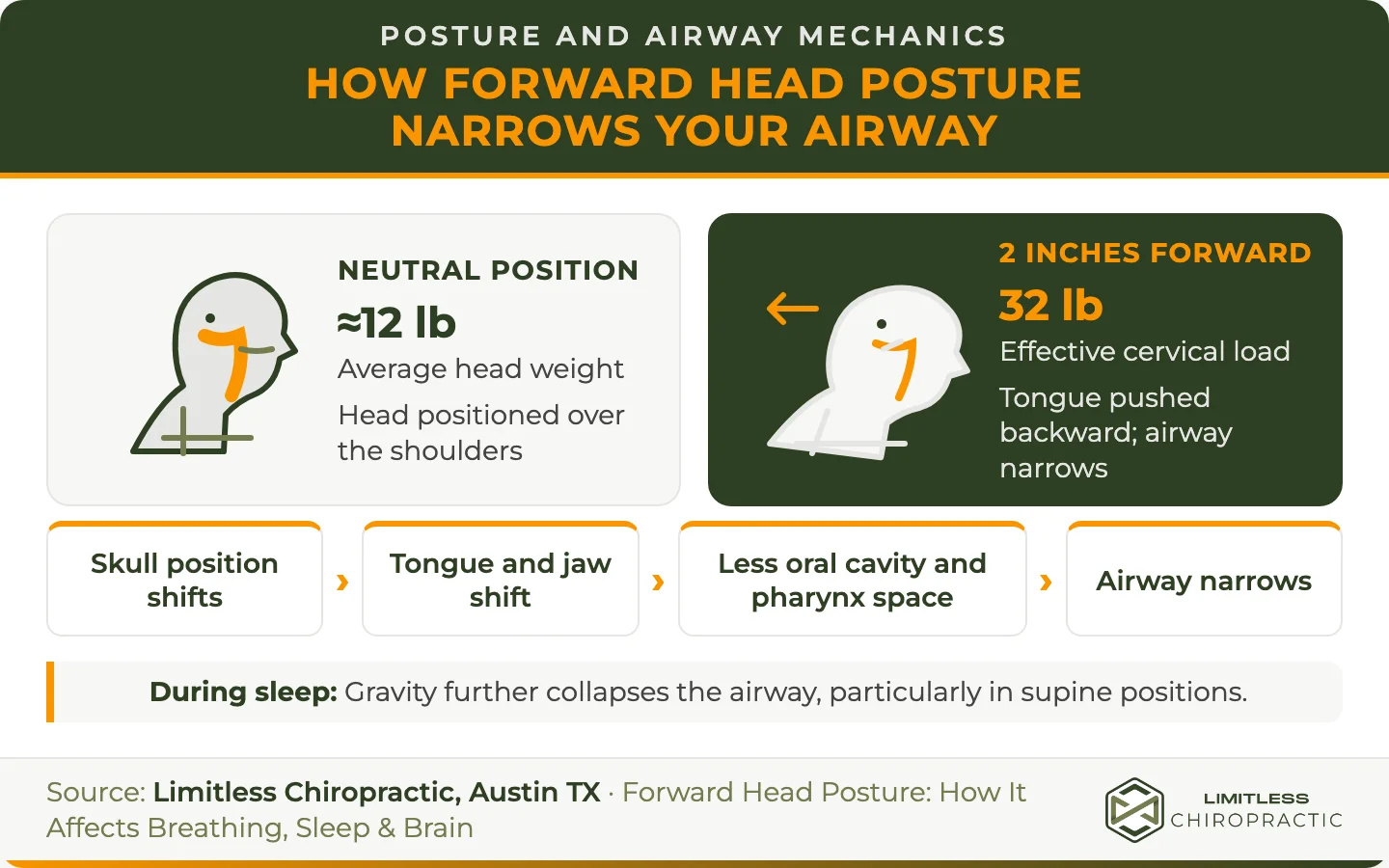
The relationship between head position and airway function is both profound and measurable. When your head moves forward from its ideal position over your shoulders, it triggers a chain reaction. The skull's position shifts, which alters the position of your tongue and jaw. That displacement reduces the space available in your oral cavity and pharynx: the critical passageways that air must travel through to reach your lungs.
Your tongue, which should rest comfortably against the roof of your mouth, gets pushed backward when the head protrudes forward. The backward displacement narrows your airway and can partially obstruct airflow during breathing and sleep. Studies published in the Journal of Physical Therapy Science have documented measurable reductions in airway size correlated directly with the degree of forward head posture.
The Weight on Your Cervical Spine
The biomechanical stress is staggering. Research consistently demonstrates that for every inch your head moves forward from its ideal position, it adds an additional 10 pounds of stress to your cervical spine and supporting structures.
The average human head weighs approximately 12 pounds in neutral position. With just two inches of forward head posture (a common finding in office workers and smartphone users), the effective weight on the cervical spine increases to 32 pounds. At three inches forward, your neck muscles and spine support over 42 pounds of load. That is the equivalent of carrying a bowling ball on your shoulders throughout every waking hour.
Restricted Tongue Space and Mouth Breathing
The compression and crowding from forward head posture forces many people into chronic mouth-breathing patterns. When nasal passages and the posterior airway become restricted, the body compensates by opening the mouth to increase air intake. While that provides temporary relief, mouth breathing bypasses the natural filtration, warming, and humidification processes that occur when breathing through the nose.
Forward head posture also restricts thoracic movement: the bony structure housing your lungs. The altered biomechanics reduce diaphragm efficiency and force overreliance on accessory respiratory muscles in the neck and shoulders. Those smaller muscles weren't designed for primary breathing function, leading to rapid fatigue and reduced breathing capacity.
How Poor Posture Affects Breathing and Sleep
The connection between posture, breathing mechanics, and sleep quality creates a destructive cycle that compounds over time. Anyone experiencing unexplained fatigue, poor sleep, or morning grogginess should understand this relationship before reaching for another stimulant.
The Chain Reaction to Sleep Apnea
When your head tilts forward during the day, the postural pattern often persists during sleep. The anatomical changes (reduced airway space, posterior tongue position, and compressed throat structures) become even more problematic when you lie down. Gravity further collapses the airway, particularly in supine positions.
This mechanical obstruction triggers shallow breathing patterns and can lead to sleep-disordered breathing, including obstructive sleep apnea. Research has established clear links between forward head posture and increased snoring, with the postural dysfunction identified as a contributing factor to nocturnal breathing obstruction.
A 2024 study published in Nature found that forward head posture with a craniovertebral angle less than 48 degrees adversely impacts both pulmonary capacity and cardiorespiratory fitness. The morphological changes create measurable deficits in vital capacity, forced vital capacity, and diaphragmatic movement.
Oxygen Restriction Through the Night
When the airway becomes restricted during sleep, oxygen saturation drops throughout the night. Repeated dips in blood oxygen prevent the body from reaching the deep, restorative sleep stages necessary for cellular repair, memory consolidation, and cognitive processing.
The brain is particularly vulnerable. Representing only 2% of body weight but consuming 20% of the body's oxygen supply, even small reductions in delivery create noticeable cognitive effects. Limited oxygen manifests as brain fog, headaches, anxiety, difficulty concentrating, and impaired decision-making: symptoms many attribute to stress or aging when the root cause is structural.
The Domino Effect on Brain and Body
Oxygen restriction from compromised breathing creates system-wide dysfunction. The impact extends far beyond respiratory symptoms to influence brain function, physical performance, hormonal balance, and energy levels.
Impact on Brain Function
Your brain requires constant, adequate oxygen delivery to maintain optimal function. When breathing is compromised by postural dysfunction, cognitive performance suffers. Mental fog, difficulty with focus, impaired memory, and increased anxiety are common manifestations of chronic low-grade oxygen deprivation.
Headaches and migraines frequently accompany forward head posture, both from muscular tension and from altered cerebral blood flow. For desk workers, the pattern often presents as upper cervical headaches that radiate from the suboccipital region forward into the temples. Cranial techniques have been shown to improve cerebrospinal fluid dynamics and reduce intracranial pressure, which can alleviate these symptoms. The glymphatic system (the brain's waste-clearance mechanism) functions optimally during quality sleep, which is precisely what restricted breathing disrupts.
Effects on Muscle Performance and Recovery
Athletes and active individuals are particularly impacted by breathing restrictions. When oxygen delivery to working muscles is suboptimal, performance capacity decreases measurably. Studies show forward head posture is associated with reduced cardiorespiratory fitness and exercise inefficiency.
Recovery times lengthen significantly when tissues cannot receive adequate oxygen for energy production and metabolic waste removal. The body's repair processes depend on sufficient oxygenation during rest and sleep. When postural dysfunction compromises breathing, athletes experience persistent fatigue, decreased performance gains, and increased injury risk.
Hormonal Disruption and Stress Response
The body interprets chronic oxygen deprivation as a physiological stressor, triggering elevation of cortisol and other stress hormones. The autonomic nervous system shifts toward sympathetic dominance (the fight-or-flight state), keeping you in a persistent state of physiological arousal.
This hormonal dysregulation disrupts sleep architecture, making it difficult to fall asleep and stay asleep. The resulting sleep fragmentation further compounds the problem, creating a self-perpetuating cycle of poor sleep, elevated stress hormones, and continued breathing dysfunction.
Energy Depletion and Chronic Fatigue
The cumulative effect of poor oxygenation, disrupted sleep, and chronic stress response manifests as persistent fatigue. Many patients describe feeling tired regardless of hours spent in bed, experiencing afternoon energy crashes, and lacking the mental and physical vitality they once enjoyed.
This energy depletion affects mood regulation, making individuals more susceptible to depression, irritability, and emotional instability. The reduced resilience to daily stressors creates a perception that life is overwhelming, when the underlying issue is fundamentally structural.
How Chiropractic Restores Airway Function
Chiropractic care addresses breathing dysfunction by correcting the structural root causes rather than managing symptoms. Through targeted adjustments and specialized techniques, the goal is to rebuild the biomechanical foundation needed for efficient respiration.
Restoring Spinal Curvature and Nerve Communication
Specific adjustments work to restore the natural cervical curve that forward head posture flattens. When proper spinal alignment is achieved, several improvements occur simultaneously: airway space naturally reopens, the tongue can return to its optimal position, and the diaphragm and ribcage can move freely to facilitate efficient respiration.
Beyond the mechanical benefits, spinal adjustments optimize nerve communication between the brain and respiratory system. The cervical and thoracic spine house nerve pathways that control breathing muscles and regulate respiratory rhythm. When spinal misalignments are corrected, nerve function improves, allowing your body to breathe more efficiently with less conscious effort.
Digital X-Ray Analysis for Airway Assessment
Digital X-ray imaging is an essential diagnostic tool for identifying airway narrowing, cervical curve loss, and structural abnormalities contributing to breathing difficulties. These objective measurements quantify the severity of postural dysfunction and track improvements throughout care.
X-ray analysis reveals the precise location and degree of spinal misalignment, enabling targeted correction strategies. Patients can see their own structural issues, which increases understanding and compliance with care recommendations.
Measurable Improvements in Breathing Capacity
The benefits of chiropractic care for respiratory function are not subjective. They can be measured through pulmonary function testing. Clinical studies consistently demonstrate a 15-25% increase in forced vital capacity following eight weeks of targeted chiropractic treatment. That represents clinically significant enhancement in lung function, translating to better oxygen intake and reduced respiratory effort.
Respiratory rate improvements show patients breathing more efficiently following chiropractic care, with average rates decreasing from 18 breaths per minute to 14. Each breath becomes more effective at delivering oxygen and removing carbon dioxide, reducing the work of breathing and increasing energy levels.
Oxygen saturation levels also show measurable improvements. Some patients with chronic respiratory conditions experience increases from 95% to 98% oxygen saturation, representing significant enhancement in the blood's oxygen-carrying capacity. The 2019 Journal of Manipulative and Physiological Therapeutics published research demonstrating significant lung function improvements following thoracic spinal manipulation, using objective spirometry measurements to document respiratory parameter changes.
One study documented a 73% reduction in asthma attacks following 12 weeks of targeted chiropractic care combined with breathing exercise instruction. Asthma patients frequently report decreased rescue inhaler use by 40% following chiropractic treatment, indicating improved underlying respiratory function and reduced bronchial reactivity.
The Cranial Connection: Cranial Facial Release
Cranial Facial Release is an advanced, complementary technique that directly addresses airway restrictions at the level of the skull and nasal passages. For patients with nasal obstruction, deviated septums, or chronic sinus issues, CFR provides targeted relief that enhances the benefits of traditional spinal adjustments.
What Cranial Facial Release Does
CFR is a non-invasive endonasal technique that mobilizes the bones of the skull and face using a brief, balloon-assisted method. It grew out of early work by osteopaths and chiropractors who observed connections between facial structure, breathing quality, and various neurological symptoms.
The goal is to induce micro-movements in cranial bones (especially the sphenoid bone), unlocking restrictions and restoring what practitioners refer to as normal cranial respiratory motion. These subtle movements can have significant effects on breathing, sinus drainage, cerebrospinal fluid flow, and nervous system function.
How CFR Opens Airways
During the procedure, a small, lubricated medical balloon is inserted into the nasopharynx: the region where air travels during nasal breathing. The patient takes and holds a deep breath while the practitioner briefly inflates the balloon for approximately 1-3 seconds.
This transient pressure creates gentle separation at cranial sutures, releasing restrictions that may have accumulated from injury, chronic inflammation, or developmental factors. While the sensation can feel intense (similar to water forcefully entering the nose while diving), the entire procedure takes only a few seconds and is followed by immediate relief.
Most protocols involve an initial series of four sessions within 1-2 weeks. Initial improvements in nasal airflow and reduced facial tension may be noted after the first session, with more robust effects appearing after completing the full series.
Benefits for Nasal Breathing and Sleep
CFR provides particularly significant benefits for patients with sleep-disordered breathing. By widening nasal airways and optimizing cranial bone alignment, CFR makes it easier to breathe through the nose instead of the mouth: critical for preventing nighttime airway collapse.
In mild to moderate sleep apnea cases with significant nasal obstruction, CFR has shown favorable outcomes through enhanced airway patency and support for better sleep quality. Patients frequently report improved nasal breathing, quieter sleep environments with reduced snoring, and more sustained daytime focus.
Beyond structural improvements, CFR influences the autonomic nervous system, promoting balance that reduces the stress response and improves overall nervous system regulation. The technique enhances natural cerebrospinal fluid flow, which is essential for clearing metabolic waste from the brain and maintaining optimal neurological function.
Limitless Chiropractic offers both spinal correction and Cranial Facial Release in Austin. We use digital X-ray to confirm what's restricting your airway before recommending which technique fits.
When breathing mechanics and spinal alignment are optimized, patients experience changes across multiple health domains. The improvements extend far beyond the absence of pain to include enhanced function, vitality, and quality of life.
Deeper, More Restorative Sleep
The most immediately noticeable benefit is dramatic improvement in sleep quality. As airway patency improves and oxygen saturation normalizes throughout the night, patients reach the deep, restorative stages essential for physical recovery and cognitive function.
Patients report falling asleep more easily, staying asleep through the night, and waking genuinely refreshed. Sleep partners often notice reduced or eliminated snoring: a positive indicator of improved airflow. The improvement in sleep quality has cascading effects on every other aspect of health.
Reduced Anxiety and Mental Clarity
As the nervous system shifts from sympathetic dominance to parasympathetic balance, patients frequently report feeling calmer, more centered, and better able to handle daily stressors. The constant background tension that many have lived with for years begins to dissipate.
Mental clarity improves noticeably as oxygen delivery to the brain normalizes. Patients describe thoughts as clearer, decision-making as easier, and mental stamina as significantly enhanced. The cognitive benefits extend to improved concentration, better memory retention, and reduced brain fog.
Enhanced Athletic Performance
Athletes discover they can train harder, recover faster, and maintain better endurance when breathing mechanics are optimized. The efficiency improvements reduce the work of breathing, allowing more energy to be directed toward performance.
Cardiorespiratory fitness improves measurably, with patients noting better performance during aerobic activities. Recovery between training sessions shortens, and the risk of overtraining symptoms decreases. Many athletes report that addressing posture and breathing was the missing piece that finally allowed them to break through performance plateaus.
Increased Energy and Focus
Patients commonly experience substantial increases in daily energy, no longer battling the afternoon slump that plagues so many office workers. The improved oxygenation and better sleep quality create a foundation for sustained vitality throughout the day.
Focus and concentration improve as the brain receives adequate oxygen and functions in a more balanced neurological state. Tasks that previously felt mentally exhausting become manageable. Productivity often increases significantly as cognitive resources are no longer depleted by the chronic stress of poor breathing.
Relief from Headaches and Neck Tension
Many patients report dramatic reductions in headache frequency and intensity. By addressing the structural causes (cervical misalignment, muscle tension, and compromised blood flow), chiropractic care and CFR provide relief that medications alone cannot achieve. Chronic neck tension that patients have carried for years often resolves as proper spinal curvature is restored and the excessive load on cervical structures is eliminated. The reduction in muscular strain has benefits that extend to the shoulders and upper back as well.
At-Home Strategies for Posture and Breathing
Supporting your in-clinic care with consistent at-home practices accelerates results and helps maintain improvements. These strategies become a recovery routine for desk workers that reinforces proper posture and breathing mechanics across the day.
1.Chin-tuck exercises. Strengthen the deep neck flexor muscles that hold your head in proper alignment. Sit or stand with your spine straight and gently draw your chin straight backward (not downward) as if creating a "double chin." You should feel a gentle stretch at the base of your skull. Hold 5-10 seconds, release, repeat 10 times, several times per day.
2.Daily nasal-breathing practice. Consciously practicing nasal breathing retrains your respiratory pattern and activates the parasympathetic nervous system. Make a deliberate effort to breathe in and out through your nose during rest periods, then extend the practice to more activities. Over time, nasal breathing becomes automatic.
3.Foam-roller extensions. Counteract forward-rounded posture from prolonged sitting. Place a foam roller perpendicular to your spine at mid-back level, support your head with your hands, and gently extend backward over the roller. Hold the extended position for 1-2 minutes daily to open the chest and restore thoracic curvature.
4.Limit forward-head time. Bring screens to eye level rather than dropping your head. Take frequent breaks (at least every 30-60 minutes) to reset posture and move. Set reminders to perform posture checks throughout the day. When you catch yourself in forward head posture, gently correct your position and perform a few chin tucks.
5.Evening relaxation breathing. Practice slow, deep nasal breathing for 5-10 minutes before bed to calm the nervous system and prepare your body for restorative sleep. Extend exhales slightly longer than inhales to activate the relaxation response.
Frequently Asked Questions
Can forward head posture really cause sleep apnea?
Forward head posture is a documented contributing factor in sleep-disordered breathing, including obstructive sleep apnea. The reduced airway space, posterior tongue position, and compressed throat structures created by the postural pattern persist when you lie down, and gravity makes the obstruction worse. It does not cause every case of sleep apnea, but for patients with measurable forward head posture, addressing the structural component often reduces snoring and improves sleep quality.
How long until I notice changes from chiropractic care?
Many patients notice improved breathing ease and reduced neck tension within the first few sessions. Measurable improvements in pulmonary function (forced vital capacity, respiratory rate) typically appear over 6-8 weeks of consistent care. Sleep quality changes can be among the earliest improvements patients report, often within 2-3 weeks.
Is Cranial Facial Release safe?
CFR is non-invasive and performed by certified practitioners using a sterile, lubricated medical balloon. The procedure takes only seconds. Some patients experience mild, transient discomfort during balloon inflation, but the technique has a strong safety profile. Your provider screens for contraindications before recommending it.
Can I fix forward head posture with exercises alone?
Exercises help, especially when caught early, but chronic forward head posture creates structural changes (loss of cervical curve, joint dysfunction, muscle imbalance) that exercise alone often cannot fully correct. Combining targeted chiropractic adjustments, ergonomic changes, and corrective exercise produces the most durable results. Imaging is the only way to know what stage of structural change you're working with.
Do I need imaging before starting care?
For postural dysfunction with breathing or sleep symptoms, yes. Digital X-ray analysis quantifies cervical curve loss, identifies airway narrowing, and reveals structural contributions to your symptoms. Without that baseline, treatment is guesswork. We perform imaging in-office during the initial evaluation.
What if my symptoms come back after I stop care?
The structural improvements gained from spinal correction last as long as the daily inputs (workstation setup, screen habits, sleep posture) don't reverse them. Patients who maintain corrective exercises, ergonomic awareness, and periodic check-ins typically retain their gains. Patients who return to 8+ hours of unbroken forward-head positioning will eventually see the pattern reassert.
Restore Your Breathing. Transform Your Health.
Shallow breathing, snoring, poor sleep, persistent fatigue, and chronic neck tension share a hidden architecture: the way your head sits over your shoulders. The structural restrictions from forward head posture don't improve on their own. They require targeted intervention to restore proper alignment and breathing mechanics.
Through digital X-ray analysis, specific spinal adjustments, and Cranial Facial Release, you can rebuild airway space, recover proper cervical curvature, and breathe the way your body was built to. Your breathing affects every aspect of your health: from sleep quality to mental clarity, athletic performance, and long-term wellness.
Limitless Chiropractic in Austin evaluates posture-driven breathing problems with imaging first, recommendations second. We treat the structural cause, not just the symptoms.
We'll show you exactly how your posture is affecting your airway
Posture is a respiratory issue. Treat it like one.
Limitless Chiropractic | 2800 S I-35 Frontage Rd, Ste 175 | Austin, TX 78704 | Serving Downtown Austin, South Austin, Round Rock, Cedar Park, and Pflugerville
Dr. Scott Mitchell
About the author
Dr. Scott Mitchell, a Boston-accented chiropractor with a passion for holistic health,dedicates his life to helping people unlock their LIMITLESS potential through personalized chiropractic care.