Whiplash symptoms often appear 24–120 hours after impact
You may feel fine at the scene but develop serious pain later
Adrenaline and inflammation mask early symptoms
Your body hides the injury from you at first
Low-speed crashes under 15 mph still cause whiplash
Vehicle damage does not equal body damage
Untreated whiplash leads to chronic pain and degeneration
Early care prevents long-term problems
Proper imaging catches what standard X-rays miss
Ligament damage requires specific diagnostic tests
Chiropractic and decompression therapy treat the root cause
You can heal without surgery or drugs
"I Felt Fine… Until a Few Days Later"
You know the story. Maybe you lived it.
A fender bender at a red light. The other driver's fault. Your car has a dented bumper but still runs. The EMTs ask if you're hurt. You shake your head. You feel shaken up, sure, but nothing hurts. You decline the ambulance ride.
Three days later, you can barely turn your neck.
This is not unusual. According to the Insurance Institute for Highway Safety, whiplash injuries affect over 3 million Americans each year. What catches people off guard is the delay. You walk away from the accident thinking you dodged a bullet. Then the pain arrives like an uninvited guest who won't leave.
Delayed symptoms after a car accident are common, real, and documented by decades of medical research. Whiplash is not a muscle strain that shows up immediately. It's a ligament and disc injury that builds over hours and days as inflammation spreads and adrenaline wears off.
If your neck started hurting days after a crash, you are not imagining things. You are experiencing what millions of accident victims experience. And what you do next determines whether this becomes a temporary setback or a chronic condition.
Why Whiplash Symptoms Often Don't Show Up Right Away
How Acceleration-Deceleration Injuries Work
Whiplash happens when your head snaps forward and backward faster than your muscles can react. The cervical spine—the seven vertebrae in your neck—absorbs the force. But the ligaments and discs take the real hit.
Your muscles are too slow to protect you during impact. By the time they tense up, the damage is done. The ligaments connecting your vertebrae stretch beyond their normal range. The discs between vertebrae compress and can bulge or tear. Your nervous system goes into overdrive trying to stabilize what just became unstable.
None of this hurts immediately. Not because the injury isn't there, but because your body is hiding it from you.
Adrenaline and Inflammation: The One-Two Punch
Two things conspire to mask your pain after an accident:
Why Pain Is Delayed After Impact
Factor
What It Does
Timeline
Adrenaline
Suppresses pain signals to your brain
First 24–48 hours
Inflammation
Builds slowly as damaged tissue swells
24–72 hours to peak
Adrenaline is your body's emergency response system. It floods your bloodstream during the crash and stays elevated for hours afterward. While it's active, you feel alert, focused, maybe a little jittery. You do not feel pain the way you normally would.
Meanwhile, inflammation is just getting started. Your body sends immune cells to the damaged ligaments and discs. Swelling increases. Pressure on nerve roots builds. The pain that was masked by adrenaline now has a biological source pushing it forward.
By day two or three, the adrenaline is gone and the inflammation has peaked. That's when you wake up unable to move your neck.
Low-Speed Crashes Still Cause Whiplash
Here's what insurance companies don't want you to know: crashes under 15 mph cause whiplash injuries every day.
Modern vehicles are engineered to absorb impact. Bumpers crumple. Frames flex. The car takes the hit so you don't have to. Except your neck didn't get the memo.
The National Highway Traffic Safety Administration has documented whiplash injuries at collision speeds as low as 5 mph. Your head weighs 10-12 pounds. When it whips forward and back, even at low speeds, the forces on your cervical spine multiply.
Vehicle damage is a poor predictor of bodily injury. A car with no visible damage can still produce a passenger with significant ligament tears. The insurance adjuster looking at your bumper cannot see your cervical spine.
Common Whiplash Symptoms That Appear Days Later
24-72 Hours After the Accident
The first symptoms usually show up within three days. They start mild and worsen:
Neck stiffness — Reduced ability to turn your head side to side
Shoulder and upper back tightness — Muscles guarding the injured area
Headaches at the base of your skull — Tension radiating from the cervical spine
Jaw tension or TMJ discomfort — Your jaw muscles connected to neck stability
These symptoms often feel like you "slept wrong" or "overdid it at the gym." The connection to the accident isn't obvious unless you're looking for it.
3-7 Days After the Accident
By the end of the first week, symptoms typically escalate:
Symptoms That Develop After Impact
Symptom
What's Happening
Worsening neck pain
Inflammation reaching peak levels
Radiating pain into shoulders or arms
Nerve root irritation beginning
Tingling, numbness, or heaviness in arms
Disc pressure on cervical nerves
Dizziness or balance issues
Proprioception disruption from cervical injury
Fatigue and difficulty concentrating
Nervous system overload
The radiating symptoms are concerning because they indicate the injury has progressed beyond muscle tension. When you feel tingling down your arm, that's a nerve being compressed. Your disc or swollen ligaments are pressing on structures they shouldn't touch.
One to Two Weeks Later
If left untreated, whiplash symptoms don't resolve on their own. They adapt:
Chronic headaches — Cervicogenic headaches that drugs don't fix
Sleep disruption — Pain wakes you when you change positions
Persistent muscle guarding — Your body stays tense protecting the injury
Increased pain with sitting, driving, or screens — Postures that load the cervical spine
By week two, you're no longer dealing with an acute injury. You're developing a chronic condition. The window for easy recovery is closing.
Whiplash Is Not "Just a Muscle Strain"
Ligament Injury and Cervical Instability
Muscles heal in weeks. Ligaments take months.
The ligaments in your cervical spine hold your vertebrae in proper alignment. When they stretch or tear, the vertebrae can shift out of position—even slightly. This cervical instability creates ongoing irritation to nerves, discs, and joints.
Dr. Christopher Centeno of the Centeno-Schultz Clinic has published research showing that ligament damage is present in the majority of chronic whiplash cases. Standard imaging often misses it because ligaments don't show up well on regular X-rays.
Disc Involvement
Your cervical discs are shock absorbers between vertebrae. They have a soft inner core (nucleus pulposus) and a tough outer ring (annulus fibrosus). Impact forces can:
Cause disc bulges where the outer ring weakens and expands
Create herniations where the inner core pushes through the outer ring
Reduce disc hydration leading to early degeneration
Once a disc is injured, it doesn't fully regenerate. The goal becomes managing the injury and preventing progression—not reversing what happened.
Nervous System Irritation
Your cervical spine houses your spinal cord and the nerve roots that control your arms, hands, and shoulders. Whiplash disrupts more than just neck mobility:
Nervous System Impact of Whiplash
System Affected
Symptoms
Motor nerves
Weakness in arms or grip
Sensory nerves
Numbness, tingling, burning
Proprioception
Balance problems, spatial disorientation
Autonomic function
Dizziness, nausea, brain fog
The headaches, dizziness, and concentration problems that follow whiplash are not psychological. They result from cervical spine irritation affecting neurological pathways. This is distinct from traumatic brain injury—the symptoms overlap but the source differs.
Why Delayed Whiplash Symptoms Get Ignored
Most people with delayed whiplash symptoms make the same mistake: they wait.
They tell themselves the pain will pass. They take ibuprofen and hope for the best. They assume that because they felt fine at the accident scene, the injury can't be serious.
Insurance companies love this. Every day you wait creates a "gap in care" that adjusters use to argue your injury isn't related to the accident. By the time you finally seek treatment, you're fighting two battles: healing your neck and proving the crash caused it.
Delayed symptoms also feel disconnected from the accident. By day five, you've moved on mentally. The crash feels like last week's problem. But your cervical spine is still dealing with the consequences.
Pain that slowly becomes normalized is pain that becomes permanent.
What Happens If Whiplash Goes Untreated
Short-Term Consequences (Weeks to Months)
Pain transitions from acute to chronic
Mobility decreases as scar tissue forms
Inflammation spreads to adjacent structures
Compensatory muscle patterns develop
Long-Term Consequences (Months to Years)
Long-Term Consequences of Untreated Whiplash
Outcome
What It Means
Degenerative disc disease
Accelerated aging of cervical discs
Chronic headaches
Cervicogenic headaches that respond poorly to medication
Cervical arthritis
Joint breakdown from altered mechanics
Persistent nerve irritation
Ongoing numbness, weakness, or pain in arms
The Quebec Task Force on Whiplash-Associated Disorders found that up to 50% of whiplash patients still report symptoms one year after injury. The difference between those who recover and those who don't often comes down to timing. Early treatment produces better outcomes. Delayed treatment produces chronic conditions.
How Whiplash Is Properly Diagnosed
Physical and Neurological Examination
Proper whiplash diagnosis starts with hands-on testing:
Range of motion assessment — Measuring how far you can turn, flex, and extend your neck
Orthopedic stress tests — Specific maneuvers that load cervical structures
Neurological screening — Testing reflexes, sensation, and muscle strength in your arms
A thorough exam takes 30-45 minutes. A rushed exam misses things.
Why Standard X-Rays Often Miss Whiplash
Traditional X-rays show bones. Whiplash damages ligaments, discs, and soft tissue. Taking a static X-ray of a dynamic injury is like photographing a car to see if the engine runs.
Regular X-rays have value—they rule out fractures and show alignment. But they cannot detect:
Ligament laxity or tears
Disc bulges or herniations
Instability that only appears with movement
Flexion-Extension X-Rays
These specialized X-rays capture your cervical spine in motion. You flex forward, extend backward, and images are taken at each position. The comparison reveals:
Abnormal movement between vertebrae
Instability patterns invisible on static films
Ligament failure that allows excessive motion
For accident cases, flexion-extension views provide documentation that static imaging cannot.
Advanced Imaging When Needed
Advanced Imaging Options
Imaging Type
Best For
When Indicated
MRI
Disc herniations, soft tissue damage
Radiating symptoms, suspected disc injury
Upright MRI
Weight-bearing stress on spine
Symptoms worse when sitting or standing
Motion studies
Dynamic instability
Suspected ligament damage with negative X-rays
Not every whiplash case needs advanced imaging. But when symptoms include radiating pain, numbness, or weakness, MRI becomes necessary to see what X-rays cannot show.
Why Early Evaluation Matters (Even If Pain Is Delayed)
Medical Reasons
Starting treatment early accomplishes three things:
Prevents chronic instability — Ligaments heal better when protected and supported during recovery
Reduces inflammation — Targeted care decreases swelling before it causes secondary damage
Improves healing timelines — The body repairs faster when given proper conditions
Waiting does not give your body time to heal. Waiting gives your body time to adapt to being injured.
Legal and Insurance Reasons
Personal injury claims depend on documentation. A gap between your accident and your first medical visit creates problems:
Insurance adjusters argue the delay proves your injury isn't serious
Defense attorneys claim something else caused your symptoms
Settlement values drop when causation is questioned
Seeing a provider within 72 hours of symptom onset establishes the connection between your accident and your injury. The medical record becomes evidence.
This isn't about being litigious. It's about protecting yourself from a system designed to pay you as little as possible.
Non-Surgical Treatment Options for Whiplash
Chiropractic Care for Whiplash
Chiropractic treatment addresses the mechanical dysfunction that whiplash creates:
Specific adjustments restore proper alignment to shifted vertebrae
Gentle mobilization reduces joint fixation and muscle guarding
Nerve irritation decreases as pressure on cervical structures normalizes
The American College of Physicians includes spinal manipulation as a recommended first-line treatment for acute and chronic neck pain. Chiropractic care treats the cause, not just the symptoms.
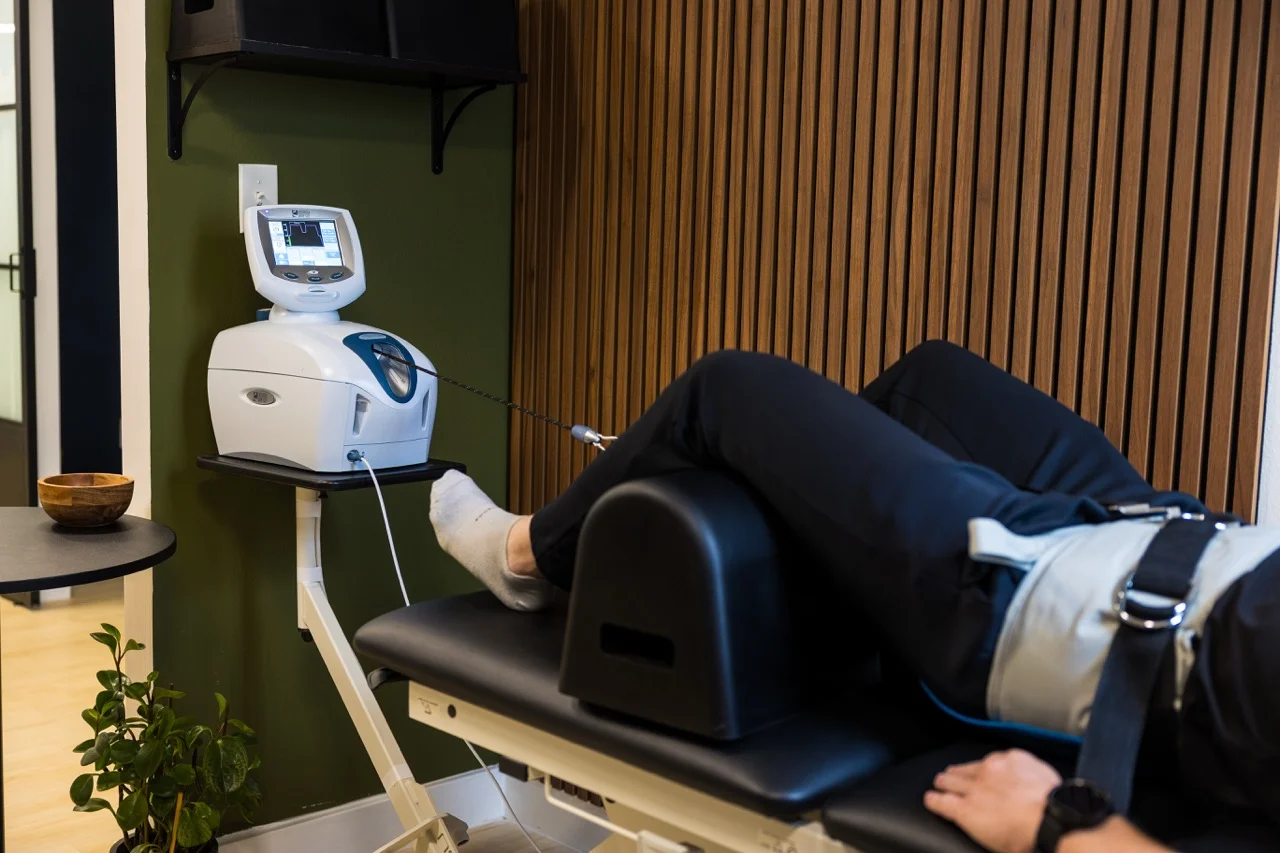
Spinal Decompression Therapy
When discs are involved, spinal decompression provides targeted relief:
How Spinal Decompression Works
What Decompression Does
Why It Helps
Creates negative pressure in the disc
Draws bulging material back toward center
Improves disc hydration
Nutrients flow into dehydrated disc tissue
Reduces nerve root pressure
Symptoms like tingling and radiating pain decrease
Decompression therapy uses computerized traction to gently separate vertebrae. Each session lasts 15-20 minutes. Most protocols involve 12-20 sessions over 4-6 weeks.
Soft Tissue and Ligament Support
Complete whiplash recovery requires more than adjustments:
Myofascial release — Breaks up adhesions and scar tissue in muscles and fascia
Corrective exercises — Rebuilds strength and stability around damaged structures
Postural retraining — Addresses habits that load the cervical spine improperly
The goal is restoring function, not just eliminating pain. A neck that doesn't hurt but can't move properly hasn't healed.
How Limitless Chiropractic Treats Whiplash Differently
At Limitless Chiropractic in Austin, whiplash treatment follows a specific protocol:
Comprehensive cervical evaluation — We test everything before we treat anything. Range of motion, neurological function, orthopedic stress tests, and postural analysis.
Imaging-guided care — We have digital X-ray equipment in-office. When flexion-extension views or advanced imaging is needed, we coordinate it. We don't guess at what's wrong.
Non-surgical decompression — Our decompression tables target cervical disc injuries specifically. We've treated hundreds of accident patients with this technology.
Documentation for your case — Every visit is recorded. Every finding is noted. If you need records for insurance or legal purposes, they exist.
We focus on long-term stability, not just pain relief. Getting you out of pain is the first step. Keeping you out of pain is the goal.
Frequently Asked Questions
Can whiplash symptoms really show up days later? Yes. Adrenaline suppresses pain for 24-48 hours after impact. Inflammation builds over 2-3 days. Most delayed whiplash symptoms appear between 24-120 hours post-accident.
How long after an accident should I get checked? Ideally within 72 hours of symptom onset. If you felt fine at the scene but develop neck pain, stiffness, or headaches later, get evaluated as soon as symptoms appear.
Can whiplash cause headaches and dizziness? Yes. Cervicogenic headaches originate from cervical spine dysfunction. Dizziness results from proprioceptive disruption—your neck's position sensors sending faulty signals to your brain.
Do I need imaging if my pain started later? It depends on your symptoms. Standard X-rays rule out fractures. Flexion-extension X-rays detect instability. MRI becomes necessary if you have radiating pain, numbness, or weakness.
Is chiropractic safe after a car accident? Yes, when performed by a provider experienced with trauma cases. We modify techniques based on your injury. Gentle, specific care—not aggressive manipulation.
Will insurance cover whiplash treatment? Most auto insurance policies include personal injury protection (PIP) that covers chiropractic care after an accident. The at-fault driver's liability insurance may also apply. We verify coverage before treatment begins.
When to Seek Care Immediately
Don't wait if you experience any of the following:
Pain that worsens despite rest
Numbness or tingling spreading down your arm
Weakness when gripping or lifting
Loss of neck motion that isn't improving
Symptoms lasting longer than 72 hours
Severe headaches, especially with dizziness or vision changes
These signs indicate the injury may be progressing. Earlier intervention produces better results.
Take the Next Step
Your neck pain is not going to fix itself. What felt like a minor accident is producing symptoms that interfere with your sleep, your work, and your life.
You have two choices. Wait and hope the pain goes away—knowing that chronic whiplash patients often started exactly where you are now. Or get evaluated, understand what's actually wrong, and start treatment that addresses the cause.
Limitless Chiropractic has helped hundreds of Austin accident victims recover from whiplash. We offer comprehensive evaluation, in-office imaging, and non-surgical decompression therapy. We document everything for your records.
Call (512) 999-6115 or book online to schedule your evaluation. Most patients are seen within 24-48 hours.
Your neck doesn't have to hurt forever. But waiting makes that outcome more likely.
Limitless Chiropractic | Austin, TX | Serving Downtown Austin, South Austin, Round Rock, Cedar Park, and Pflugerville
Dr. Scott Mitchell
About the author
Dr. Scott Mitchell, a Boston-accented chiropractor with a passion for holistic health,dedicates his life to helping people unlock their LIMITLESS potential through personalized chiropractic care.