
Sleep, snoring, and nasal breathing
Sleep Apnea, Snoring & Nasal Breathing Concerns in Austin
A condition-first guide for people dealing with loud snoring, mouth breathing, poor sleep, nasal obstruction, and insomnia, with clear referral boundaries and a cautious look at where Cranial Facial Release may fit.
In this guide
Start With The Right Diagnosis
If you are searching for help with snoring, sleep apnea, mouth breathing, blocked nasal airflow, or insomnia, the first question is not "which technique should I try?" The first question is what is actually driving the problem.
Loud snoring can be a nuisance. It can also be a sign of obstructive sleep apnea. Poor sleep can come from stress, pain, airway issues, medication effects, shift work, chronic insomnia, or several problems at once. Nasal obstruction can make sleep feel harder, but improving the nose is not the same as treating every cause of sleep-disordered breathing.
Screening and referral boundaries come first on this page, then Cranial Facial Release, or CFR. Limitless Chiropractic offers CFR as a conservative in-office service for selected patients. Sleep apnea and chronic insomnia still need the right medical lane when the symptoms point there.
Get medical evaluation for sleep apnea or another medical condition if you have witnessed pauses in breathing, choking or gasping during sleep, severe daytime sleepiness, drowsy driving, morning headaches, high blood pressure, chest pain, shortness of breath, new neurological symptoms, or sleep problems that are rapidly worsening.
If you already have a sleep apnea diagnosis, do not stop CPAP, oral appliance therapy, medication, or specialist-directed care because you are exploring conservative support.
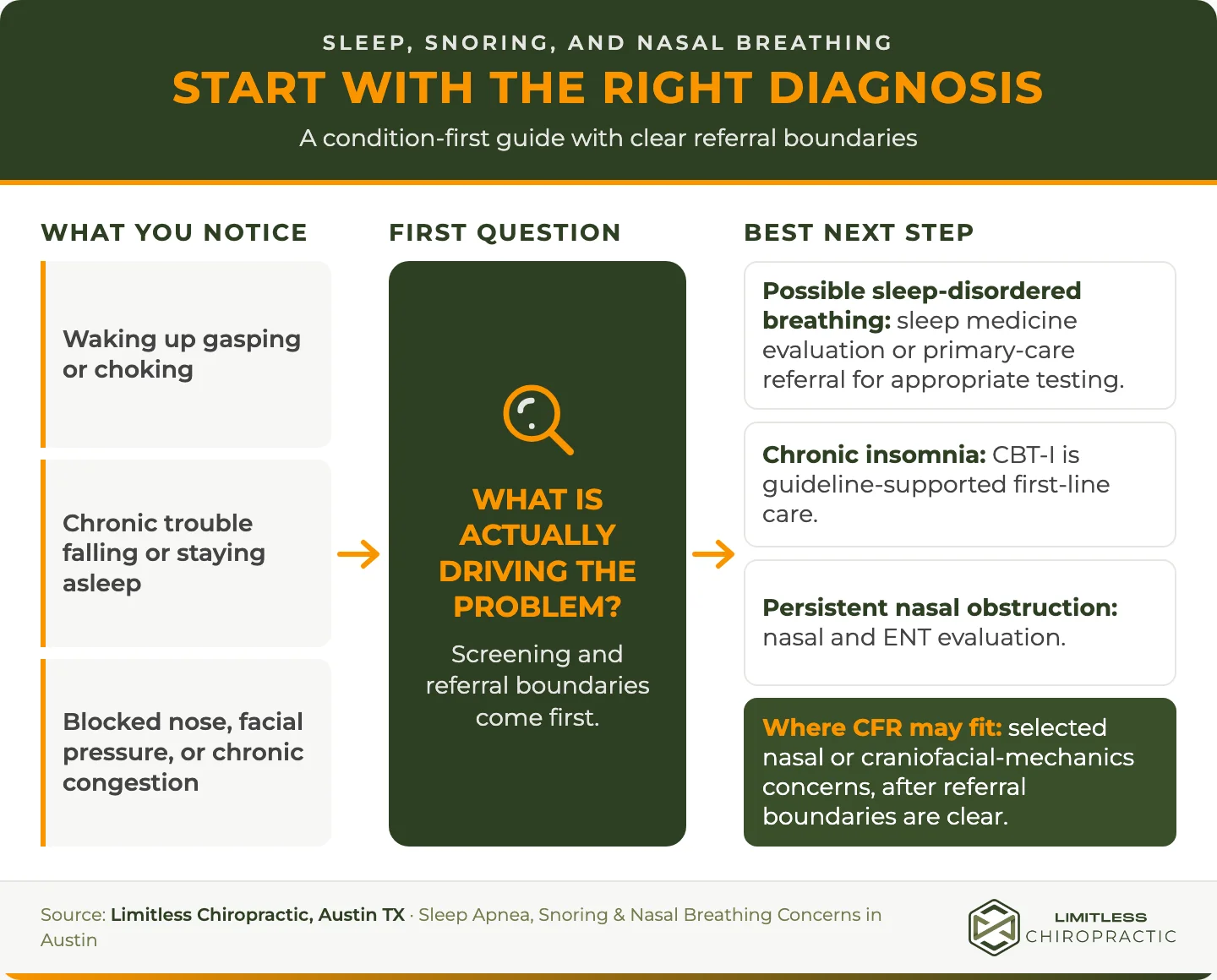
What These Symptoms May Mean
People often use the same words for different problems. "I cannot breathe at night" might mean nasal congestion. It might mean waking up gasping. It might mean anxiety, reflux, asthma, sleep apnea, or a mix of several issues. The search term is not enough to make the diagnosis.
| What You Notice | Possible Meaning | Best Next Step |
|---|---|---|
| Loud habitual snoring | Primary snoring, nasal obstruction, airway narrowing, or obstructive sleep apnea | Screen for sleep apnea risk, especially if there are pauses, choking, morning headaches, or daytime sleepiness. |
| Waking up gasping or choking | Possible sleep-disordered breathing | Seek sleep medicine evaluation or primary-care referral for appropriate testing. |
| Mouth breathing at night | Nasal congestion, nasal obstruction, habit, allergy, or airway compensation | Consider nasal and ENT evaluation if congestion or obstruction is persistent. |
| Chronic trouble falling or staying asleep | Chronic insomnia, stress physiology, pain, medications, or overlapping sleep apnea | CBT-I is guideline-supported first-line care for chronic insomnia; screen for sleep apnea if symptoms overlap. |
| Blocked nose, facial pressure, or chronic congestion | Allergy, sinus disease, deviated septum, turbinate issues, or other nasal obstruction | ENT or medical evaluation may be appropriate when symptoms are persistent, one-sided, severe, or recurrent. |
What Standard Care Usually Looks Like
For suspected obstructive sleep apnea, guidelines from the American Academy of Sleep Medicine emphasize clinical evaluation and appropriate sleep testing. Snoring alone does not diagnose sleep apnea, and symptoms alone do not rule it out.
When sleep apnea is diagnosed, standard care may include positive airway pressure therapy, oral appliance therapy in selected patients, weight-loss support when appropriate, follow-up with a sleep clinician, and ENT evaluation when nasal obstruction or upper-airway anatomy is part of the picture. The right path depends on the diagnosis, severity, medical history, and what the patient can actually tolerate long term.
For chronic insomnia, the American College of Physicians and the American Academy of Sleep Medicine both support cognitive behavioral therapy for insomnia, often called CBT-I, as first-line care. That matters because insomnia is not just "bad sleep." It has its own evaluation and treatment lane, even when neck pain, stress, or breathing symptoms are also present.
| Concern | Common Evidence-Based Lane | Where Limitless Fits |
|---|---|---|
| Possible sleep apnea | Sleep medicine evaluation, sleep testing, PAP therapy, oral appliance therapy, medical follow-up | Screen for red flags, avoid replacing sleep care, and coordinate around musculoskeletal or nasal-mechanics concerns when appropriate. |
| Primary snoring | Sleep-apnea screening first when risk signs are present; oral appliance therapy may be considered through the appropriate clinician pathway | Help patients understand whether their symptoms sound like a referral-first problem or a conservative consultation problem. |
| Nasal obstruction | Primary-care, allergy, or ENT evaluation depending on severity and duration | Evaluate craniofacial and nasal-mechanics fit for CFR only after referral boundaries are clear. |
| Chronic insomnia | CBT-I as first-line care, medical review for overlapping conditions, sleep-apnea screening when indicated | Address pain, tension, and conservative support goals without claiming CFR treats insomnia. |
If your main concern is snoring, mouth breathing, nasal restriction, or poor sleep, Limitless can help you sort out whether this is a referral-first issue, a conservative-care issue, or both.
Where Nasal Breathing Fits
Nasal breathing matters. A blocked or restricted nose can make sleep feel lighter, increase mouth breathing, contribute to snoring, and make CPAP harder to tolerate for some patients. ENT literature also recognizes that improving nasal airway patency may help selected sleep-apnea patients use CPAP more comfortably.
That said, nasal breathing is one part of a larger airway system. Research on isolated nasal surgery shows that improving nasal obstruction does not reliably cure obstructive sleep apnea by itself. This is a useful caution for every conservative option too. If the diagnosis is sleep apnea, the airway problem can involve the throat, tongue, soft palate, jaw position, weight, nervous-system control of breathing during sleep, and other factors beyond the nose.
The practical takeaway is simple: nasal obstruction deserves attention, but it should not be oversold. If the problem is structural, severe, chronic, one-sided, or associated with recurrent sinus infections, an ENT conversation may be the right next step. If the problem is milder, mechanical, or tied to facial pressure and nasal-resistance sensations, a conservative evaluation may also be reasonable.
Where CFR May Fit At Limitless
Cranial Facial Release is a service Limitless Chiropractic offers for selected patients with nasal and craniofacial-mechanics concerns. It is not a replacement for sleep testing, CPAP, oral appliances, ENT care, insomnia treatment, or emergency medical evaluation.
Think of CFR as a candidacy conversation, not a cure claim. During a consultation, your chiropractor can look at your history, nasal-breathing complaints, facial pressure patterns, prior injuries, prior nasal procedures, sleep symptoms, and red flags. From there, the recommendation may be CFR, another chiropractic service, a sleep-medicine referral, an ENT referral, or a decision that this is not the right service for your situation.
That restraint matters. If your symptoms point toward sleep apnea, you need appropriate sleep evaluation. If your symptoms point toward chronic insomnia, you need insomnia-specific care. If your symptoms point toward nasal obstruction, you may need medical or ENT evaluation. CFR enters the conversation only after those boundaries are clear.
How Limitless frames CFR for sleep and breathing concerns: CFR is an in-office conservative option for selected nasal or craniofacial-mechanics concerns. It is not a treatment for obstructive sleep apnea, a CPAP alternative, a snoring cure, or an insomnia treatment.
What To Expect At Limitless
The first step is a real conversation. Your chiropractor will ask what you are noticing at night, whether anyone has witnessed pauses in breathing, whether you wake up gasping, how tired you feel during the day, whether you have morning headaches, whether you already use CPAP or an oral appliance, and whether nasal obstruction is constant, seasonal, one-sided, trauma-related, or tied to sinus symptoms.
The visit may include a chiropractic and craniofacial evaluation, posture and neck assessment, nasal-breathing discussion, and review of prior sleep testing, imaging, ENT notes, or medical history if you have them. If your presentation sounds like sleep apnea or another medical issue, the recommendation should be referral-aware, not technique-first.
If CFR appears appropriate, the doctor can explain what the procedure involves, why it may or may not fit your goals, how many visits may be reasonable, what outcomes are realistic to track, and when to stop or refer out. If CFR does not appear appropriate, you should leave with a clearer next step instead of a sales pitch.
FAQ
Can CFR treat sleep apnea?
No. Sleep apnea requires appropriate medical evaluation and, when diagnosed, evidence-based care such as PAP therapy, oral appliance therapy for selected patients, weight-loss support when appropriate, ENT evaluation when indicated, and follow-up with a sleep clinician. CFR is not a substitute for any of that.
Can nasal obstruction make snoring worse?
Yes, nasal obstruction can contribute to mouth breathing, snoring, poor sleep quality, and difficulty tolerating CPAP in some patients. But nasal obstruction is only one possible contributor. Loud snoring with choking, witnessed pauses, daytime sleepiness, or high blood pressure should be screened as a possible sleep-apnea issue.
What if I hate CPAP?
Talk with the clinician managing your sleep apnea before stopping treatment. Some patients need mask changes, pressure adjustments, humidification, oral appliance evaluation, nasal-obstruction evaluation, or other support. Limitless can discuss conservative nasal and craniofacial-mechanics concerns, but that is not the same as replacing CPAP or sleep-medicine care.
Is insomnia the same as sleep apnea?
No. Insomnia and sleep apnea are different conditions, though they can overlap. Chronic insomnia is commonly managed with CBT-I as first-line care. If insomnia comes with loud snoring, gasping, witnessed pauses, morning headaches, or major daytime sleepiness, sleep-apnea screening becomes more important.
When should I see an ENT?
Consider ENT evaluation when nasal blockage is chronic, severe, one-sided, trauma-related, associated with recurrent sinus infections, or not improving with appropriate medical care. ENT evaluation is also relevant when nasal obstruction makes CPAP difficult to tolerate.
What does Limitless do on the first visit?
Limitless starts with history, examination, symptom screening, and a candidacy conversation. If the presentation sounds like a medical sleep issue, ENT issue, or insomnia-specific issue, the responsible next step may be referral or co-management. If the case fits conservative care, the doctor can explain whether CFR or another service is appropriate.
Ready to sort out whether your sleep, snoring, or nasal-breathing concern belongs in a medical referral lane, a conservative-care lane, or both?

