Post-concussion, sensory, and cranial nerve symptoms
Post-Concussion, Vertigo, Tinnitus & Cranial Nerve Symptoms in Austin
A referral-aware guide for people dealing with lingering symptoms after a concussion, dizziness, ringing in the ears, hearing or vision changes, sudden facial weakness, or electric facial pain. Written to help you find the right clinician faster, not to sell you a technique.
In this guide
- Start With The Pattern, Not The Technique
- Red Flags: When This Is Not A Chiropractic-First Problem
- The Medical And Conservative Care Lanes
- Lingering Symptoms After A Concussion
- Vertigo, Tinnitus, And Hearing Change
- Bell Palsy And Trigeminal Nerve Pain
- Where Limitless May Fit
- Where CFR May Fit
- Related Limitless Resources
- FAQ
Start With The Pattern, Not The Technique
Dizziness, ringing in the ears, facial nerve symptoms, vision changes, and symptoms that linger after a concussion can overlap with each other and with a dozen unrelated problems. That overlap is exactly why this page does not start with a technique. It starts with the pattern.
Dizziness when rolling over in bed is different from dizziness with slurred speech. Ringing in both ears for years is different from sudden hearing loss in one ear. Facial weakness that came on over hours is a different conversation from facial weakness with stroke-like signs. Electric pain triggered by brushing your teeth is not ordinary jaw tension. Sorting the pattern is the first clinical job, and sometimes the most useful thing a clinic can do is send you somewhere else quickly.
If your main complaint is headaches, jaw pain, or ongoing facial pain rather than the symptoms above, start with TMJ, Headaches and Facial Pain in Austin. That guide is built for those patterns.
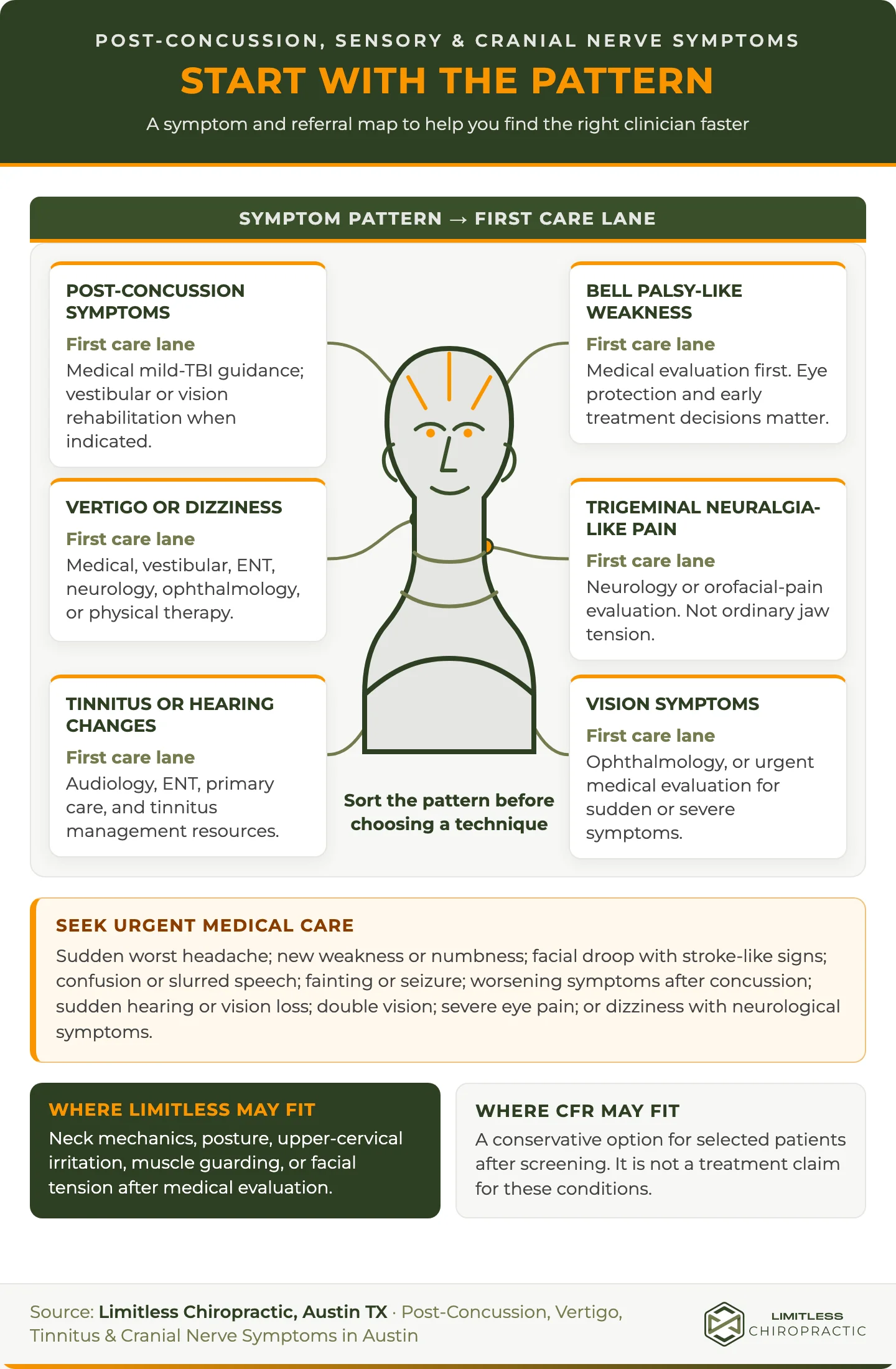
Seek urgent medical care for sudden worst headache, new weakness or numbness, facial droop with stroke-like signs, confusion, slurred speech, fainting, seizure, severe head injury, worsening symptoms after concussion, sudden hearing loss, sudden vision loss, double vision, severe eye pain, dizziness with neurological symptoms, fever with stiff neck, or facial pain with rash near the eye.
Do not use CFR, chiropractic care, massage, exercise, or home maneuvers to delay evaluation when symptoms are new, severe, progressive, traumatic, neurological, or one-sided in a concerning way.
The Medical And Conservative Care Lanes
Every symptom on this page has an established medical lane. Concussion care follows mild traumatic brain injury guidance. Trigeminal neuralgia is a neurological facial-pain condition with its own diagnostic and medication considerations. Bell palsy requires accurate diagnosis, eye protection, and treatment decisions early in the course. Persistent bothersome tinnitus belongs in an audiology and ENT-informed lane. Benign paroxysmal positional vertigo is a specific inner-ear condition with diagnostic and repositioning-maneuver standards, and it is only one of several causes of dizziness.
| Concern | First Question | Likely Care Lane |
|---|---|---|
| Post-concussion symptoms | Are symptoms worsening, lingering, or affecting work, driving, vision, mood, balance, or cognition? | Medical mild-TBI guidance, vestibular or vision rehabilitation when indicated, neurology or specialist referral when symptoms persist. |
| Vertigo or dizziness | Is it positional, post-traumatic, migraine-associated, neurological, or eye-related? | Medical, vestibular, ENT, neurology, ophthalmology, or physical therapy evaluation depending on the pattern. |
| Tinnitus or hearing changes | Is it sudden, one-sided, pulsatile, associated with hearing loss, or persistent and bothersome? | Audiology, ENT, primary care, and tinnitus management resources. |
| Bell palsy-like facial weakness | Is there sudden facial weakness, eye closure difficulty, or symptoms that could mimic stroke? | Medical evaluation first. Eye protection and early treatment decisions matter. |
| Trigeminal neuralgia-like pain | Is it electric, shock-like, triggered by touch, chewing, brushing, or wind? | Neurology or orofacial-pain evaluation. Do not treat it as ordinary jaw tension. |
| Vision symptoms | Is it sudden loss, double vision, severe eye pain, or a gradual change? | Ophthalmology or urgent medical evaluation for sudden or severe symptoms. |
If your symptoms feel like a tangle of dizziness, ear noise, facial sensations, and neck tension, Limitless can help you sort out whether this is a conservative-care case or a referral-first case.
Lingering Symptoms After A Concussion
Mild traumatic brain injury can cause short-term or long-term problems affecting thinking, behavior, and emotion. CDC guidance for adults covers evaluation, discharge instructions, and return-to-work decisions, and that guidance is the backbone of concussion care. It is not a chiropractic protocol, and this page does not pretend otherwise.
What that means practically: if symptoms are worsening, if you are having trouble at work or behind the wheel, or if balance, vision, mood, or cognition are affected weeks after the injury, the next call is medical. Vestibular and vision rehabilitation are real lanes. Neurology referral is a real lane. Conservative musculoskeletal work on the neck and jaw can be part of a plan, but only alongside those, never instead of them.
Limitless will co-manage. A patient already under medical care for post-concussion symptoms who also has neck stiffness, postural strain, or jaw tension can get help with that specific complaint while the medical plan continues. The clinic will not describe that work as concussion treatment.
Vertigo, Tinnitus, And Hearing Change
Benign paroxysmal positional vertigo is a specific diagnosis with a specific answer. Guideline care emphasizes accurate diagnosis, therapeutic repositioning maneuvers, and less reliance on vestibular suppressant medication and unnecessary testing. It is worth naming precisely because BPPV is only one cause of dizziness, and treating every dizzy patient as though they have it is how people get the wrong care for a long time.
Tinnitus follows the same logic. Persistent bothersome tinnitus in adults has evidence-based evaluation and management pathways involving primary care, specialty physicians, audiology, and mental health professionals. Sudden hearing loss, one-sided symptoms, pulsatile tinnitus, or tinnitus after major trauma need medical evaluation, not a technique.
Cranial Facial Release does not improve hearing, auditory function, or vestibular function, and this page makes no such claim. Where Limitless can help is the same narrow place as always: neck mechanics, posture, and muscle tension that sit alongside those symptoms in some patients, after the right lane is in motion.
Bell Palsy And Trigeminal Nerve Pain
Sudden facial weakness is a medical event until proven otherwise. Bell palsy requires accurate diagnosis, appropriate early treatment decisions, eye protection, follow-up, and evaluation of any new or worsening symptom that does not fit the Bell palsy picture. Some sudden facial weakness is not Bell palsy at all, which is exactly why the diagnosis matters more than the technique.
Trigeminal neuralgia is a neurological facial-pain condition. Evaluation may include imaging or reflex testing in selected cases, and carbamazepine and oxcarbazepine are first-line medication considerations for classic trigeminal neuralgia pain. If your facial pain is electric and shock-like, triggered by a light touch, a breeze, chewing, or brushing your teeth, that pattern belongs in neurology or orofacial-pain care.
The old Limitless articles on both conditions claimed CFR could restore facial nerve signaling and reduce trigeminal pain. Those claims are gone and are not coming back. What remains is the referral, and the offer to help with a separate musculoskeletal complaint when one exists.
Where Limitless May Fit
Limitless is most relevant when symptoms appear connected to neck mechanics, posture, upper-cervical irritation, muscle guarding, or facial tension, and when a patient has already been medically evaluated but still needs a practical musculoskeletal plan.
The clinic is not the right first stop for sudden neurological symptoms, acute facial paralysis, suspected stroke, sudden hearing loss, severe head injury, progressive vision changes, or electric facial pain that sounds like trigeminal neuralgia. In those cases the win is not forcing the patient into care. The win is helping them get to the right clinician faster.
Where CFR May Fit
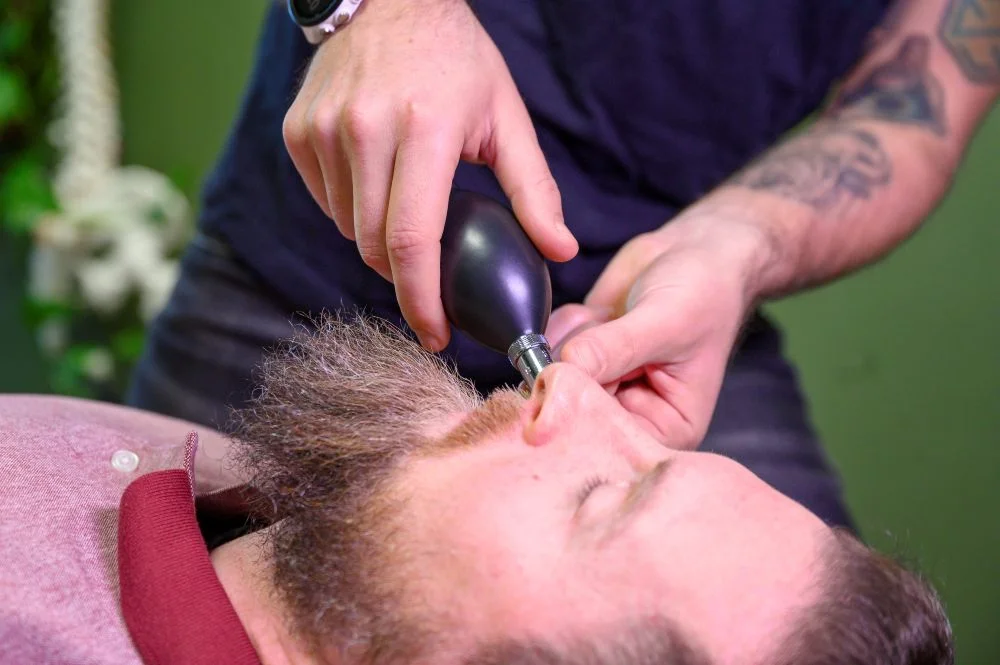
Cranial Facial Release may be discussed at Limitless as a conservative option for selected patients after screening. That is the entire safe claim. It is not a treatment claim for concussion, trigeminal neuralgia, Bell palsy, tinnitus, hearing impairment, vertigo, or vision disorders.
If CFR is considered, the conversation should be specific: what symptom are we tracking, what medical red flags have been ruled out, what other care is already involved, what would count as meaningful progress, and when would we stop or refer. That framing is what makes a consult useful instead of a sales pitch.
What CFR is and is not. CFR may be part of a conservative consultation for selected craniofacial-mechanics, nasal, or head-and-neck tension concerns. It is not a treatment for facial nerve disorders, hearing loss, vision changes, vertigo, concussion, or trigeminal neuralgia. Those conditions belong in their respective medical lanes.
FAQ
Can CFR help post-concussion syndrome?
No. Lingering symptoms after concussion follow medical mild-TBI guidance and may require vestibular, vision, neurological, or specialist care. Conservative musculoskeletal support around the neck and jaw can be discussed only alongside that care, never in place of it.
What if I have electric facial pain?
Electric, shock-like facial pain triggered by touch, chewing, brushing teeth, or wind can resemble trigeminal neuralgia. That belongs in a neurology or orofacial-pain lane. Limitless will refer you, not treat it as ordinary jaw tension.
Can CFR treat Bell palsy?
No. Sudden facial weakness needs prompt medical evaluation, accurate diagnosis, eye protection, and early treatment decisions. Some sudden facial weakness is not Bell palsy, which is another reason the diagnosis has to come first.
When is tinnitus or hearing change urgent?
Sudden hearing loss, one-sided symptoms, pulsatile tinnitus, new neurological symptoms, or tinnitus after major trauma should be evaluated medically. CFR is not an auditory-function treatment.
Can chiropractic care fix my vertigo?
Not as a blanket answer. Dizziness has many causes, and BPPV in particular has a specific diagnosis and repositioning-maneuver standard. Getting the diagnosis right is what determines the treatment, so vertigo that is sudden, severe, or paired with neurological symptoms goes to medical evaluation first.
I came here for headaches or jaw pain. Where do I go?
Read TMJ, Headaches and Facial Pain in Austin. That guide covers headache patterns, jaw mechanics, and chronic facial pain in depth.
What does Limitless do if I book with mixed symptoms?
The first job is sorting. Your chiropractor takes a history, screens for red flags, examines neck and postural contributors, and tells you whether this looks like conservative care, referral, or both. If CFR is discussed, it is with clear expectations and stop or referral rules built in.
Want help sorting a post-concussion, dizziness, ear, or facial nerve symptom pattern without getting sold the wrong lane?

