Millions of Americans experience chronic pain each year, and many turn to medications, injections, or surgery as their first response. Yet overwhelming evidence now shows that conservative, non-invasive care often produces better long-term outcomes than aggressive interventions. Before considering opioids, epidural steroid injections, or spinal surgery, it’s critical to understand what science reveals about pain management. This comprehensive guide explores why addressing pain at its root—through movement, posture correction, and chiropractic care—should be your first stop, not your last resort.
Key Takeaways
Cost burden
Chronic pain in the U.S. drove an estimated $722.8 billion in costs in 2021 ($530.6B medical + $192.2B lost productivity).
Surgery odds
Roughly 20–40% of spinal surgeries fail to provide adequate relief. First-surgery success: ~50%; second 30%; third 15%; fourth 5%.
Injection ceiling
Lumbar radiculopathy injections show 63–64% success at 1–12 months by a 50% pain-reduction criterion. Stenosis success drops to 49% → 43% at six months.
Imaging truth
For 90–95% of musculoskeletal pain (no red flags), early imaging adds no benefit and can drive ~30% higher costs in older adults.
Conservative-first
JAMA Network Open evidence: chiropractic added to usual care produced lower pain intensity, better function, and significantly reduced pain medication use.
Mechanism over masking
Movement, posture, and nervous-system regulation address central sensitization. Pain suppression alone does not.
The Current Pain Management Problem in the United States
The statistics paint a troubling picture of American pain management. In 2019, approximately 22.1% of U.S. adults with chronic pain used prescription opioids in the past three months, and the economic burden is staggering. The economic costs of chronic pain in the United States reached an estimated $722.8 billion in 2021, consisting of $530.6 billion in medical care costs and $192.2 billion in lost work productivity. This means individuals with chronic pain incur an additional $8,068 in annual medical expenditures and $2,923 in lost productivity per person compared to those without chronic pain.
The prescription opioid epidemic has made clear that medication-first approaches are fundamentally flawed. While the CDC released guidelines in 2016 to restrict opioid prescribing for chronic pain, these medications remain widely prescribed despite mounting evidence of limited long-term effectiveness and serious risks including dependency, overdose, and death. The conventional approach of reaching for medication treats pain symptoms rather than addressing the underlying mechanical and neurological dysfunction causing the pain.
Spinal injections have become increasingly popular, yet their effectiveness is decidedly limited. For patients with lumbar radiculopathy (nerve pain), success rates are modest; studies show 63% success at one month, declining to 64% at six months and 64% at one year using the criterion of at least 50% pain reduction. For those with lumbar spinal stenosis, success rates are even lower at 49% initially, dropping to 43% at six months. More critically, these injections provide only temporary relief, with many patients experiencing symptom recurrence within months. For a deeper look at the herniation pathology that often drives those injection decisions, see Disc Herniations: Prevention to Recovery.
Surgery represents the most aggressive intervention, yet outcomes are surprisingly modest. While back surgery is often promoted as the ultimate solution, research reveals sobering results: approximately 20-40% of spinal surgeries fail to provide adequate relief, and the outcomes worsen with repeat procedures. After the first spinal surgery, only 50% of patients achieve successful outcomes. This success rate plummets to 30% for a second surgery, 15% for a third, and merely 5% for a fourth. Failed back surgery syndrome has become increasingly common, affecting patients with outcomes comparable to or worse than those with serious rheumatologic conditions.
Pain that hasn’t responded to medication or injections? See whether conservative chiropractic care fits your situation.
Why Pain Isn’t Just “Inflammation” (And Why That Matters)
Modern pain science has fundamentally shifted our understanding of how pain works. For decades, healthcare providers operated under a simplified model: pain equals inflammation, so suppress inflammation and pain resolves. This oversimplification has led millions down the path of pharmaceutical management without addressing the true causes of suffering.
Pain is far more complex than a simple inflammatory response. It is a multidimensional neurological and mechanical signal generated by your nervous system based on multiple inputs. Research demonstrates that pain does not require tissue damage, and conversely, tissue damage does not always produce pain. Pain can persist long after tissues have healed, and pain can emerge without any structural damage at all. This distinction is critical because it explains why imaging often fails to correlate with symptoms, and why treating inflammation alone frequently fails to resolve pain.
Central sensitization represents a key mechanism underlying many chronic pain conditions. Central sensitization occurs when the central nervous system becomes hypersensitive, dramatically amplifying pain signals. The nervous system essentially develops a “louder volume” for pain signaling, such that stimuli that shouldn’t hurt become painful (allodynia), and normally painful stimuli cause exaggerated pain responses (hyperalgesia). Research shows that central sensitization is present in a significant subgroup of patients with chronic low back pain and is highly correlated with pain intensity, disability, depression, and anxiety.
The cascade that produces central sensitization involves glial cell activation in the spinal cord and brain, release of neuroinflammatory mediators, loss of inhibitory mechanisms, and altered brain processing of pain signals. Importantly, movement, proper posture, and nervous system regulation—not pain suppression—are the evidence-based interventions for addressing central sensitization. This is why chiropractic care, which focuses on restoring proper movement patterns and spinal function, can be so effective.
Joint dysfunction, postural distortion, and poor movement patterns are mechanical contributors that perpetuate pain by maintaining abnormal neural signaling. When joints don’t move properly, nerves don’t glide smoothly, muscles become chronically tense, and the nervous system stays on high alert. Rather than numbing the signal with medication, addressing the mechanical dysfunction resolves the underlying problem.
At-Home, Non-Invasive Strategies That Actually Work
Before considering any medication or injection, several evidence-based at-home strategies can significantly reduce pain and improve function. These interventions address the root causes of musculoskeletal pain rather than merely masking symptoms.
Movement and Gentle Mobility
Contrary to outdated advice, rest makes pain worse for most musculoskeletal conditions. Multiple randomized controlled trials demonstrate that appropriate movement significantly outperforms immobilization for reducing pain and improving functional outcomes. The key is selecting movements that challenge without aggravating the condition.
Walking represents one of the most evidence-supported interventions for chronic pain. It maintains cardiovascular fitness, activates pain-inhibitory pathways in the nervous system, and prevents the deconditioning that perpetuates chronic pain. Begin with walks you can tolerate without significant symptom exacerbation, gradually increasing duration and intensity as tolerated.
Controlled mobility drills and gentle range-of-motion exercises restore proper movement patterns. These exercises should be performed in pain-free or minimally painful ranges and progressed gradually. The goal is to restore nervous system confidence in movement, reducing the protective muscle guarding that limits function. Specific exercises tailored to your individual impairments consistently outperform generic exercises in clinical trials.
Posture and Ergonomics
Your postural habits throughout the day create repetitive forces that either support or stress your musculoskeletal system. Forward head posture—where your head juts forward from your shoulders—adds 10-12 pounds of stress to your cervical spine per inch of forward head position. Over a typical workday where you’re looking at screens, your neck may be supporting 30-42 extra pounds of load, creating muscular strain and nerve irritation.
Audit your workspace and daily activities. Position screens at eye level rather than below eye level. Take frequent breaks (every 30-60 minutes) to reset your posture and move. During prolonged sitting, maintain a neutral spine with your shoulders relaxed. At night, sleep on your side or back with pillow support that maintains neutral neck alignment; avoid stomach sleeping, which rotates your neck.
Poor posture creates muscle imbalances between your front and back, left and right sides. These imbalances overload some structures while underloading others, creating pain and dysfunction. Simple postural awareness and correction, when practiced consistently, can dramatically reduce pain by distributing forces more evenly across your body.
Ice, Heat, and Recovery Tools
Understanding when to use ice versus heat optimizes recovery. Ice reduces inflammation and is most appropriate in the immediate aftermath of acute injury (first 48-72 hours). Heat relaxes muscular tension and improves blood flow; it’s appropriate for chronic muscular pain and after the acute phase of injury. Many people benefit from alternating between heat and ice.
Foam rollers, massage balls, and stretching straps enable self-myofascial release, addressing the muscular tension patterns that perpetuate pain. Self-massage reduces muscle tension, improves circulation, and can provide pain relief. However, avoid aggressive techniques in acutely injured or sensitized tissues. Gentle, sustained pressure is often more effective than aggressive rolling for chronic pain conditions.
Breathing and Nervous System Regulation
Your breathing pattern directly influences your nervous system state. Shallow, rapid chest breathing activates the sympathetic nervous system (fight-or-flight), increasing muscle tension and pain perception. Deep, slow nasal breathing activates the parasympathetic nervous system (rest-digest), reducing muscle tension and pain sensitivity.
Practice diaphragmatic breathing throughout your day. Breathe in through your nose for a count of four, hold for a count of four, and exhale through your nose for a count of six. The longer exhale particularly activates parasympathetic calming. Practice this breathing for 5-10 minutes daily, especially before bed. This simple practice reduces muscle tension, improves sleep quality, and modulates pain perception through nervous system regulation.
Ready to address pain at the source? Book a comprehensive evaluation at Limitless Chiropractic in Austin.
Where Chiropractic Care Fits In (And Why It’s Often Skipped Too Late)
Chiropractic care should be your first professional intervention for musculoskeletal pain, not your last resort after years of failed medication trials. Chiropractors address the mechanical and neurological dysfunction underlying pain through spinal adjustments, postural correction, and movement retraining—interventions that target root causes rather than symptoms. For disc-driven pain, the spinal decompression complete guide walks through how non-surgical decompression fits inside that conservative-first sequence.
Research published in JAMA Network Open demonstrated that chiropractic care, when added to usual medical care, produced moderate short-term improvements in low back pain intensity and disability compared to usual care alone. Specifically, patients receiving chiropractic care plus usual medical care reported lower pain intensity, better function, higher satisfaction, and significantly reduced pain medication use compared to those receiving usual care alone. No serious adverse events were reported.
A critical advantage of chiropractic care is that it’s provided without medication or injection, avoiding both immediate side effects and long-term risks. Unlike injections, which provide temporary relief, chiropractic adjustments work to restore normal joint mechanics, improve nerve function, and restore proper movement patterns. These improvements can be sustained long-term through appropriate follow-up care and self-management. Pricing for cash-pay chiropractic care in Austin is broken down in our 2026 cash-pay cost guide.
Chiropractors identify and correct joint dysfunction (subluxations) that cause abnormal mechanical stress and nerve irritation. When proper spinal alignment and movement are restored, your nervous system receives normal sensory input, allowing pain-protective muscle guarding to resolve. Additionally, spinal adjustments improve circulation, reduce inflammation through movement, and restore proper proprioceptive feedback to the brain.
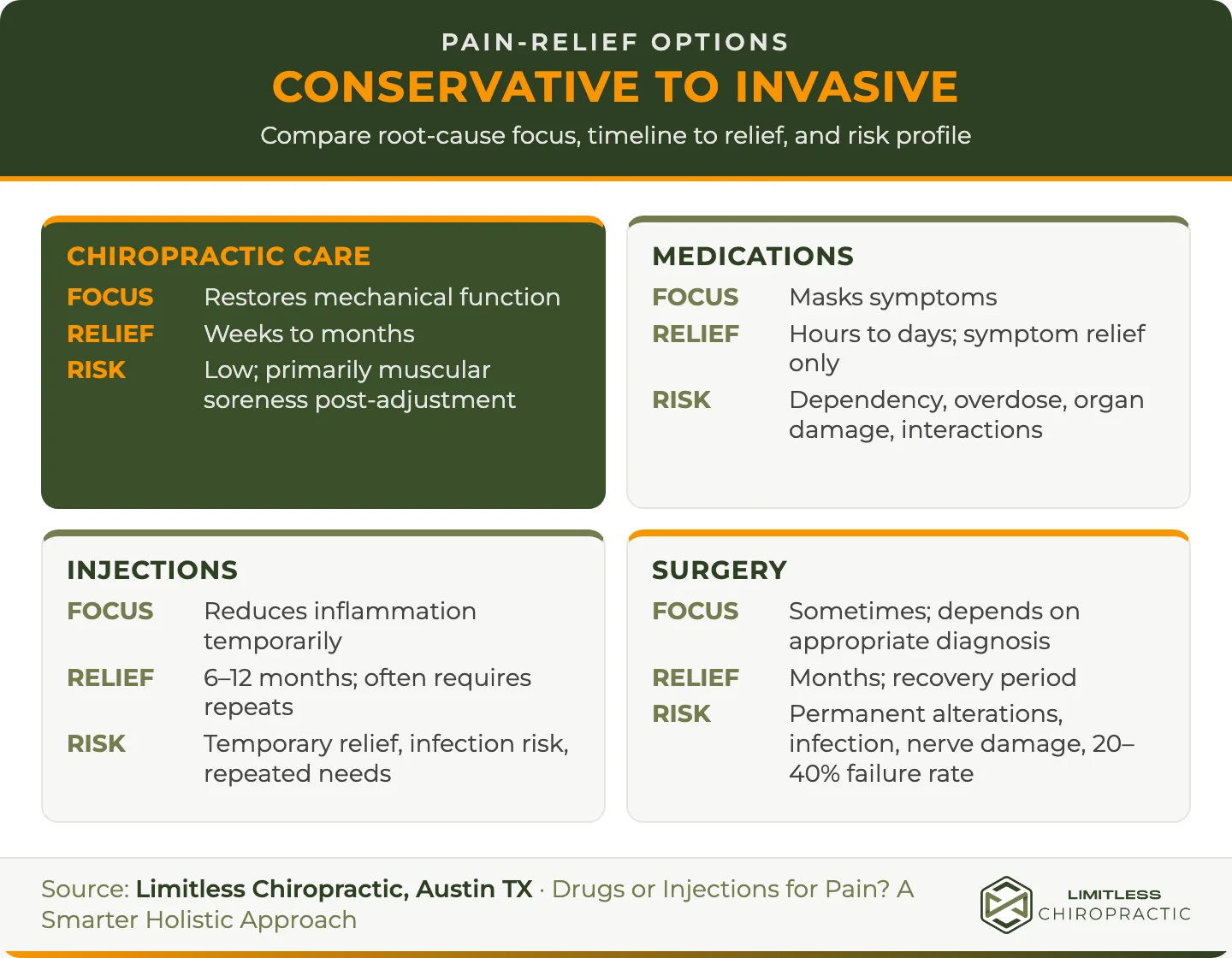
Temporary symptom suppression; diminishing returns over time
6–12 months of relief; often requires repeats
Modest outcomes; worse with repeat surgeries
Root Cause Focus
Yes; restores mechanical function
No; masks symptoms
No; reduces inflammation temporarily
Sometimes; depends on appropriate diagnosis
Patient Satisfaction
High; noticeable functional improvements
Variable; side effects often problematic
Moderate; temporary relief often disappointing
Variable; high complication rates
Timeline to Relief
Weeks to months
Hours to days (symptom relief only)
Days to weeks
Months (recovery period)
The evidence clearly favors a conservative, mechanical approach. Chiropractic care produces superior outcomes to medication for low back pain, avoids the risks inherent to injections and surgery, and addresses the actual dysfunction causing pain rather than merely suppressing the pain signal.
When Imaging and Advanced Care Make Sense (And When They Don’t)
Not all pain requires imaging, and in fact, unnecessary imaging often causes more harm than benefit. Current clinical guidelines recommend imaging only when there is suspicion of serious underlying pathology—conditions accounting for only 5-10% of back pain presentations. These “red flag” conditions include cancer, infection, inflammatory disease, fracture, and severe neurological deficits.
Research demonstrates that for the remaining 90-95% of musculoskeletal pain cases (non-specific pain without red flags), imaging provides no benefit and can cause harm. Studies show that patients who received unnecessary early imaging for low back pain had:
No improvement in pain, function, or quality of life compared to those without imaging
Greater use of unnecessary healthcare services including injections and surgery
Greater work absence
Increased healthcare costs (approximately 30% higher in older adults)
This occurs partly because knowledge of imaging findings can increase fear and catastrophizing about pain, psychologically worsening outcomes. A patient learning they have disc degeneration, bulging discs, or arthritis often becomes more fearful and protective, leading to worse functional outcomes despite tissue changes being normal age-related findings.
Appropriate scenarios for imaging include:
Failure to improve after 6-12 weeks of appropriate conservative care
Presence of red flag symptoms (fever, unexplained weight loss, night pain, progressive neurological deficits, history of cancer)
Clinical suspicion of fracture, infection, or serious systemic disease
Planning for injection or surgical intervention (to confirm diagnosis and appropriate targeting)
For initial evaluation of non-specific musculoskeletal pain, clinical assessment and trial of conservative care represent the evidence-based approach.
A Smarter Order of Operations for Pain Relief
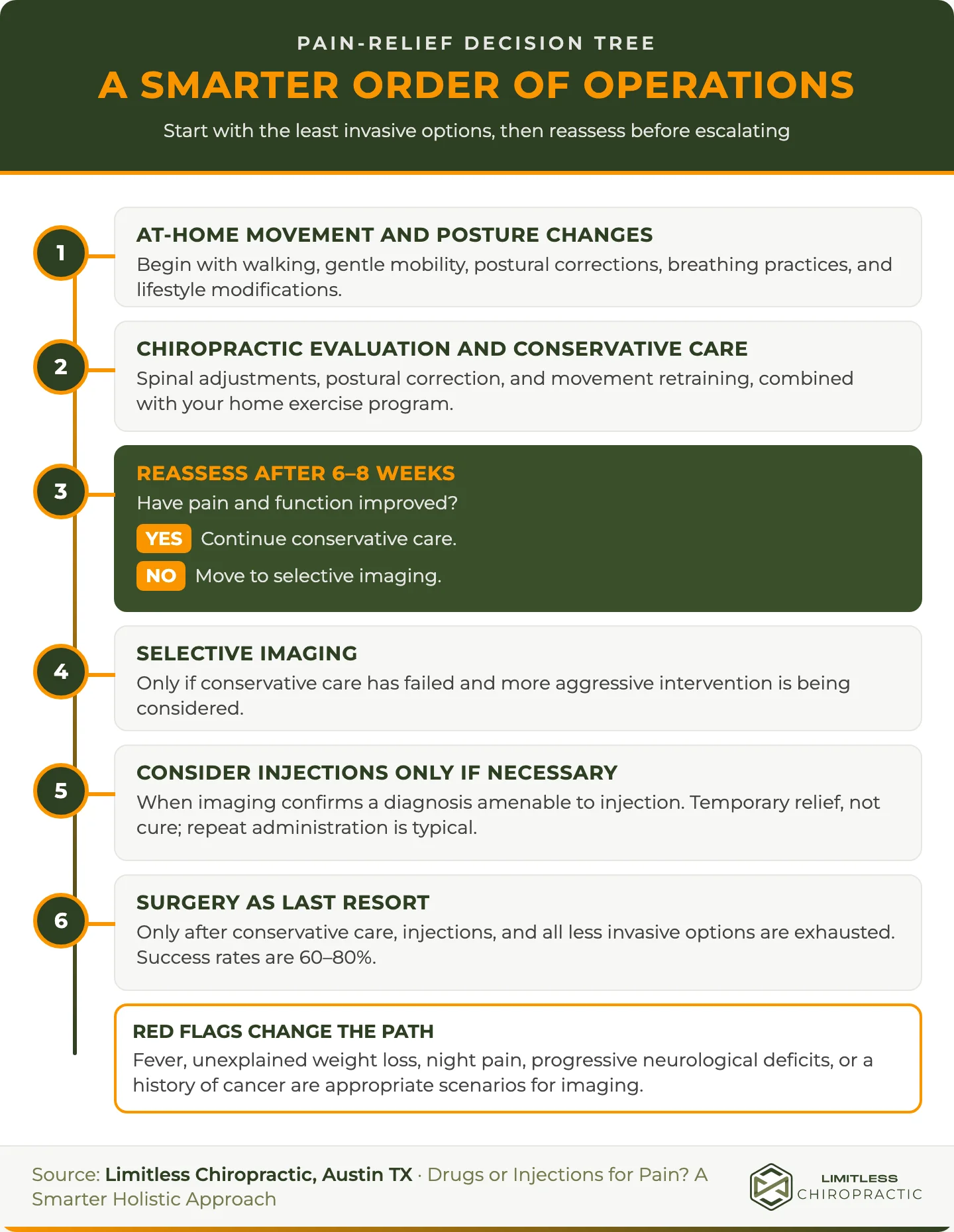
The following hierarchy represents the evidence-based approach to pain management:
Step 1: At-Home Movement and Posture Changes
Begin immediately with walking, gentle mobility exercises, postural corrections, breathing practices, and lifestyle modifications. Many acute pain episodes resolve completely with these interventions alone.
Step 2: Chiropractic Evaluation and Conservative Care
Seek chiropractic assessment to identify structural dysfunction and receive spinal adjustments, postural correction, and movement retraining. Combine chiropractic care with your home exercise program. Most musculoskeletal pain conditions respond well to conservative chiropractic care when initiated early.
Step 3: Reassess After Conservative Care
After 6-8 weeks of appropriate conservative management, reassess whether your pain and function have improved. Many patients achieve substantial improvement or complete resolution at this stage. If significant improvement has occurred but recovery is incomplete, continue conservative care potentially at increased frequency.
Step 4: Selective Imaging
Only if conservative care has failed and you’re being considered for more aggressive intervention should imaging be obtained. Imaging helps confirm the specific diagnosis and guides decisions about injections or surgery.
Step 5: Consider Injections Only If Necessary
If conservative care has failed and imaging confirms a diagnosis amenable to injection (such as herniated disc with radiculopathy or facet-mediated pain), epidural steroid injections may provide temporary relief allowing continued rehabilitation. Understand that injections provide temporary relief, not cure, and typically require repeat administration.
Step 6: Surgery as Last Resort
Spinal surgery should be considered only after conservative care, injections, and all other less invasive options have been thoroughly exhausted. Be aware that surgery success rates are modest (60-80%) and diminish with repeat procedures. Surgery creates permanent changes and should not be undertaken lightly.
Who This Approach Is Best For
This conservative, evidence-based approach works best for:
Back and Neck Pain
The vast majority of low back and neck pain cases are non-specific and respond excellently to conservative care, particularly when initiated early.
Headaches
Many headaches originate from cervical spine dysfunction and postural distortion. Chiropractic care correcting cervical alignment frequently eliminates headaches entirely.
Desk Workers
Those spending hours at computers develop characteristic postural distortions and muscle imbalances. Ergonomic modification and chiropractic care resolve the majority of office-related pain.
Athletes
Active individuals often experience pain from movement dysfunction and muscle imbalances rather than structural damage. Chiropractic care restoring proper movement patterns allows return to activity.
Post-Accident Patients
If your pain started after a collision, the conservative-first sequence still applies — with the added wrinkle of insurance and documentation. Our personal injury chiropractor in Austin hub walks through what to do in the first 72 hours and how PIP coverage interacts with conservative care.
Anyone Seeking Long-Term Solutions
If you want lasting improvement rather than temporary symptom suppression, you need to address mechanical dysfunction. Chiropractic care delivers this by restoring proper movement and function.
Final Thoughts: Don’t Skip the Conservative Options
Pain doesn’t always require aggressive intervention. Jumping to medications, injections, or surgery often delays true recovery by avoiding the mechanical dysfunction underlying pain.
Pain doesn’t always require aggressive intervention. In fact, jumping to medications, injections, or surgery often delays true recovery by avoiding the mechanical dysfunction underlying pain. The evidence overwhelmingly shows that conservative care—combining appropriate movement, posture correction, and chiropractic treatment—produces superior long-term outcomes while avoiding medication side effects, injection risks, and surgical complications.
Empower yourself with education about your pain. Understand that pain is your body’s protective signal, not your enemy. Address that signal by restoring the mechanical and functional foundations underlying healthy pain-free living. Most musculoskeletal pain conditions will resolve completely when appropriate conservative care is initiated early and pursued consistently.
Don’t become another statistic in the opioid epidemic or a patient regretted spinal surgery. Instead, invest in conservative care that addresses root causes and restores your body’s ability to move, function, and thrive without medication or invasive intervention.
Frequently Asked Questions
Why isn’t pain just inflammation that I can suppress with medication?
Pain is a multidimensional neurological and mechanical signal generated by your nervous system based on multiple inputs. Pain does not require tissue damage, and tissue damage does not always produce pain. That mismatch is why suppressing inflammation often fails to resolve pain, and why central sensitization — a hypersensitive central nervous system — needs movement, posture, and nervous-system regulation, not just pharmacology.
Are spinal injections actually effective long-term?
The published numbers are sobering. For lumbar radiculopathy, success rates by a 50% pain-reduction criterion are about 63% at one month, 64% at six months, and 64% at one year. For lumbar spinal stenosis the figures are 49% initially, dropping to 43% at six months. Many patients see symptoms recur within months and end up needing repeat injections.
How successful is spinal surgery, really?
Approximately 20–40% of spinal surgeries fail to deliver adequate relief, and the odds get worse with each repeat procedure: ~50% successful after the first surgery, 30% after the second, 15% after the third, and only 5% after the fourth. Failed back surgery syndrome has become increasingly common.
When is imaging actually needed for back or neck pain?
Only 5–10% of back-pain cases involve red-flag pathology (cancer, infection, fracture, severe neurological deficit, inflammatory disease). For the remaining 90–95%, early imaging shows no improvement in pain or function and is associated with more injections, more surgery, more time off work, and roughly 30% higher healthcare costs in older adults. Imaging is appropriate after 6–12 weeks of failed conservative care or when red flags are present.
How does chiropractic care compare to medication for low back pain?
Research published in JAMA Network Open showed that chiropractic care, added to usual medical care, produced moderate short-term improvements in low back pain intensity and disability compared with usual care alone. Patients receiving the combination reported lower pain, better function, higher satisfaction, and significantly reduced pain medication use, with no serious adverse events. See the spinal decompression complete guide for how decompression fits into a conservative-first plan.
What at-home strategies should I start with before booking anything?
Walking, gentle range-of-motion drills, and posture audits at your workstation address most non-specific pain. Use ice in the first 48–72 hours of an acute injury and heat for chronic muscular pain. Practice diaphragmatic nasal breathing — in for four, hold four, exhale through the nose for six — for 5–10 minutes daily to lower sympathetic load and pain perception. If pain persists, see Disc Herniations: Prevention to Recovery for a deeper view of how mechanical dysfunction drives chronic symptoms.
Take Action: Schedule Your Conservative Care Evaluation
If you’re experiencing pain and haven’t yet explored conservative chiropractic care, now is the time. Schedule a comprehensive evaluation at Limitless Chiropractic in Austin to identify the mechanical dysfunction underlying your pain. Through spinal adjustments, digital imaging when appropriate, postural correction, and personalized movement rehabilitation, we help you achieve lasting pain relief the smart way—by addressing causes, not just masking symptoms.
Your body has remarkable healing capacity when supported properly. Contact Limitless Chiropractic today to begin your journey toward pain-free living without drugs, injections, or unnecessary surgery.
Schedule your conservative care evaluation. No medication. No injections. No premature surgery. Just a thorough look at the mechanical drivers behind your pain.
Limitless Chiropractic | 2800 S I-35 Frontage Rd, Ste 175 | Austin, TX 78704 | Serving Downtown Austin, South Austin, Round Rock, Cedar Park, and Pflugerville
Dr. Scott Mitchell
About the author
Dr. Scott Mitchell, a Boston-accented chiropractor with a passion for holistic health,dedicates his life to helping people unlock their LIMITLESS potential through personalized chiropractic care.